Why Worldcoin’s 44M WLD Transfer Sparked Market Panic — A Guide for Investors
Summary
What happened: the WLD transfer that rattled markets
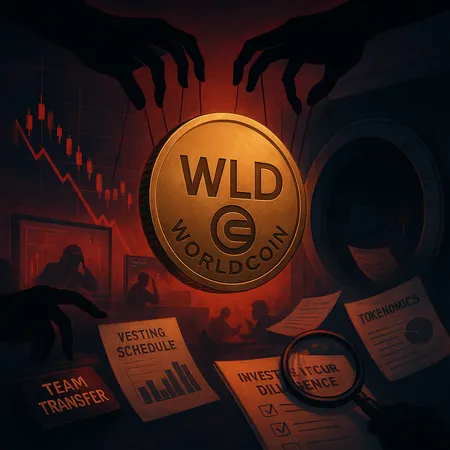
In early trading the Worldcoin team moved roughly 44 million WLD — a transfer reported to be worth about $25.6 million — and the market response was immediate. The transfer itself was a single on-chain transaction, but traders reacted as if fresh supply had been dumped onto exchanges. Coverage of the move can be found in the AmbCrypto report detailing the transfer and ensuing panic (AmbCrypto report).
That reaction is not unique to WLD. Crypto markets are hypersensitive to perceived supply shocks; when a large, team-controlled allocation moves, market makers, algos, and retail participants often treat it as an imminent sell event — even before tokens hit an order book. Combine that with thin liquidity on some pairs and the result is amplified slippage and cascading stop-losses.
Why team-controlled token transfers trigger panic
There are three overlapping mechanics at work when teams transfer large allocations: perceived supply risk, information asymmetry, and market microstructure.
- Perceived supply risk: Large holdings controlled by insiders can be sold quickly, diluting value for public holders. Even if tokens are moved between team wallets, observers often assume preparation for listing or selling.
- Information asymmetry: Projects or teams typically have more context than the market. Without timely, transparent communication, traders fill uncertainty with worst-case assumptions.
- Market microstructure effects: Automated strategies react to on-chain signals; a single transfer can trigger algorithmic market-making adjustments, widen spreads, and prompt stop-loss cascades. The episode echoed how broader volatility can amplify token-specific moves — similar contagion dynamics are discussed in CoinPedia’s analysis of bitcoin’s flash moves (CoinPedia analysis).
For many traders, Bitcoin remains the primary market bellwether, and when BTC or the broader crypto market is jittery, an on-chain transfer in an alt token is likelier to provoke panic selling.
Centralization risk: why concentration of supply matters
Centralization risk refers to the share of a token’s supply controlled by insiders, foundations, or a small group of wallets. High concentration raises several hazards:
- Price manipulation and front-running: Large holders can coordinate sales or transfers to influence market prices or benefit from pre-arranged liquidity events.
- Governance capture: When token-weighted governance exists, concentrated balances can subvert decentralization goals and allow unilateral protocol changes.
- Regulatory spotlight: Regulators view concentrated pre-mine or team reserves suspiciously — especially where token distribution resembles an investment contract rather than a decentralized currency.
Token concentration is not inherently malicious, but it must be managed with durable, verifiable guardrails: multi-signature controls, on-chain timelocks, transparent vesting contracts, and clear public communication.
Tokenomics and vesting transparency: why it matters now
Tokenomics is no longer a whitepaper footnote. In practice, investors expect easily verifiable structures for how team allocations vest and when tokens become transferable. Key elements that reduce panic include:
- Verifiable smart-contracted vesting: When vesting schedules are enforced by audited contracts (not just off-chain promises), markets can price risk more accurately.
- Cliffs, linear release, and long-tail schedules: Long-term, gradual release reduces immediate dilution risk compared with short cliffs or lump-sum unlocks.
- On-chain timelocks and multisig custody: Public timelocks and multisig requirements for movement reduce single-person risk and demonstrate operational security.
- Distribution dashboards: Live charts showing holder concentration, vesting timelines, and lockup expiries help traders model future supply dynamics.
Without these elements, a single large transfer — even if innocuous — becomes a narrative: "team may dump." That narrative alone can be self-fulfilling, as liquidity providers withdraw and price impact worsens.
Regulatory and reputational consequences
Large, opaque allocations invite scrutiny. Regulators look for characteristics of securities (promises of profit, centralized control) and concentrated team holdings weigh into those analyses. If a token behaves like an investment product controlled by insiders, projects may face enforcement or be forced into stricter disclosure regimes.
Reputational damage is immediate, too. Community trust erodes when teams move tokens without prior notice or clear justification. For platforms and custodians — including services like Bitlet.app that evaluate listings and risk — transparent vesting and on-chain proof are increasingly minimum standards.
Practical checklist: how investors should evaluate project-controlled supply
Below is a tactical checklist investors and allocators can use before allocating capital to tokens with significant team or foundation reserves.
Check holder concentration: What percentage of circulating and total supply do the top 10 wallets control? Anything above ~30–40% should trigger deeper scrutiny.
Verify vesting contracts on-chain: Are vesting schedules enforced by smart contracts? Look for immutable schedules, not just team blog posts.
Inspect cliffs and release cadence: Short cliffs or large lump-sum unlocks are red flags. Favor linear, multi-year releases.
Confirm custody controls: Are team wallets governed by multisig, timelock, or delegated governance? Who are the signers and are they reputable?
Look for distribution transparency: Does the project publish a live distribution dashboard or a Dune/Etherscan visualization of token flows and unlock schedules?
Audit and change-ownership history: Has the vesting contract been audited? Was ownership renounced, or are upgrades possible? An upgradeable contract with privileged access requires extra caution.
Monitor on-chain activity, not rumors: Use explorers, alerts, and analytics to watch for large transfers. Sudden movement without announcement merits a pause on new allocation.
Assess market liquidity and depth: How large would a sell order need to be to move price materially? Low liquidity amplifies transfer risk.
Ask governance questions: If tokens enable governance, can concentrated holders unilaterally change economics or reassign vesting? That’s a structural risk.
Demand communication: Prior notice of planned transfers and reasoning reduces knee-jerk market reactions. Teams that proactively communicate reduce uncertainty.
Red flags and nuance — what to watch for
- Transfers to newly created or cold wallets without multisig: suspicious.
- Token movements coinciding with exchange listings or market-making wallet changes: prepare for amplified volatility.
- Contracts allowing arbitrary token recovery or pausing transfers: centralized power can be weaponized in crises.
That said, not every team transfer is nefarious. Moving tokens between controlled wallets for treasury management, liquidity provisioning, or operational payments is routine. The problem is unpredictability: when markets lack context, they substitute panic.
Monitoring tools and practical workflows
Set up a simple monitoring playbook:
- Use Etherscan or the relevant chain explorer to follow token-contract events and watch key team addresses.
- Subscribe to on-chain alerting services or Dune dashboards for unlock schedules and large transfers.
- Maintain a checklist before buying: distribution %s, vesting enforcement, custody controls, and liquidity depth.
For allocators managing portfolios, incorporate tokenomics risk into position sizing. A concentrated team holding should reduce position size or mandate an explicit hedging approach until unlocks pass and behavior is proven benign.
Conclusion: reduce uncertainty, not emotion
The Worldcoin 44M WLD transfer is a reminder that even routine treasury moves can unsettle markets when supply is concentrated and disclosure is incomplete. Investors can’t control token distributions, but they can insist on transparency and on-chain guarantees before allocating capital. Use the checklist above, monitor on-chain activity, and factor centralization risk into sizing and liquidity planning. In a market where narratives shift fast — from NFTs and memecoins to governance tokens — clarity wins.
For deeper analysis on particular projects, tools like analytics dashboards and community governance records can help separate reasonable treasury management from risky centralization.
Sources
- AmbCrypto report on the WLD transfer: https://ambcrypto.com/worldcoin-team-triggers-panic-after-shifting-25-6-mln-wld-will-0-55-hold/
- CoinPedia piece on broader market sensitivity and BTC volatility: https://coinpedia.org/news/what-caused-bitcoin-price-to-crash-below-90k-today/