What Morgan Stanley’s MSBT Launch Means for the US Spot Bitcoin ETF Market
Summary
Executive snapshot
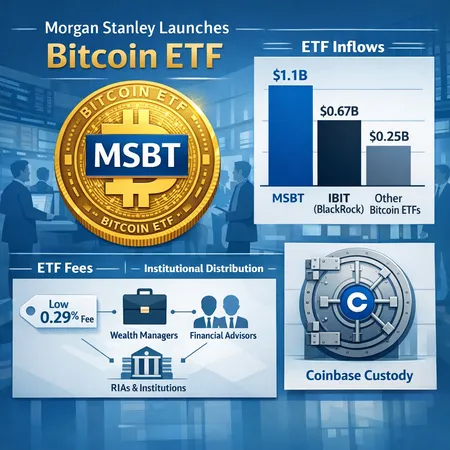
Morgan Stanley’s spot Bitcoin ETF, MSBT, launched with two headlines: a very low fee that positions it as one of the cheapest spot-BTC ETFs, and a distribution channel that taps Morgan Stanley’s advisor network. Estimates reported MSBT drew roughly $30–34 million in first-day net inflows (Unchained Crypto and Cointelegraph). Those numbers are meaningful but modest versus the early leaders; the more important read is how fee structure, advisor distribution, and custody arrangements will steer future flows.
For asset managers and wealth advisors evaluating ETF allocation strategies and custody risk, MSBT’s launch offers a live case study in how price, access, and operational alignment combine to win institutional business. For many allocators, Bitcoin is now a tradable, regulated instrument — not just an OTC or custodial choice — and sponsors are competing on multiple fronts to capture those allocations.
MSBT product features: fee, advisor distribution and custody
MSBT’s two headline features are its fee and its access to Morgan Stanley’s advisor ecosystem. Media coverage framed MSBT as the market’s cheapest spot BTC ETF on debut; that pricing differential is meaningful for fee-sensitive institutions and retail-wrapped 401(k) channels. But fee alone rarely wins every account.
Why advisor distribution matters now
Large wealth channels and broker-dealers still determine the speed and scale of ETF adoption. Morgan Stanley’s distribution — which plugs MSBT directly into its advisor platform and affiliated broker-dealer channels — creates a straight conduit for inflows from advisory mandates, model portfolios, and managed accounts. A low fee plus front-door access to advisors short-circuits many of the adoption frictions that new crypto products typically face.
Distribution can amplify modest marketing wins into sustained flows. Sponsors that lack large advisor networks can still capture market share via wholesaling agreements, sub-advisory deals, or partnerships. That’s why conversation about a potential fee war must be paired with a distribution map: institutional clients care about how they can buy and integrate the ETF, not just how cheap it is.
Custody and operational setup: Coinbase’s role
MSBT uses Coinbase custody arrangements, and Coinbase’s public comments emphasize a significant custodial role for these ETFs. Coinbase CEO commentary on the launch highlights the operational plumbing required when mainstream custodians back regulated ETF products (U.Today). For allocators, Coinbase custody brings several practical advantages: familiar institutional APIs, proven hot/cold key management frameworks, and an existing compliance posture for institutional clients.
But custody concentration is a real consideration. Relying on a single custodian increases counterparty and operational risk: outages, governance disputes, or regulatory friction at one custodian can affect multiple ETFs simultaneously. Many allocators will weigh the convenience of Coinbase custody against the diversification benefits of using multiple custodians or hybrid custody strategies.
First-day inflows — how MSBT compares and what the numbers mean
Reported first-day net inflows for MSBT landed in the $30–34M range, according to market coverage. That is a solid opening for a new entrant, but it trails the largest sponsors’ headline figures when they first listed their spot BTC ETFs. Early leaders benefited from scale advantages, faster AUM accrual, and sometimes earlier market-maker and AP support.
Context matters: one sponsor’s first-week inflows depend on timing, market sentiment, and whether advisors had pre-existing model allocations. Decrypt’s morning market coverage noted Morgan Stanley helped drive a big day for Bitcoin ETFs broadly, underscoring that MSBT’s debut didn’t occur in isolation but within a broader flows narrative (Decrypt).
Two practical takeaways from the day-one numbers:
- A modest day-one haul does not preclude fast follow-on growth if the sponsor can convert advisor relationships into ongoing model exposures.
- First-day inflows are often driven by a handful of large buyers (institutional mandates, high-net-worth advisory models or seed investments) rather than broad retail adoption.
Fee competition and advisor channels: is a fee war likely?
A lower-fee entry like MSBT raises the specter of a fee-driven market. Sponsors with deep balance-sheet and client distribution advantages can sustain lower margins to win market share. But history — even outside crypto — shows that distribution is often more defensible than price alone.
Why? Advisors and allocators evaluate operational fit, trading spreads, AP relationships, reporting, and custody. If an ETF is cheap but suffers from wide creation/redemption spreads, poor liquidity, or operational shortfalls, many institutional allocators will pay a small premium for reliability.
Still, the presence of a low-fee MSBT will pressure incumbent sponsors to rethink pricing tiers, especially in channels where price is visible to clients (model portfolios, managed accounts, 401(k) platforms). Expect three dynamics to play out:
- Sponsors will use selective fee cuts in targeted channels to win shelf space with advisor networks.
- We’ll see more distribution-first strategies (sub-advisory deals, wholesaling) rather than purely price-led marketing.
- Operational robustness — custody, trading integrations, and quick creation/redemption mechanics — will be marketed as value-adds that justify fee differentials.
Custody with Coinbase: operational risk and mitigants
Coinbase custody offers turnkey institutional tooling that simplifies ETF back-office needs, but it also concentrates exposure. Operational risks to consider:
- Platform outages or maintenance windows that impede redemptions or settlement.
- Key management or governance incidents that delay movement of underlying BTC.
- Regulatory or enforcement actions that could constrain custodial services in certain jurisdictions.
Mitigants for allocators include contract-level protections, SLAs, and custody diversification (allocating between ETFs that use different custodians or combining ETF exposure with separate cold-storage holdings). For some sophisticated allocators, a hybrid approach — using ETFs for trading and liquidity while holding a portion of strategic BTC in segregated custody — may be optimal.
Flow scenarios: concentration vs. diversification and tactical plays
Institutional flows into spot Bitcoin ETFs can follow several plausible paths over the next 6–18 months. I outline three scenarios and tactical responses for allocators.
Scenario A — Concentrated leader flows
- A few sponsor-led ETFs (by firm reputation and distribution heft) capture the bulk of inflows. Price leadership and AP liquidity concentrate assets and tighten secondary spreads on those tickers.
- Tactical implication: Trade the leaders for execution efficiency; use limit orders and block execution facilities to minimize market impact. Consider laddered entries into smaller sponsors if you want exposure to potential fee compression upside.
Scenario B — Diversified sponsor market
- The market fragments across multiple low-fee and niche ETFs. Liquidity is more dispersed but competition reduces fees and improves service across the board.
- Tactical implication: Rebalance periodically across several tickers; use VWAP/TWAP strategies for large allocations to avoid signaling. Keep an eye on creation/redemption spreads and AP availability for each ticker.
Scenario C — Episodic flows tied to macro shocks
- ETF flows spike during macro-risk episodes or when BTC has large moves; sponsors with robust custody and dealer relationships handle redemptions more smoothly.
- Tactical implication: Maintain liquidity buffers and prefer ETFs with proven AP support. For long-term allocations, stagger contributions to avoid buying at local peaks.
Across scenarios, institutions should monitor: authorized participant depth, creation/redemption spreads, NAV discounts/premiums, and sponsor operational transparency. ETF tickers trade like stocks — but the underlying asset is still BTC — so both capital-market execution and crypto-market microstructure matter.
Regulatory and market-structure takeaways
MSBT’s launch reinforces several market-structure lessons:
- The post-spot-ETF market is now a multi-sponsor, distribution-driven landscape. Sponsors that combine low fees with native advisor access will be advantaged.
- Custodial choices (Coinbase and others) are central to product viability. Operational resilience and regulatory compliance at custodians will be a recurring discussion for wealth platforms and institutional allocators.
- Fee compression is likely, but not decisive. Execution quality, AP depth, and distribution hooks will determine long-term market share.
Regulators will continue to watch custody arrangements, market surveillance, and whether ETFs introduce systemic links between traditional broker-dealers and crypto custodians. For advisors and allocators, the right approach is pragmatic: evaluate ETFs on price, access, and operational robustness — and maintain a plan for custody diversification when appropriate.
Practical checklist for allocators
- Confirm the ETF’s fee and compare total cost of ownership (bid/ask spreads, creation/redemption costs).
- Map the sponsor’s distribution channels and confirm whether model portfolios or managed account engines will include the ticker.
- Evaluate the custodian (Coinbase or otherwise) for SLA terms, operational track record, and concentration risk.
- Test execution pathways with your broker-dealer or trading desk; measure AP reliability and settlement timing.
- Consider a hybrid allocation (ETF for tradability + segregated custody for permanent holdings).
Bitlet.app’s product set and market commentary have noted how allocation decisions now hinge not only on custody but on which custodian and distribution partner can deliver consistent operational performance.
Conclusion
MSBT’s debut — a low-fee ETF backed by Morgan Stanley’s advisor network and Coinbase custody — is a reminder that the modern spot-BTC ETF market is shaped by price, distribution, and operations in roughly equal measure. Day-one inflows were respectable but not runaway; the long game will be won by sponsors who convert advisor access to persistent model allocations while maintaining custody resilience and tight trading conditions. For asset managers and wealth advisors, the right posture is disciplined: evaluate ETFs across fees, distribution access, and custodial risk, and use execution tactics that respect both ETF liquidity and spot-BTC microstructure.
Sources
- Unchained Crypto — Morgan Stanley’s MSBT debuts as the cheapest spot Bitcoin ETF, logs $34 million on day one
- Decrypt — Morning Minute: Morgan Stanley helped drive a big day for Bitcoin ETFs
- Cointelegraph — Morgan Stanley Bitcoin ETF trails BlackRock with $30M in first-day inflows
- U.Today — Coinbase CEO Armstrong breaks down significance of Morgan Stanley’s historic Bitcoin ETF launch