How Charles Schwab’s Expanded Crypto Access Could Shift Institutional Flows and BTC/ETH Price Structure
Summary
Executive snapshot
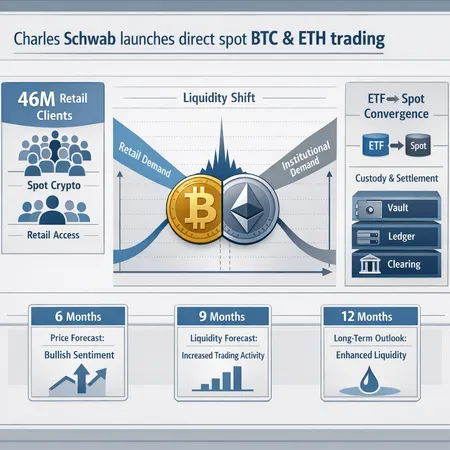
Charles Schwab expanding straightforward access to crypto through mainstream brokerage channels is not just about convenience. For wealth managers and institutional allocators, it changes where capital sits, how it moves, and which market plumbing is used to express exposure to BTC and ETH. This article breaks down the product routes Schwab offers, the mechanics by which expanded access alters ETF flows, liquidity and custody dynamics, and concludes with 6–12 month bullish, neutral and bearish scenarios.
Why Schwab’s scale matters and the product routes to BTC/ETH
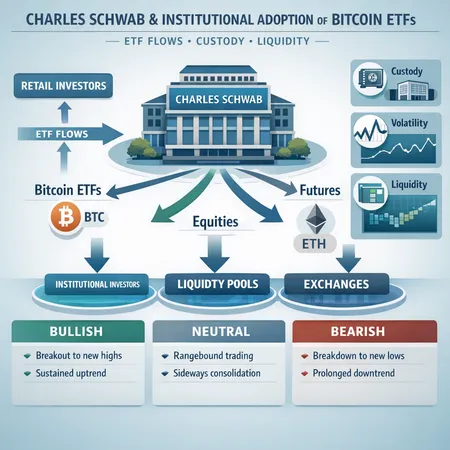
Charles Schwab manages trillions in client assets and services millions of brokerage accounts. That distribution muscle lowers the activation energy for advisors and retirement accounts to add crypto exposure. As CryptoSlate observes, Schwab’s existing infrastructure and custody relationships allow it to route clients into multiple instruments that provide BTC/ETH exposure, including spot ETFs, futures-based products, and equities tied to mining or service providers.
- Spot and futures-backed Bitcoin ETFs create a direct conduit for brokerage assets to tap BTC without clients holding private keys. See the analysis from CryptoSlate detailing Schwab’s distribution power and the practical routes investors use to access BTC/ETH. (For many allocators, on-balance ETF wrappers are the most familiar entry.)
- Futures and listed derivatives remain accessible for clients seeking regulated margin exposure or tactical overlays. Broker-mediated futures access typically routes through prime brokers or clearinghouses, which changes the counterparty and collateral requirements.
- Equities (mining firms, custody providers, or public crypto infra companies) provide indirect exposure when direct crypto allocations are undesired or restricted by mandate.
The net effect: capital that previously required specialist desks or OTC relationships can now flow through mainstream brokerage rails in larger volumes and with lower frictions.
How expanded brokerage access reshapes ETF flows and liquidity
The most immediate microstructural change is the potential for persistent ETF inflows rather than episodic retail waves. That has three linked effects:
- Creation/redemption mechanics and liquidity sourcing
- Spot BTC/ETH ETFs rely on authorized participants (APs) to create or redeem units, which in turn requires underlying spot supply. Larger, recurring ETF demand pushes APs and custodians to tap broader spot liquidity pools, including OTC venues and exchanges. That can deepen on-exchange liquidity but also increase OTC reliance during stressed moments.
- Retail-to-institutional flow mixing
- As advisors allocate client assets into ETFs through Schwab, flows look more like institutional inflows: larger ticket sizes, systematic rebalancing, and steady contributions from retirement accounts. This tends to smooth short-term spikes in trading but concentrates exposure in ETF vehicles that have correlated rebalance mechanics.
- Impact on spreads, market depth and price impact
- Greater ecosystem demand generally compresses spreads and improves displayed depth. However, when the marginal buyer is an ETF that transacts via AP creation baskets, the visible order book may understate real available liquidity, increasing market impact when sudden large redemptions or liquidations occur.
Blockonomi’s research on post-shock performance shows how BTC has historically outperformed traditional safe havens after major disruptions—an insight relevant to how institutional flows may behave when macro shocks prompt allocations into ETFs.
Custody, counterparty risk and market structure implications
One of the biggest strategic changes for allocators is custody: who holds the underlying asset, and under what legal/operational regime?
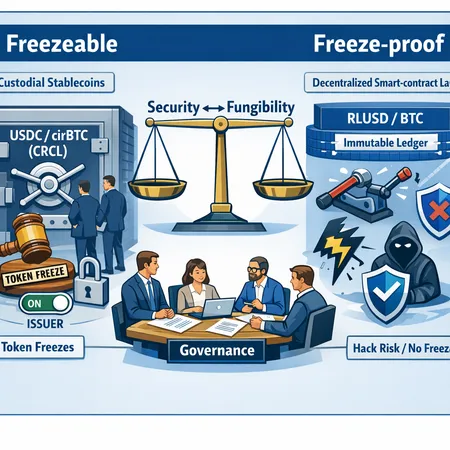
- ETF custody models centralize holdings with regulated custodians rather than with retail self-custody. This reduces key-management risk but concentrates counterparty exposure to custodians and APs.
- For institutions used to segregated or omnibus custody, the ETF model may mean pooled custody with specific legal protections. That changes due diligence priorities: operational resilience, insurance, proof-of-reserves frameworks and reconciliation cadence.
- Prime brokerage and clearing arrangements for futures introduce margining and rehypothecation dynamics that were rarer in OTC spot trades.
The consequence: custody choices affect liquidity channels. With ETFs, allocations are fungible and tradeable on-exchange, which can lower transaction costs for portfolio reshuffling. But it also ties price discovery to the ETF’s creation/redemption flows and AP behaviour, particularly in stressed markets.
Volatility: dampened or redistributed?
Greater participation via Schwab may reduce intraday volatility as more shallow retail order flow is replaced by larger, institutional-style orders executed through APs and custodians. That said, volatility can be redistributed rather than eliminated:
- Positive: Improved depth and tighter spreads reduce slippage for routine trading and rebalancing.
- Negative: Concentrated, passive ETF exposures can lead to synchronized buying or selling during rebalances or systemic risk events—magnifying moves when flows reverse.
On-chain indicators and macro-bottom signals (as highlighted in NewsBTC’s analysis) suggest that institutional entry timing often follows macro capitulations. If Schwab’s client base treats ETFs as a safe-on-ramp during those windows, sudden inflows could push prices higher quickly, but sudden outflows could be equally fast if correlated policies change.
Scenario analysis: 6–12 month outlook for BTC and ETH
Below are three pragmatic scenarios to help allocators plan—each includes likely drivers, price-structure consequences and tactical considerations.
Bullish scenario (30% probability)
- Drivers: Continued macro uncertainty, strong ETF inflows through brokerages like Schwab, positive regulatory clarity, and robust on-chain demand. Institutional reallocation from traditional diversifiers into spot BTC/ETH ETFs accelerates.
- Price structure: Wider structural bid; tighter spreads and higher realized correlations during risk-off flows. BTC and ETH both trend higher, with BTC leading on safe-haven narrative and ETH catching up as ETF demand uses staking & L2 optimism narratives.
- Tactics: Increase allocations incrementally using spot ETFs to reduce operational overhead; layer in direct custody for core positions; maintain liquidity buffers for client redemptions.
Neutral scenario (45% probability)
- Drivers: Gradual inflows offset by profit-taking and macro stabilization. Schwab-driven flows are steady but not transformational; ETFs absorb some capital while futures and equities take the rest.
- Price structure: Improved depth during normal market conditions, but occasional volatility spikes on macro headlines. Liquidity is adequate for medium-sized institutional trades, but large block trades still need OTC execution.
- Tactics: Keep target allocations modest, use ETFs for ease of implementation, but maintain access to OTC desks and futures for tactical exposure and hedging. Reassess monthly using flow and custody metrics.
Bearish scenario (25% probability)
- Drivers: Regulatory shocks, major redemptions, or a severe macro dislocation that triggers correlated ETF outflows. Custodial failures or operational incidents at a major AP amplify market stress.
- Price structure: Liquidity fractures during stress; on-exchange order books show shallow depth despite ETF AUM; realized volatility spikes and basis between spot and ETF NAV widens.
- Tactics: Reduce active exposure, prioritize segmented custody and insured custody solutions, increase use of OTC execution to minimize market impact, and keep hedge overlays via futures.
Practical checklist for wealth managers and allocators
- Decide execution path by mandate: ETF for simplicity and reporting, OTC/spot for lower basis risk, futures for leverage/hedging.
- Vet custodians and APs: focus on insurance, proof-of-reserves, audit cadence and legal segregation.
- Model liquidity: stress-test creation/redemption mechanics, bid-ask spreads and OTC depth for planned trade sizes.
- Rebalancing rules: avoid mechanical, calendar-only rebalances that can coincide with broad ETF flows; consider liquidity-aware rebalancing triggers.
- Maintain a playbook for market stress: pre-approved OTC counterparties, escalation paths with custodians, and hedges ready to deploy.
Platforms across the ecosystem, including services like Bitlet.app, are making execution and settlement pathways more accessible — but institutional allocators must still run their own custody and counterparty checks.
Final thoughts
Charles Schwab’s expanded crypto access lowers the barrier for large pools of capital to enter BTC and ETH markets via familiar brokerage rails. That can improve day-to-day liquidity and compress trading costs, but it also shifts the plumbing of price discovery toward ETF creation/redemption and custodian/AP behaviour. For wealth managers and allocators, the right strategy balances ease of access with careful custody selection, liquidity stress-testing and scenario-driven position sizing over the next 6–12 months.
For many decision-makers, the question isn’t whether exposure will be easier to obtain—it's how that ease changes the nature of liquidity, volatility and operational risk.
Sources
- Charles Schwab’s brokerage scale and product routing context: CryptoSlate
- Research on bitcoin outperforming traditional safe havens after shocks: Blockonomi
- On-chain indicators and macro-bottom signals relevant to timing institutional entries: NewsBTC
For ongoing coverage of market microstructure and product flows, see commentary on Bitcoin, Ethereum and broader DeFi.