Charles Schwab Enters Spot BTC & ETH: Market, Liquidity and Custody Implications for 2026
Summary
Executive overview
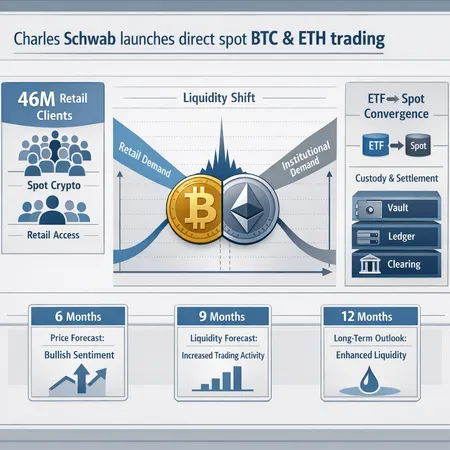
Charles Schwab’s announcement that it is on track to offer direct spot Bitcoin and Ether trading in H1 2026 is one of the clearest signs yet that mainstream brokerages are bringing crypto into traditional wealth channels. The development (reported in industry press and confirmed by Schwab) matters not just because of brand credibility, but because of scale: industry estimates put Schwab’s client base at roughly 46 million — a distribution that can meaningfully change retail demand curves and the institutional landscape. See the initial confirmation from industry reporting here and the client-count discussion here.
For financial advisors, wealth managers and institutional analysts, the practical questions are straightforward: how much incremental buying power will arrive, where will liquidity consolidate, and which custody/settlement choices will create counterparty or operational friction? Below I unpack the strategic market implications and offer scenario-driven forecasts for BTC and ETH over the next 6–12 months after launch, with concrete points advisors should consider.
How access for ~46M clients changes demand curves
Schwab’s reach is a distribution multiplier. When a trusted broker adds spot trading, several behavioral shifts typically follow:
- Reduced friction increases conversion. Retail investors who previously gained crypto exposure via ETFs, derivatives, or secondary platforms may prefer native spot ownership within the same brokerage account. That conversion is not automatic, but accessible UX, tax reporting and custodial convenience make it more likely.
- Latent demand becomes realized demand. A significant share of Schwab’s 46M clients are do-it-yourself or advised investors; even small allocation moves (0.5–2% of portfolios) aggregate into large USD flows for BTC and ETH.
- Retail volumes become stickier. Accounts held at a trusted custodian tend to trade less frequently than on spot exchanges, which can reduce microstructural volatility while increasing overall share-of-wallet for spot positions.
Quantifying the pick-up: if just 1% of Schwab clients allocate $1,000 each to BTC or ETH at launch, that’s roughly $460M in initial flows (a simplified illustration drawn from the client estimate in coverage here). That kind of concentrated retail entry can matter for intraday liquidity and order book depth, especially in smaller-cap hours.
For context, many advisors will compare this to ETF demand dynamics — and Schwab’s product is likely to accelerate the convergence between ETF flows and spot markets rather than replace ETFs entirely.
ETF convergence, institutional flows and flow dynamics
The coexistence of ETFs and newly available spot trading at major brokers creates two channels for capital:
- Direct spot buys within brokerage accounts (native custody).
- Continuing ETF flows through institutional and retail channels.
Recent analysis shows ETF flows have already shifted liquidity into U.S. hours as markets concentrate where the biggest buyers operate; this trend will likely intensify after Schwab’s launch (detailed analysis here). Institutional desks and arbitrageurs already treat ETF and spot venues as linked — the incremental liquidity from Schwab could tighten spreads and reduce premium/discount persistence between ETF prices and spot indices.
Institutional flows will respond in two ways:
- Arbitrage amplification. More retail spot on Schwab reduces the arbitrage window for ETFs, encouraging institutional market-makers to operate more in U.S. hours and compress basis volatility between ETF NAVs and spot.
- Rotation risk. If Schwab offers custody solutions or segregated accounts, large allocators might prefer balance-sheet-neutral spot exposures via brokers rather than ETFs, shifting flow composition away from institutional ETF creations/redemptions.
In short: expect greater ETF–spot convergence, stronger U.S.-hour arbitrage activity, and thinner cross-border liquidity during off-hours.
Liquidity shift into U.S. hours: what changes and why it matters
ETF flows have already biased activity to U.S. market hours; Schwab’s direct retail flows magnify that effect. The consequences:
- Volume concentration. More volume during NYSE/NASDAQ hours reduces weekend and overnight depth, increasing the likelihood of larger intraday moves when macro headlines break. Coinciding with active U.S. macro calendars, this can amplify volatility on news.
- Execution quality improvements during U.S. hours. Deeper U.S. order books reduce slippage for large institutional trades executed during local hours — a net positive for advisors executing block trades for clients.
- Reduced global dispersion. Centralization in U.S. hours makes price discovery faster for U.S.-domiciled investors but may push some offshore liquidity providers to provide cross-listed liquidity or offer OTC solutions to service 24/7 needs.
This is consistent with reporting that ETF mechanics have already shifted liquidity timing; Schwab’s entry acts as a second-order amplifier of that pattern (see analysis here).
Custody and settlement: the operational battleground
Custody is the most consequential design choice Schwab will make because it determines counterparty exposures, operational risk and the broader competitive map.
Key custody and settlement questions institutions will ask:
- Will Schwab custody on-chain assets directly (self-custody via an insured custodian) or act as an overlay using third-party custodians and omnibus wallets?
- How will settlement timing work for large retail buys? Instant execution with later final settlement (common in brokerages) requires robust back-office reconciliation and insured custody to reassure fiduciaries.
- What insurance, proof-of-reserve or auditing standards will Schwab adopt? Advisors will demand clear safeguards and transparent reporting to meet suitability and compliance needs.
The answers matter because they change counterparty and operational risk assumptions for advised portfolios. If Schwab offers segregated custody with institutional-grade partners, that lowers systemic counterparty risk and encourages larger allocations. Conversely, omnibus models can be operationally efficient but may raise questions for high-net-worth clients and institutions.
For custodians and prime brokers, Schwab’s approach will set new service expectations. Firms that can offer integrated custody, fast settlement and transparent reporting will be better positioned to win flow from both retail and institutional clients. Platforms like Bitlet.app that monitor settlement and custody offerings will be watching these design choices closely.
Competitive pressure on exchanges, brokerages and custodians
Schwab’s move is not just additive; it’s disruptive:
- Retail migration pressure. Many retail accounts will prefer a single consolidated statement and tax reporting within their primary brokerage. That convenience is competitive advantage — other brokerages will be compelled to offer spot trading, better staking/custody options, or preferential pricing to retain clients.
- Fee compression. As mainstream brokers offer spot access, standalone retail exchanges may face fee pressure, particularly if brokers bundle spot trading with existing account services. This could compress retail trading revenues and force exchanges to compete on execution quality, custody guarantees and developer ecosystems.
- Institutional product evolution. Custodians and prime brokers will need to match Schwab-level custody options and reporting to stay relevant to wealth managers and advisors. Expect faster productization of institutional APIs, segregated custody offerings, and white-label custody integrations.
The net effect: a structural push toward consolidation and product parity. Firms that cannot match custody, reporting, or execution expectations risk losing retail and smaller institutional relationships.
Scenario-driven forecasts (6–12 months): BTC & ETH price liquidity
Below are three plausible scenarios for how BTC and ETH price and liquidity could evolve in the 6–12 months after Schwab’s H1 2026 rollout. These scenarios are directional, not predictive; they emphasize likely liquidity and volatility regimes.
Scenario A — Conservative (low uptake, gradual migration)
- Assumptions: 0.5–1% of Schwab clients adopt spot positions in the first 6 months; many prefer ETFs for simplicity; Schwab uses third-party omnibus custody.
- BTC/ETH liquidity: modestly improved U.S.-hour depth; minimal change to global overnight liquidity.
- Price impact: temporary buy-in at launch (a short-lived bid), followed by mean-reversion as ETF and OTC channels absorb flows. Volatility declines slightly during U.S. hours but persists globally.
- Implication for advisors: execution windows narrow; consider staging large client buys over several days to minimize market impact.
Scenario B — Base case (meaningful retail adoption, active arbitrage)
- Assumptions: 2–4% of clients allocate modest spot positions within 6 months; Schwab offers segregated custody options and integrates tax/reporting well; arbitrage desks tighten ETF–spot spreads.
- BTC/ETH liquidity: noticeable depth increase during U.S. hours; tighter spreads and reduced ETF premium/discount duration. Liquidity provision offshore becomes more specialized (OTC desks, 24/7 LPs).
- Price impact: constructive for both BTC and ETH — demand shock compresses sell-side liquidity temporarily, pushing prices higher for several weeks. After initial rally, increased market-making capacity restores depth and reduces realized volatility during U.S. hours.
- Implication for advisors: favorable execution environment during market hours; consider tactical rebalancing into nights/weekends when liquidity thins.
Scenario C — Bull case (fast adoption, network effects)
- Assumptions: 5%+ client adoption within 6 months; Schwab becomes a material net buyer at launch; custody is segregated and insured, attracting institutional reallocation from some ETFs.
- BTC/ETH liquidity: much deeper on U.S. books, persistent demand raises realized volumes and compresses spreads materially; arbitrage across ETF and spot tightens to millisecond markets.
- Price impact: sustained price appreciation for BTC and ETH due to structural demand and reallocation; temporary liquidity squeezes during spikes could increase intraday volatility despite deeper general depth.
- Implication for advisors: potential alpha opportunity for early diversified spot allocations; but be mindful of execution costs during rapid rallies and use limit orders or VWAP strategies.
Practical guidance for financial advisors and institutional analysts
- Reassess suitability frameworks. Update model portfolios and client suitability memos to account for easier spot access and new custody exposures.
- Rethink execution windows. With liquidity concentrated in U.S. hours, schedule large rebalances accordingly and avoid thin offshore hours when possible.
- Demand transparency. Ask custodians and platform partners about segregation, proof-of-reserves, insurance and settlement finality so client reporting is defensible.
- Stress-test operational flows. Back-office teams should simulate settlement mismatches, tax reporting edge cases, and reconciliations for spot buys within brokerage accounts.
- Monitor ETF–spot basis. Advisors should track basis dynamics between ETFs and spot indices as arbitrage tightens — the basis can be an indicator of demand and potential execution costs.
Final thoughts: structural acceleration, not a magic bullet
Schwab’s entry into spot BTC and ETH trading is a structural acceleration of a trend that began with ETF approvals and institutional onboarding. It lowers friction for retail adoption, concentrates liquidity in U.S. hours, and forces custody/settlement standards into the spotlight. The exact magnitude of impact depends on product design (custody/settlement), pricing, and client uptake — but even a modest adoption rate among Schwab’s millions of clients will be meaningful for market structure.
For advisors and wealth managers, the sensible next step is not to chase headlines but to prepare operationally: update suitability documents, confirm custody assurances, and plan execution strategies around concentrated U.S. liquidity. Keep an eye on how ETFs and spot markets converge — that convergence will determine whether Schwab’s arrival is a transient demand shock or a durable reallocation engine.
Sources
- Schwab preps spot Bitcoin and Ether trading — Crypto.News
- Schwab’s 46 million clients to gain direct Bitcoin access in 2026 — Blockonomi
- Bitcoin and Ethereum soon available for spot purchase at Charles Schwab — Cointribune
- Bitcoin’s weekend gap: ETFs shift liquidity to U.S. hours — DailyCoin
Note: For deeper readings on on-chain liquidity and product design, see commentary on Bitcoin markets and broader DeFi liquidity dynamics.