How Tariffs, AI Rotation and Deglobalization Are Reshaping Crypto Risk Appetite
Summary
Executive summary
The recent crypto sell‑off is not just an idiosyncratic market wobble — it reflects a set of coherent macro developments that have reduced risk appetite across asset classes. Short‑term triggers like tariff threats and rotation of capital into AI and large‑cap tech combine with slower structural forces such as deglobalization. Together they change where marginal dollars flow and how investors price tail risk in crypto. In this article I link those macro drivers to on‑chain evidence (exchange supply, active addresses, BTC dominance) and offer portfolio‑level adjustments for volatility control and drawdown mitigation.
How macro forces transmit into crypto demand
Macro developments affect crypto primarily by altering where marginal capital goes, by changing risk premia and funding needs, and by shifting cross‑asset correlations. Below I break these mechanisms into three threads that matter today.
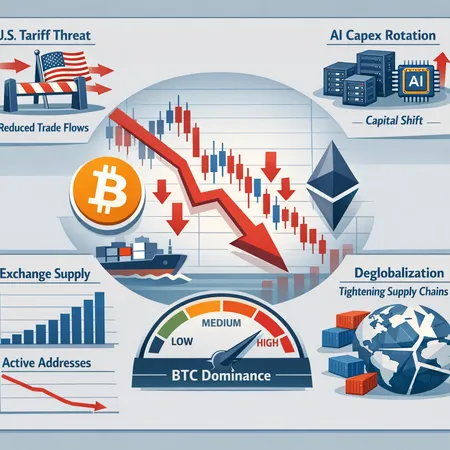
Tariff threats and trade policy — tightening the cash valve
When tariff threats rise, companies and investors forecast greater trade friction: higher working capital needs, margin pressure and localized supply chains. That raises near‑term cash demand for corporates and can increase demand for short‑dated safe assets. On the investor side, higher trade uncertainty increases risk premia: managers prefer liquidity and short‑term conservatism over carry strategies. Practically, those flows reduce the marginal bid for speculative assets, including crypto.
Coincu reported how tariff shock narratives coincided with weaker BTC bids, showing this channel in recent price action. Higher risk aversion also tends to push assets onto exchanges as investors prioritize liquidity over long‑term holdings.
AI capex rotation — bigger tech, smaller crypto beta
The AI investment cycle has pulled enormous capital into large‑cap tech stocks and semiconductors as funds chase durable winners in productivity‑oriented capex. This rotation is not just about equity reweighting; it’s about where institutional and retail marginal allocations land. Capital that would earlier chase anything with momentum is increasingly concentrated in a smaller set of mega‑cap names, leaving less incremental cash to support broad crypto rallies.
This effect intensifies during concentrated rallies: ETFs, quant funds and discretionary managers shift exposure to AI beneficiaries, trimming other risk positions. The net result is lower incremental buying pressure for BTC and ETH, and a higher correlation between crypto drawdowns and tech sector squeezes — not the other way around.
Deglobalization — structural headwinds to cross‑border crypto demand
A longer horizon risk is deglobalization: trade fragmentation, on‑shoring and regionalization of supply chains. Deglobalization raises frictional costs for cross‑border capital flows, increases regulatory uncertainty, and encourages domestic cash hoarding. All of these reduce the pool of global marginal buyers for crypto and tilt demand toward local, liquid assets. In passthrough, deglobalization tends to emphasize safer, more liquid allocations at times of stress — again crowding out speculative bids.
On‑chain indicators that confirm macro-driven bid erosion
Macro signals are useful, but investors also need on‑chain confirmation. Several indicators have already started to flash weakness consistent with reduced demand.
Exchange supply and realized selling pressure
Exchange supply — the aggregate balance of tokens held on centralized exchange wallets — is a simple but potent metric: when it rises, there is more inventory available to sellers and often less willingness to hold for the long term. During the recent drawdown, markets saw a tangible uptick in coins moving to exchanges, consistent with forced or precautionary selling as macro uncertainty rose. Coinciding reporting suggests this move onto exchanges amplified selling: CryptoPotato quantified roughly $150 billion leaving crypto markets during the dip, a scale that lines up with increased exchange balances and liquidation cascades.
Active addresses — usage and network demand are weakening
On‑chain usage metrics provide a behavioral read on participation. A detailed report shows a historic decline in Bitcoin active addresses, a clear sign that network engagement cooled significantly during the sell‑off. Falling active addresses imply fewer new users, reduced on‑chain transactions for payments or defi activity, and a weaker fundamental narrative for price support. Lower network activity amplifies susceptibility to price declines because there are fewer natural bidders at every price level.
BTC dominance and cross‑asset flows
BTC dominance — the share of total crypto market cap held by Bitcoin — can behave two ways when macro stress hits: it can rise if BTC is seen as the relatively safer crypto, or it can fall if liquidations and margin calls disproportionately hit Bitcoin. In the current environment, BTC has generally held relative market share early in the sell‑off but the macro narrative of cash rotation into AI/large‑cap tech reduces both BTC and altcoin bids. Portfolio managers should watch BTC dominance as a barometer for whether capital is fleeing the broader crypto risk stack or concentrating into Bitcoin as a higher‑quality crypto asset.
For macro investors who monitor cross‑asset positioning, coupling these on‑chain signals with traditional indicators (equity flows into tech ETFs, FX moves, bill yields) provides a more complete picture of shifting risk appetite.
Connecting on‑chain warnings and on‑chain research
On‑chain research groups and analytics firms have warned that the current dynamic could amplify downside. Coingape summarized analysis from Glassnode and 10x Research that flagged the on‑chain amplification mechanism that often follows macro shocks: lower activity, rising exchange balances, and concentrated liquidations can lead to outsized price moves. Those warnings align with the drop in active addresses and the market value contraction reported across outlets.
Portfolio adjustments for volatility control and alignment with macro trends
For portfolio managers and macro‑focused crypto investors, the question is practical: how to reconfigure exposures while keeping conviction optionality. Below are tactical and strategic levers to consider.
1) Convert unconstrained beta into managed beta
If your allocation previously assumed a benign macro backdrop, trim unmanaged exposures. Replace a portion of open‑ended long allocation with delta‑neutral or defined‑risk structures (e.g., covered calls, collars) that limit downside while preserving upside participation. This reduces the portfolio’s sensitivity to macro reallocation into AI and tariffs shocks.
2) Increase liquidity and stablecoin buffers
Raise cash or high‑grade stablecoin allocations to service margin needs and to exploit buying opportunities post‑drawdown. A deliberate liquidity buffer (5–15% depending on mandate) reduces the need to sell long positions into illiquid windows. Platforms such as Bitlet.app provide ways to manage stablecoin liquidity across earn and exchange rails, which can be part of a broader toolkit (note: this is contextual mention, not a product endorsement).
3) Use futures and option hedges for tail protection
Allocate to systematic tail hedges: put spreads, long‑dated out‑of‑the‑money options, or variance swaps where available. For managers worried about short, sharp pitchfork moves from tariff headlines, short‑dated option collars provide asymmetric protection with controlled cost. For longer deglobalization risks, consider staggered option laddering over multiple expiries.
4) Tactically favor higher‑quality crypto exposures
When macro liquidity is constrained and active addresses are falling, relative quality matters. Consider overweighting BTC versus lower‑liquidity altcoins when BTC dominance signals stabilise, while keeping strict position limits for single‑name or low‑market‑cap assets.
5) Dynamic rebalancing tied to macro/on‑chain triggers
Build a rules‑based overlay: rebalance to target allocations only when specific macro or on‑chain thresholds are met (e.g., rolling 30‑day rise in exchange supply > X%, active addresses down Y% from 90‑day average, or tech ETF inflows exceed a set percentile). This ties execution to measurable signals and avoids emotional trading during headline storms.
6) Cross‑asset hedges
If tariff-induced dollar strength or US rates are the chief worry, consider cross‑asset hedges (e.g., short equity exposure, long duration in sovereign bills, or gold) to offset macro pressures. The exact hedge depends on your correlations: when AI rotation draws cash into tech instead of crypto, shorting concentrated tech exposure can be a natural offset for long crypto beta.
Implementation checklist (practical steps)
- Review position sizes and set hard single‑name and single‑protocol limits; reduce small‑cap alt exposure first.
- Create a 5–15% liquidity buffer in stablecoins or short‑dated T‑bills.
- Implement option collars on core BTC/ETH exposures for defined downside.
- Monitor exchange supply and active addresses daily; trigger tactical selling or hedging when thresholds are breached.
- Document macro scenarios (tariff shock, sustained AI capex rally, deglobalization shock) and predefine trade responses.
Closing thoughts
Tariff threats, AI rotation and deglobalization are not isolated narratives — they interact to reshape where marginal dollars go and how risk is priced. On‑chain indicators such as rising exchange supply and a historic decline in active addresses corroborate that demand for crypto has weakened in this environment. For macro‑oriented portfolio managers, the right response is pragmatic: reduce unmanaged beta, preserve liquidity, use defined‑risk hedges and let rules‑based rebalancing do the heavy lifting. That approach keeps optionality for a reacceleration of crypto demand while protecting downside during periods when macro capital prefers AI and large‑cap liquidity over speculative risk.
Sources
- Coincu analysis linking tariff shock and AI rotation to weakened BTC bids
- Coingape coverage summarizing Glassnode and 10x Research warnings about deeper BTC falls
- Report on a historic decline in Bitcoin active addresses
- CryptoPotato market‑watch quantifying $150B lost across crypto markets
For ongoing tracking, combine on‑chain metrics with macro flow data and watch cross‑asset signals (equity tech flows, FX moves) to keep crypto allocations aligned with the evolving macro backdrop. For many traders, Bitcoin remains the primary bellwether; for others, activity in DeFi and stablecoin flows give earlier warning of changing risk appetite.