Beyond USDT: PYUSD, QVAC Fabric and the Practical Playbook for Multi‑Stablecoin Payments
Summary
The new posture: not just one stablecoin anymore
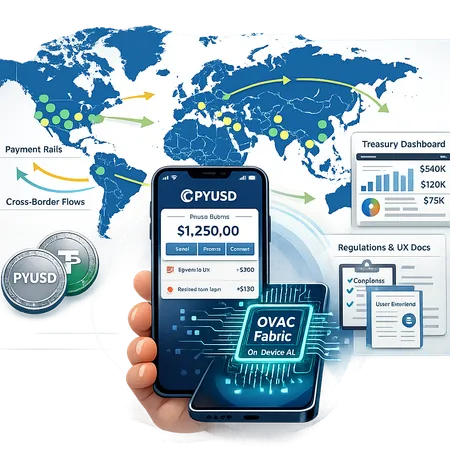
The stablecoin layer is no longer monolithic. USDT still dominates headline liquidity, but two parallel trends matter for product and treasury teams: large consumer platforms are launching payment‑centric stablecoins, and issuers are innovating the underlying utility of tokens. PayPal’s expansion of PYUSD into 70 markets signals the first trend; Tether’s QVAC Fabric — an on‑device AI initiative linked to the issuer — signals the second. Both change how firms think about rails, custody and product UX.
PayPal’s PYUSD: payments scale and product signals
PayPal moved PYUSD into roughly 70 markets as a payments and custody primitive, pushing stablecoins into mainstream consumer rails (PayPal expands PYUSD to 70 markets). For treasury teams that focus on cross‑border payouts and merchant settlements, this is consequential for three reasons:
- Reach and KYC: A major payments brand with existing KYC, fiat on/off ramps and merchant relationships reduces adoption friction. That matters more than raw on‑chain liquidity when you’re paying suppliers or employees in dozens of jurisdictions.
- Product fit for payments: PYUSD is positioned as a payment instrument rather than purely a trading asset, which changes expectations around settlement guarantees, refund mechanics and dispute handling.
- Custody and liquidity partners: PayPal’s custody footprint and settlement agreements create a different counterparty risk profile than purely market‑issued stablecoins.
Payment‑first stablecoins are optimized for predictable rail behavior: slower volatility concerns, clearer fiat redemption paths, and integrated refunds/chargebacks where needed. For many treasury use cases, that is as important as the narrow cheapest per‑transaction gas cost.
QVAC Fabric: when stablecoins meet on‑device AI
Tether’s QVAC Fabric is an intriguing pivot: it’s a framework for on‑device AI training and inference that the issuer links to USDT’s broader ecosystem (Tether introduces QVAC Fabric for on‑device AI). The practical implications for product teams are subtle but meaningful:
- New utility model: Stablecoins may be used to pay micropayments for model updates, data licensing, or compute credits at the edge. That converts a floating asset into a utility token inside an ecosystem of devices and services.
- Offline and privacy‑sensitive flows: On‑device AI reduces round trips to central servers; coupling this with tokenized incentives enables localized value exchange without constant network dependence.
- Infrastructure demands: On‑device micropayments require ultra‑lightweight settlement channels, revocable receipts, and often off‑chain payment channels or payer authorization primitives.
From a treasury perspective, QVAC‑style use cases create recurring, high‑frequency micro‑flows that require different monitoring, FX treatment and cost models compared with occasional cross‑border supplier payments.
Liquidity and rails: why fragmentation matters (Solana as an example)
A multi‑stablecoin world increases the chance of liquidity fragmentation. The Solana ecosystem shows strong on‑chain stablecoin liquidity growth and rising open interest, which highlights both opportunity and complexity (Solana stablecoin liquidity hits record). Key consequences:
- Routing and conversion costs: If PYUSD liquidity concentrates on certain consumer rails while USDT dominates OTC desks and DeFi pools, treasuries must manage conversion costs and slippage when moving between rails.
- Cross‑chain and bridge risks: Moving value across chains or between token standards introduces bridge, smart‑contract and custodian risk. That risk profile changes the moment you move from a single native token to a basket.
- Market‑making and depth: Payment reliability depends on depth at the destination chain/token. If your payroll is in a region where PYUSD markets are shallow, settlement could require temporary on‑ramps to another stablecoin.
For product teams, these are technical and contractual challenges. For treasury teams, they’re execution risk and P&L considerations.
Regulatory and compliance considerations
A multi‑stablecoin strategy expands the regulatory footprint you must manage:
- Licensing and geofencing: Different issuers and custodians will have different geographies of legal approval. PYUSD backed by PayPal may be usable in places USDT cannot—or vice versa.
- AML/KYC and sanctions screening: Each token flow needs provenance and compliance plumbing. Integrating issuer attestations, wallet scoring and chain analytics into payments pipelines is now table stakes.
- Accounting and tax: Multi‑token holdings complicate accounting (realized/unrealized gains, FX treatment). Stablecoins pegged to fiat still create taxable events if they are converted between tokens or to fiat at different rates.
- Consumer protections: Payment‑oriented stablecoins will be judged by familiar consumer protections (refunds, dispute resolution), while market‑oriented coins might not offer these services out of the box.
Regulators are watching. Any cross‑border payroll or merchant settlement program must bake regulatory checks into routing decisions and partner selection.
UX and product design: reduce friction, hide complexity
End users and counterparties don’t care which stablecoin was used; they care about speed, predictability and clarity. Product leaders should focus on:
- Abstraction: Provide a single payment experience that hides whether rails used PYUSD, USDT or another coin. Abstract conversion and gas into a single fee line item.
- Transparency and receipts: Record what token was used, expected redemption path, and a short explanation of refund rules.
- Fallbacks and retries: If a chosen stablecoin pathway fails due to low liquidity or regulatory block, automatically route to a vetted alternative.
- Onboarding: Use progressive KYC where low‑risk flows start fast and higher‑risk flows trigger stronger checks.
Good UX reduces outbound support costs and improves counterparty trust—especially important for cross‑border payroll where missed payments damage relationships.
Technical checklist for integration teams
Adopting multiple stablecoins requires engineering rigor. Core items to evaluate:
- Custody and settlement: Native custody vs hosted custodians; hot wallet controls; cold wallet redemption processes.
- Liquidity partners: Market makers, AMMs, OTC desks, and custodial partners per token and per corridor.
- Payment channels: Off‑chain channels, state channels, or rollups to support micropayments (relevant for QVAC scenarios).
- Orchestration: Routing engine to select token and corridor based on cost, speed, compliance and liquidity.
- Reconciliation: Real‑time ledgering that maps token flows to fiat accounting codes; automated FX P&L reporting.
- Monitoring and SLAs: On‑chain and off‑chain monitoring with alerting for confirmations, finality thresholds and bridge queues.
- Smart contract risk assessment: Audits, upgrade patterns, and emergency‑stop procedures.
Teams should also plan for vendor lock‑in: rely on well‑documented APIs, and prefer modular designs so you can swap liquidity and custody providers without re‑engineering the product.
Tactical strategies for treasury teams
Here are practical, low‑regret moves treasury teams can adopt today:
- Define corridors and acceptable tokens per corridor. Not every coin is equal in every country.
- Maintain a primary and secondary liquidity provider for each token to reduce slippage risk.
- Use a stablecoin basket for exposure management: hold both payment‑centric coins (e.g., PYUSD where supported) and market‑centric coins (e.g., USDT) and rebalance quantitatively.
- Hedge FX when on‑chain routing introduces conversion windows longer than your payment SLA.
- Automate reconciliation between on‑chain events and the general ledger; sample and audit frequently.
These tactics reduce single‑point failures while keeping costs predictable.
Product roadmap implications
For fintech product leaders building payments and payroll infrastructure, the multi‑stablecoin world implies a small set of platform bets:
- Build or buy a routing/orchestration layer capable of evaluating liquidity and compliance policies in real time.
- Support multiple custody models (in‑house cold storage, custodial wallet partners, and custodial‑wallet hybrids) for flexibility.
- Instrument UX to surface only necessary token details to end users but log full provenance for compliance.
- Monitor innovations like QVAC Fabric because they transform transaction profiles—from occasional large transfers to continuous micro‑payments tied to device interactions.
Platforms like Bitlet.app and other integrators will increasingly act as aggregators of rails, letting product teams focus on UX and treasury workflows rather than plumbing every corridor themselves.
Conclusion: pragmatic diversification, not token shopping
A multi‑stablecoin future is less about replacing USDT and more about contextual rails. Payment‑first coins like PYUSD will win where consumer trust and integrated fiat on/off ramps matter. Innovator issuers who tie tokens to new utility (QVAC Fabric and on‑device AI) create recurring micro‑flows that require new settlement patterns. Liquidity concentration (as seen on Solana) paints a reminder: deep markets matter.
For treasury and product leaders the goal is pragmatic diversification: build routing, custody and compliance layers that treat stablecoins as configurable rails—each with different costs, risks and product fit—rather than as a single interchangeable unit.
Sources
- PayPal expands PYUSD to 70 markets: https://bitcoinist.com/paypal-expands-pyusd-68-countries-stablecoin-push/
- Tether introduces QVAC Fabric for on‑device AI: https://en.cryptonomist.ch/2026/03/18/on-device-ai-qvac-fabric/
- Solana stablecoin liquidity growth: https://cryptonews.com/news/solana-stablecoin-liquidity-hits-record-open-interest-climbs/
For deeper reading on market‑level behavior and liquidity engineering, teams should watch developments in Stablecoin and DeFi as they influence rails and product design.