When Revenue Doesn't Move the Token: Pump.fun, Hyperliquid and the DeFi Revenue Paradox
Summary
The puzzling gap: booming DeFi revenue, dormant tokens
DeFi revenue — once a rare badge of sustainability — now arrives with a complication: more protocols are minting real dollars on‑chain, but their native tokens don't always follow. That divergence matters for anyone allocating capital to crypto projects or reporting on emerging protocols. In some cases large revenues coexist with flat token prices; in others, modest revenues can coincide with outsized token rallies. Understanding why requires looking beyond headlines and into how revenue is captured and who actually benefits.
For many readers, the instinctive benchmark is simple: revenue up, token up. It worked for a handful of early protocols where fees flowed directly to token holders through clear sinks, buybacks, or dividend‑style mechanics. But the newer wave of platforms—often fast‑moving, experimental DeFi apps—use more complex treasuries, partner flows, and off‑chain rails that can decouple protocol cash flows from token demand. That disconnect is exactly what we see when comparing Pump.fun and Hyperliquid.
Pump.fun: Top‑five revenue with a flat PUMP
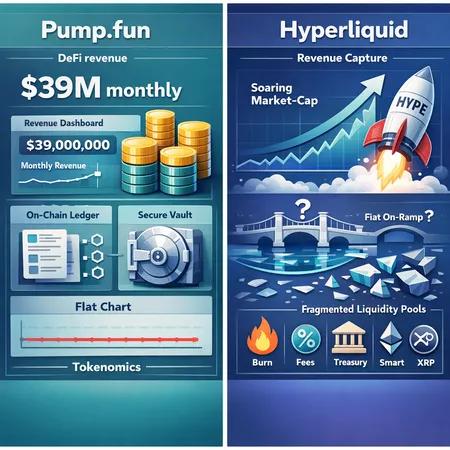
Pump.fun entered the headlines after moving into the crypto market’s top five by monthly revenue, posting roughly $39 million in 30‑day revenue according to reporting that tracked protocol receipts. Despite that impressive topline, PUMP’s market action stayed surprisingly calm.
Why would a protocol earn tens of millions and not ignite token demand? The short answer: revenue does not equal revenue capture by token holders. Digging deeper reveals several likely explanations.
What the numbers say (brief)
On‑chain and analytics services tracked Pump.fun’s user activity and fee streams, estimating the ~$39M monthly revenue figure. Yet token market structure—distribution, lockups, and how fees are routed—appears to blunt the revenue→price transmission. In plain terms: the protocol can be collecting real dollar value without a structural mechanism that turns those fees into sustained buying pressure for PUMP.
Specific levers likely at play
- Treasury allocation: If fees are routed into a multisig treasury and not used to buy back or burn PUMP, the immediate demand signal to markets is muted. Treasuries can accumulate value while tokens float independently.
- Revenue sinks: Some projects implement burns or buybacks, but the scale and cadence matter. Small or irregular buybacks won't overcome large circulating supplies or heavy vesting flows.
- Liquidity fragmentation and listings: When token liquidity is split across many pools or locked behind CEX listings, price impact from treasury buys can be minimal.
Pump.fun is a reminder that headline revenue should prompt follow‑up: who gets the cash, and what rules turn that cash into token scarcity or yield? For reporters tracking these stories, it’s worth contrasting Pump.fun’s revenue figures with the token‑side plumbing before drawing valuation conclusions. See the original coverage documenting Pump.fun’s revenue performance for context: Pump.fun moved into the top five revenue ranks.
Tokenomics mechanics that decouple revenue from price
If you want to predict whether protocol revenue will lift a token, focus on the mechanics that govern revenue capture. Several recurring patterns explain why revenue can stay high while token price does not.
1) Fee routing and treasury policy
Revenue that accumulates in a treasury but is not deployed to buy or burn tokens creates a balance sheet that benefits the protocol but not necessarily token holders. Treasuries can fund development, grants, or marketing; those are long‑term value drivers but often do not create immediate demand for the token.
2) Inadequate revenue sinks
Burns, buybacks, staking rewards, or distributions are the bridges between protocol cash and token scarcity/demand. When these sinks are small relative to circulating supply or when buybacks are irregular, market participants may see revenue as transient.
3) Token supply dynamics and vesting
Large allocations to founders, investors, or partners with future unlock schedules create a looming overhang. Even strong revenue can be overwhelmed by predictable sell pressure when vesting cliffs arrive.
4) Liquidity fragmentation and shallow markets
If meaningful liquidity sits in a few pools or on specific exchanges, token buying from treasury actions faces high slippage or becomes expensive, reducing the appetite for consistent buybacks.
5) Off‑chain or routing revenues (third‑party rails)
Revenue that reflects third‑party integrations—not direct protocol fees—can inflate topline numbers without increasing on‑chain fee capture. The Hyperliquid case below shows how ambiguity about fiat on‑ramps can generate headlines while the actual revenue capture story is more nuanced.
6) Narrative and speculative flows
Sometimes market cap moves faster than revenue because of listings, social narratives, or token staking incentives that attract quick capital. Conversely, strong revenue with weak narrative or listing coverage can remain unnoticed by traders.
Each of these mechanisms reduces the correlation between protocol cash flows and token market cap. Investors who ignore them risk mistaking good product metrics for token fundamentals.
Hyperliquid: rapid market‑cap ascent and on‑ramp ambiguity
Hyperliquid’s HYPE provides a useful contrast: the project’s token climbed quickly into the top 10 by market cap at one point, and short‑term performance showed notable gains (reports flagged an 11% week‑to‑date jump). That market action stands in contrast to Pump.fun where revenue was large but token movement was subdued.
A big part of HYPE’s story was market narrative: excitement around a product that promises low‑latency trading and accessible rails. Yet some of the most viral claims were about “fiat access” and seamless on‑ramps. It’s crucial to separate the marketing framing from technical reality: public reporting clarified that Hyperliquid’s fiat references largely relate to third‑party on‑ramps and integrations rather than native fiat rails built into the protocol itself. That nuance matters because third‑party on‑ramps can drive user growth and nominal volume without directly increasing protocol revenue capture the way on‑chain fees would.
Read the coverage noting HYPE’s performance and market moves here: Hyperliquid HYPE jumps 11% WTD, and the clarification about fiat tests and third‑party on‑ramps here: Hyperliquid details fiat access amid test reports.
Why HYPE could rally while Pump.fun’s PUMP stayed flat
- Narrative speed: HYPE benefited from a strong marketing push, listings and speculative flows that re‑rated the token quickly.
- Perceived utility: If traders expect HYPE to be needed for platform access, that drives demand even if on‑chain revenue capture is limited today.
- Supply dynamics: HYPE’s circulating float and distribution schedule may have been tighter at the time of the rally, amplifying price moves.
Hyperliquid shows that market cap moves can be driven as much by perception and liquidity structure as by immediate protocol receipts. Pump.fun shows the opposite: real revenue without a token story that leverages that cash to create token scarcity or yield.
A practical framework to evaluate whether revenue justifies token valuation
For investors and reporters, a checklist approach helps separate meaningful revenue capture from misleading toplines. When you see a headline about protocol revenue, run this framework before assuming the token is undervalued.
Fee‑to‑Market‑Cap ratio (F/MC):
- Compute trailing 30‑ or 90‑day protocol fees divided by token market cap. Higher ratios imply stronger revenue backing per dollar of market value. Compare across peers (e.g., rev/MCAP for PUMP vs peers).
Revenue share to token holders:
- Ask: do fees flow to token holders via burns, buybacks, staking rewards or distributions? If not, the revenue is less likely to translate into price.
Treasury transparency and policy:
- Review treasury allocations, multisig controls, and written budgets. A treasury that hoards funds without a clear buyback or utility plan creates friction.
Circulating supply, vesting and unlock schedule:
- Check upcoming vesting cliffs. Predictable unlocks can negate revenue effects by adding sell pressure.
Liquidity depth and fragmentation:
- Measure DEX pool depths and CEX orderbook liquidity. Shallow markets mean even moderate buys can swing price; deep markets absorb revenue‑driven buys more evenly.
Source of revenue (on‑chain fees vs third‑party flows):
- Differentiate between fees generated by native protocol activity and money that flows through integrations or partners. The latter may inflate revenue but not protocol capture.
Token utility and mandatory demand:
- Does the product require token use for core functionality (discounts, access, governance)? Mandatory utility creates baseline token demand.
Narrative catalysts and listing status:
- Listings on major exchanges, partnerships, or clear fiat‑rail integrations can change supply/demand dynamics quickly—sometimes independent of revenue.
Regulatory and custodial risk:
- Treasury holdings, fiat on‑ramp partners, or custodial arrangements can introduce liabilities that depress token value.
Apply these factors holistically. For example, a protocol with excellent F/MC but massive vesting cliffs might still be a risky bet; conversely, modest revenue can justify a premium token price if the token is scarce, utility‑heavy and well‑listed.
Practical takeaways for investors and reporters
- Always look past headline revenue. Ask where the cash goes, who controls it, and whether there is a credible mechanism to convert revenue into token demand.
- Use on‑chain tools and treasury dashboards to verify fee flows, and compare fee‑to‑market‑cap ratios across similar protocols.
- Treat narrative and listings as separate drivers. A token can rally on story momentum even without underlying revenue capture; that makes timing and risk appetite critical.
- Remember that some revenues are short term (promotional volume, partner integrations) and won’t persist unless the protocol embeds capture mechanics.
If you want to model this in practice, run a simple spreadsheet: 30‑day fees, market cap, circulating supply, upcoming vesting, and declared buyback schedule. That clarity will often separate noise from signal.
Bitlet.app users and other market participants should factor tokenomics design into any investment thesis rather than relying on headline revenue alone.
Conclusion
Pump.fun and Hyperliquid illustrate two sides of the modern DeFi revenue paradox. One generated tens of millions in monthly revenue yet saw little token movement; the other enjoyed rapid market‑cap gains amid strong narrative and ambiguous fiat‑on‑ramp headlines. The core lesson: revenue is necessary but not sufficient for token appreciation. Tokenomics—specifically how revenue is captured and converted into token scarcity or yield—ultimately determines whether booming protocol revenue will translate into price.
For investors and reporters, that means asking the right questions about treasury policy, fee sinks, supply dynamics, liquidity and the true source of reported revenue before drawing conclusions about valuation.
Sources
- Pump.fun revenue reporting: https://crypto-economy.com/pump-fun-enters-top-5-revenue-ranks/
- Hyperliquid market performance coverage: https://u.today/hyperliquid-hype-jumps-11-wtd-outperforms-xrp-and-ethereum?utm_source=snapi
- Hyperliquid fiat access clarification: https://coincu.com/news/hyperliquid-details-fiat-access-amid-test-reports/?utm_source=snapi