Solana SIMD-0266: Lower Fees, Whale Accumulation, and the DeFi Pivot
Summary
Executive snapshot
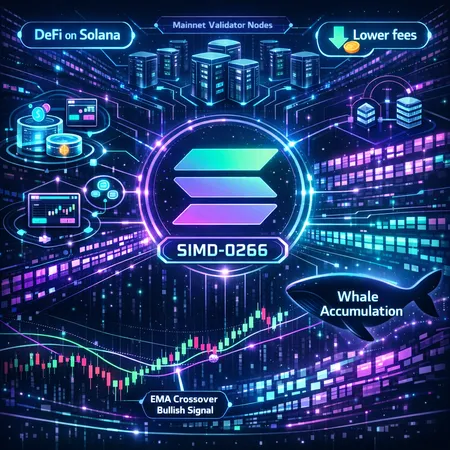
Solana’s SIMD-0266 p-token upgrade just landed on mainnet with the explicit goal of making token operations cheaper and more predictable for users and dApp builders. At the same time, on-chain signals are showing renewed whale accumulation and a technical setup Blockonomi described as the first bullish signal in two months, while Solana leadership is publicly pivoting the chain’s narrative toward DeFi. For builders and DeFi traders, the question isn’t just whether fees fall a few cents — it’s whether lower friction meaningfully changes throughput economics, liquidity distribution, and product-market fit.
What SIMD-0266 is and what it changes for UX and fees
The upgrade in plain terms
SIMD-0266 is a protocol-level enhancement to Solana’s token handling—often called the “p-token” upgrade in technical coverage—that optimizes how token accounts and operations are executed on mainnet. AmbCrypto’s technical breakdown explains the core idea: the upgrade reduces compute work for common token flows and streamlines account patterns used by decentralized apps, which lowers the gas/fee burden for everyday actions like swaps, transfers, and contract interactions. See AmbCrypto’s summary for a technical walkthrough.
Practical effects for users and builders
- Lower per-operation costs: cheaper SPL token transfers and cheaper batched operations mean users pay less for swaps and interactions that used to be prohibitively expensive at scale. This is a direct UX win for dApps targeting high-frequency or microtransaction use cases.
- More predictable UX: fewer unexpected failed transactions and lower compute spikes improve retention for wallets and front-ends.
- Throughput economics shift: cheaper per-tx costs make sub-dollar microtransactions and UX-centric features (gasless meta-transactions, frequent rebalance ops) more viable, but they also compress fee revenue per swap—important for AMM-based fee income models.
For builders, this is a pivot point: product architectures that previously avoided on-chain repetitions for cost reasons can now be evaluated again. Bitlet.app integrations and other payment rails that rely on predictable, low-cost token moves should see immediate benefits.
On-chain signals: whale accumulation and the first bullish technical signal
Whale behavior and accumulation
Recent on-chain metrics point to renewed accumulation by large SOL holders: increases in long-term cold-wallet balances, reduced selling pressure to exchanges, and discrete large inbound transfers into custody or cold storage. Blockonomi highlights that these accumulation patterns, coupled with institutional chatter, suggest a higher conviction cohort is returning to Solana. Whale accumulation matters because concentrated holders can tighten free float and amplify price moves when liquidity thins.
A technical pulse: EMAs and the bullish signal
Blockonomi labeled the market’s shift as the first bullish signal in two months; technically this kind of reversal is often associated with short-to-medium-term moving average behavior. For traders, the most relevant EMAs are the 20-, 50-, and 200-day lines:
- A 20/50 EMA cross to the upside can mark a short-term momentum flip.
- The 200-day EMA remains the macro trend filter—price above it suggests regime change for many institutions.
Volume confirmation and on-chain flow (net exchange outflows, rising wallet clustering) should accompany any EMA cross. Without that confirmation, the signal is more likely to be a relief bounce than a structural reversal.
The narrative shift: DeFi as Solana’s economic purpose
Solana Foundation president Lily Liu has been explicit: DeFi is the ecosystem that gives blockchains their true economic grounding. Her framing — discussed in Blockonomi’s coverage of Solana leadership — helps explain why the Foundation and builders are orienting developer incentives, grants, and tooling toward lending, AMMs, and composable financial primitives. A clear ideological pivot from NFTs or gaming back to core financial rails changes where teams allocate resources and where liquidity concentrates.
Why this matters: DeFi use-cases are fee-sensitive but volume-rich. Lower fees from SIMD-0266 combined with a governance/marketing push toward DeFi increases the odds that liquidity providers and yield-bearing products become primary growth vectors on-chain.
Implications for dApp builders and liquidity providers
For builders
- Revisit UX trade-offs: previously off-chain batch strategies or optimistic rollups for microflows may no longer be necessary. You can redesign UX to favor on-chain composability and simpler reconciliation.
- Gas budgeting: lower costs reduce the need for subsidized gas, but teams should model new fee curves since per-swap fee revenue may decline.
- Integration decisions: adopt the updated p-token patterns to reduce account bloat and tap lower compute units—this will simplify wallet UX and reduce friction across smart contract flows.
For liquidity providers
- Fee income vs. volume: lower fees mean LP income per trade falls; the counterbalance must be materially higher volume. Evaluate AMM pools where tighter spreads and more swaps can offset fee compression.
- Concentrated liquidity strategies: consider narrower ranges or active management to maintain yield in higher-throughput environments.
- Impermanent loss calculus: with more intra-chain activity, non-stable pools may see more frequent rebalancing and different IL profiles; model with higher tick-level granularity.
Builders should also track developer tooling support, grant programs, and changes in RPC/validator behavior—those operational dimensions determine how easily you can onboard users post-upgrade.
What traders should watch next (a practical checklist)
On-chain metrics
- Whale accumulation: monitor large wallet balance growth and clustering, and watch whether these wallets move into custody or remain cold.
- Exchange flows: net outflows from exchanges are bullish; significant inflows can presage sell pressure.
- Liquidity pool depth: track liquidity across major Solana AMMs and stablecoin pools—shallow depth magnifies price moves.
Technical indicators
- EMA behavior: watch for a 20/50 EMA golden cross as an early momentum sign and the 200-day EMA for macro confirmation.
- Volume confirmation: any breakout above resistance should be accompanied by above-average on-chain and exchange volume.
- RSI and momentum divergence: look for bullish divergence on the RSI if price is still testing short-term support.
Market structure and levels (how to set your context)
Instead of hard price calls, anchor decisions to structure:
- Identify the recent multi-week swing high as your first resistance band; a clean break and retest are stronger than impulsive spikes.
- Mark the 50- and 200-day EMAs as dynamic support/resistance levels for stop placement and bias.
- Map concentrated liquidity pools and slippage pockets; large market orders can move price if liquidity is thin.
Risks and open questions
- Fee compression vs. revenue model: lower fees are great for users but can erode revenue that sustains some LPs and MEV strategies—expect market participants to adapt rather than disappear.
- Centralization of liquidity: if a handful of whales or LPs dominate pools, Solana becomes more sensitive to single-actor behavior.
- Execution risk: developer adoption of SIMD-0266 patterns matters. The upgrade makes things possible, but adoption curves determine the real-world change in fee dynamics.
Conclusion — how to think about product-market fit now
SIMD-0266 materially lowers the barrier for fee-sensitive use cases and improves UX reliability. Combined with renewed whale accumulation and a leadership-driven push toward DeFi, the ingredients are aligning for a renewed Solana DeFi cycle. That said, traders should wait for confirmatory on-chain volume and EMA structure before assuming a durable bullish regime; builders should prototype with the new p-token patterns and re-run economic models for LPs and fee-bearing products.
For practitioners: test the upgrade on a staging cluster, measure per-operation compute and fee changes for your critical flows, and watch whether user stickiness meaningfully improves once you migrate. If you’re tracking ecosystem sentiment, keep an eye on institutional interest and developer grants—those often precede material liquidity migration.
Sources
- AmbCrypto — Inside Solana’s upgrade: SIMD-0266 p-token upgrade and mainnet debut: https://ambcrypto.com/inside-solanas-upgrade-lower-fees-mainnet-debut-whats-next-for-sol
- Blockonomi — Solana flashes first bullish signal in two months; Grayscale eyes opportunity: https://blockonomi.com/solana-sol-flashes-first-bullish-signal-in-two-months-while-grayscale-eyes-opportunity/
- Blockonomi — Solana Foundation president Lily Liu: DeFi is what gives blockchain its true economic purpose: https://blockonomi.com/solana-foundation-president-lily-liu-defi-is-what-gives-blockchain-its-true-economic-purpose/
For more technical context and market comparisons, many traders still look to how Solana pairs stack up versus broader market indicators; and builders reconsider funding and composability trade-offs as DeFi primitives regain priority in the ecosystem.