Ethereum’s Fast Confirmation Rule (FCR): Technical explainer, UX gains and security trade-offs
Summary
Executive overview
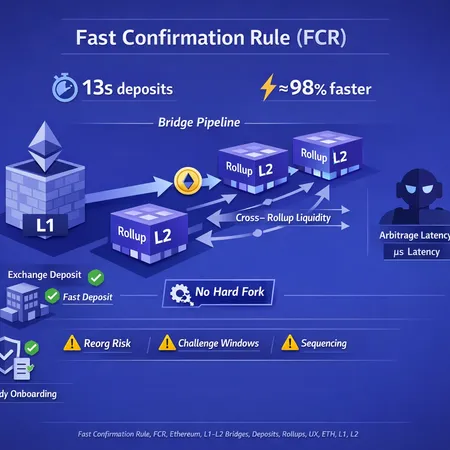
The Fast Confirmation Rule (FCR) is a pragmatic, client-side change that shortens the time most users wait to consider an L1 block "good enough" for L1→L2 deposits. Early reporting put expected acknowledgement times at roughly 13 seconds, claiming up to a 98% reduction in bridge latency for many flows. See Cointelegraph for a quick summary of the 13-second figure and the claimed bridge improvements and Cryptopolitan for coverage that emphasizes client-driven implementation without a hard fork.
For protocol designers, developers and product managers evaluating UX and security trade-offs, the FCR matters because it shifts a key choice from multi-minute human-facing waits to near real-time optimism — while retaining the possibility of rare rollbacks. Wallets and services such as Bitlet.app will need to decide how aggressively to credit balances and display certainty to users.
What the Fast Confirmation Rule changes (technical view)
At a high level, the FCR changes the point of acceptance for certain L1 events (not the underlying consensus or state transition rules). Instead of waiting for a long confirmation horizon or multiple block confirmations, clients adopt heuristics that treat a freshly mined block as sufficiently stable after a short time-window — the 13-second figure reported — for downstream systems (like L2 sequencers and relayers) to act on deposit transactions.
That does not rewrite Ethereum's finality model; it changes the practical moment when nodes and services accept a deposit as safe to act upon. In other words, the canonical chain and block validity are unchanged, but client behavior about application-level acceptance becomes faster and probabilistic. Reducing deposit latency from the typical minutes to ~seconds unlocks a different UX baseline for bridges and L2s.
Why this can be implemented without a hard fork
The key reason there’s no hard fork required is that FCR is an off-chain policy and client heuristic, not a change to consensus or EVM semantics. Client teams (execution + consensus clients and node operators) can update software to adopt a stricter rule for when to surface or forward L1 events to relayers and L2 sequencers. Cryptopolitan reports that Vitalik and client teams are coordinating precisely this kind of change.
Because the node software still validates blocks the same way and full nodes remain capable of reverting to strict acceptance policies, the network does not need a protocol upgrade that changes on-chain state transition rules. Instead the rollout is operational: operators upgrade clients, application teams tune acceptance thresholds, and services optionally rely on the new client signals.
Practical impacts on L1→L2 UX
Shorter deposit acknowledgement changes product flows across three broad user journeys: consumer dApp interactions, custody/exchange deposit flows, and cross-rollup liquidity operations.
dApp flows and user experience
For everyday users of decentralized apps, the most visible change will be fewer confusing “waiting” screens. A trade example: bridging ETH to an optimistic rollup and receiving credited funds in ~13 seconds lets users enter position openings, supply liquidity or swap in a single interaction. That reduces abandonment and makes L2s feel near-instant, bringing L2 UX closer to centralized app expectations.
However, UX must reflect the probabilistic nature of these credits. Good product signals include: optimistic status badges (e.g., "Fast-confirmed — finalizing"), expected finalization ETA, explicit rollback guidance, and an event history showing both the optimistic credit and final settlement.
Exchange and custody deposit flows
Exchanges and custodians frequently rely on long confirmation counts to avoid crediting deposits that might be reverted by reorgs. With FCR, exchanges can optionally offer an accelerated credit path for small deposits, updating balances in seconds but marking them as provisional until finality. This enables faster onboarding and customer satisfaction, but requires clear operational policies: provisional limits, swift reconciliation workflows, and insurance or reserve coverage for rare rollback losses.
From a product manager’s perspective, the decision is a business-choice: accept a small operational risk to dramatically improve inbound conversion, or keep old conservative gates and risk higher friction.
Cross-rollup liquidity and arbitrage latency
Lower L1 deposit times collapse the latency window between when an asset leaves L1 and becomes usable on an L2. That has two big implications:
- Cross-rollup liquidity becomes more composable — fast bridges enable more frequent rebalancing and capital-efficient routing between rollups.
- Arbitrage windows shrink. Traders and bots gain the ability to move funds across L2s quickly enough to capture transient price differences. That reduces spreads and increases market efficiency, but also raises the speed war: latency-sensitive strategies will intensify competition.
For example, an arbitrage strategy that previously required 2–10 minutes to move collateral between L2s may now execute in tens of seconds, enabling more immediate cross-market corrections.
Security trade-offs and edge cases
FCR deliberately moves systems toward probabilistic acceptance in exchange for speed. That introduces several edge cases that protocol designers and product teams must address.
Reorgs and deposit rollbacks
The most obvious risk is a chain reorganization that invalidates the block containing the deposit. With a fast acceptance rule, an L2 or exchange might have already credited and allowed outbound actions on funds that, in a rare reorg, no longer exist.
Mitigations include provisional crediting, delayed settlement for large amounts, reconciliations, and ex-post recovery mechanisms. The probability of deep reorgs on Ethereum is low, but non-zero — teams must measure acceptable risk thresholds and size provisional limits accordingly.
MEV and sequencer interplay
FCR short-circuits time-based friction that previously throttled some MEV strategies. Faster acceptance can change the incentive landscape for reorg-based MEV and sequencer operators: attackers who can coordinate reorgs may find more lucrative opportunities if application-layer credits are optimistic.
Product and protocol mitigations — such as better monitoring, watchtowers and stronger sequencer governance — will be important. Designers should assume adversaries will experiment with new vectors as operational latencies shrink.
Network partition and client diversity
Because FCR is client-driven, heterogeneous client behavior across the network can cause inconsistent acceptance semantics. If some nodes accept deposits quickly and others do not, relayers and L2 sequencers must standardize which signals they trust. Client diversity and coordinated upgrades limit fragmentation, but staggered rollouts can create transient UX surprises.
Mitigations and recommended practices
FCR doesn't replace sound product design. Below are practical mitigations for different stakeholders.
Product-level mitigations (for dApps, exchanges, wallets)
- Provisional / optimistic UI states: show clear, non-blocking labels when funds are fast-confirmed but not final.
- Limits on provisional credit: allow only small or medium amounts to be auto-credited; require conventional finalization for high-value deposits.
- Automated rollback handling: reconcile user balances quickly and have funds-reserve policies to cover contested credits.
- User education: inline UX copy and support flows that explain why a "fast" credit might later be adjusted.
Protocol & client mitigations (for client devs and rollup teams)
- Conservative default thresholds with opt-in aggressive modes for operators seeking lower latency.
- Standardized telemetry for fast-confirm events so downstream services can gauge operator adoption and risk.
- Watchtower and monitoring tooling that detect and alert on reorgs affecting fast-confirmed deposits.
- Coordinated client release and testing windows to minimize heterogeneity across the network.
Concrete examples: how UX and latency change
- A user bridging 0.5 ETH to an optimistic rollup: previously they might wait several minutes for a deposit to be credited; with FCR they see an optimistic credit in ~13s and can transact immediately, subject to provisional status tags.
- Exchange onboarding: a custody provider opts to auto-credit deposits under $1,000 after fast-confirm; verified users experience near-instant deposits for small transfers while large transfers use the full finality path.
- Arbitrage: a cross-rollup arbitrage bot that used to sit idle for 5+ minutes while funds moved can now execute within ~20–30 seconds total round-trip latency, increasing competition and reducing price divergence windows.
Reference reporting on the 13-second number and the claim of up to 98% faster bridge times is available from Cointelegraph, and implementation commentary about client-driven rollout without a hard fork can be found at Cryptopolitan.
Operational checklist for teams considering FCR
- Assess your risk tolerance: define provisional credit limits and SLAs for reconciliation.
- Update UX to state optimistic vs. finalized states; provide rollback guidance.
- Deploy monitoring for reorgs and fast-confirm events; integrate alerts into incident playbooks.
- Coordinate with counterparties (relayers, sequencers, exchanges) on which client signals you will accept.
- Consider insurance or pooled reserves to cover rare rollback losses.
Conclusion
The Fast Confirmation Rule is a pragmatic lever to bring L1→L2 UX into the sub-minute era without changing Ethereum’s core consensus. For product teams and protocol designers it offers clear upside in user flows, onboarding conversion and cross-rollup efficiency, but it comes with trade-offs: increased reliance on probabilistic acceptance, new MEV surfaces, and operational complexity.
The right adoption path combines cautious defaults, clear UX signals, and technical mitigations such as watchtowers, provisional crediting policies, and coordinated client upgrades. As teams experiment with FCR, expect rapid iteration: the first adopters will learn how much latency they can safely shave off while preserving business and security guarantees.
Sources
- Cointelegraph coverage of the FCR and the 13-second bridge times: Ethereum cuts bridge times 98%, 13-second fast confirmation rule
- Reporting that Vitalik and client teams are implementing rapid deposit times without a hard fork: Ethereum cuts deposit time to seconds
For team-level adoption planning, coordinate with client teams and relayer/sequencer operators, and instrument fast-confirm telemetry early so you can measure real-world reorg rates and tune policies accordingly. Faster bridges are coming — design your UX and risk controls to match.