XRP’s March 2026 Breakout: On‑Chain Drivers, Whale Accumulation and What Comes Next
Summary
Overview: why March 2026 mattered
XRP’s March 2026 breakout was notable not because the price moved — many assets move — but because multiple independent signals converged: futures open interest rotated in XRP’s favor (flipping BNB), on‑ledger activity surged to multiyear highs, and whales accumulated while exchange reserves showed ebb and flow that could supply selling pressure. These are the kinds of confirmation signals product managers and intermediate traders look for when evaluating whether a move is speculative or adoption‑driven.
CryptoNews reported the moment XRP overtook BNB in open interest, an important market‑structure clue that leverage and attention were rotating into XRP. That rotation changes how liquidity and risk are priced across the sector and can catalyze short squeezes or rapid position re‑allocation if funding rates spike source.
On‑chain activity and why it matters
Network throughput and user signals
Multiple independent measures show that XRPL activity ramped in March: daily ledger entries, payment transactions, and new account creation spiked. Finbold documented XRPL network activity hitting a 13‑year high, a raw—if not complete—proxy for genuine usage rather than only speculative transfers. Sustained increases in unique active addresses and payments per day are the kind of adoption signals product teams should track continuously source.
Why this matters: on‑chain activity is the earliest real‑world feedback loop for payments chains. A network with growing daily payments and off‑exchange custody is harder to liquidate en masse because coins are not centrally pooled.
Whale accumulation and exchange flows
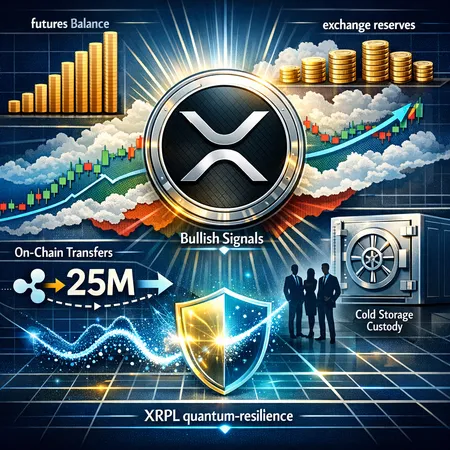
A complementary signal was large‑wallet behavior: on many chains, accumulation shows up as transfers to cold wallets (or to custody providers), and temporary falls in exchange balances. Cryptopotato covered reserve movements tied to Binance and flagged on‑chain reserve shifts concurrent with price action — a reminder that exchange balances are a primary potential source of immediate selling pressure source.
For traders: watch the net change in exchange reserves, large transfers flagged by on‑chain scanners, and the concentration of supply (e.g., percent of supply held by addresses >1M XRP). If whales are moving coins off exchange into cold storage, that reduces float and can amplify price moves when demand flows in.
XRPL fees vs Solana: payments economics
A structural differentiator in this rotation is XRPL’s ultra‑low fees. Coinpaper quantified XRPL as nearly 265x cheaper per transaction than Solana in their comparison, citing an average XRPL fee at roughly 0.0000152 XRP per transaction — an advantage for micropayments and high‑frequency payment rails source.
Practical implication: for merchant payments, IoT micropayments, and high‑volume remittance flows, per‑tx cost matters. Solana still offers broader smart‑contract tooling and a large DeFi/NFT ecosystem, but XRPL’s fee profile makes it uniquely attractive for pure payments use cases. Product teams designing payment rails or embedded payments should compare total cost of ownership (fees, finality, tooling) rather than only throughput on paper.
Technical picture: compression breakouts and implied targets
Reading the pattern
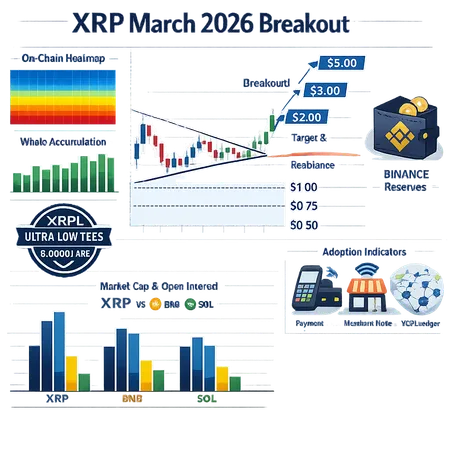
The March breakout followed a classic compression (symmetrical triangle / range compression) where volatility collapsed and liquidity clustered. Compression breakouts are useful because they give a transparent measured move. The basic method:
- Identify the widest vertical distance of the compression (pattern width).
- Add that width to the breakout price to get a first measured target.
Because every pattern starts from a different price, I’ll provide percentage‑based target bands that are easy to apply to your own entry.
Target bands (practical framework)
- Conservative target: +30–50% from breakout — likely first major resistance where liquidity and short sellers re‑enter. Expect partial profit‑taking here.
- Base measured move: +80–120% — this is the textbook measured move for many compressions and often marks the end of the first impulse leg.
- Extended breakout (momentum case): +150–300% — requires sustained volume and leverage support (futures, options) and is vulnerable to exchange selling or macro shocks.
Example (illustrative): if XRP broke out at $0.60, the conservative band targets $0.78–$0.90, the base measured move target is roughly $1.08–$1.32, and the extended target range stretches above $1.50. Use these bands relative to the breakout price you see.
Where selling pressure may come from
- Exchange reserves (Binance): movements from large custodial balances back onto exchanges can quickly add sell liquidity. Cryptopotato’s reporting on reserve dynamics during the rally is a reminder that centralized custody can blunt rallies if large blocks are deposited for sell execution source.
- Leverage unwind: when open interest is concentrated (as CryptoNews noted versus BNB), funding‑rate flips can trigger rapid deleveraging and cascading liquidations source.
- Profit taking from whales: large early accumulators will likely monetize in stages; watch on‑chain flows from whale addresses into exchange deposit addresses.
XRPL vs Solana: what the rotation implies for payments chains
The market rotation into XRP highlights a bifurcation in how chains are being valued:
- XRPL: optimized for payments — ultra‑low fees, deterministic ledger behavior, and simple native payment primitives. That makes XRPL compelling for remittances, micropayments, and rails where per‑transaction cost dominates.
- Solana: optimized for programmatic throughput and DeFi/NFT rails — faster block times and a richer smart contract stack enable complex financial products and composability.
The March rotation doesn’t say Solana is obsolete. Rather, it signals that investors and users are assigning incremental value to payments primitives when adoption metrics (active accounts, payments) rise. Product managers building payments-focused products should evaluate XRPL for cost‑sensitive flows and Solana for composable financial products. Bitlet.app and other payment builders will find XRPL’s cost profile attractive for installment and micropayment features.
Adoption indicators that matter for sustained gains
Not every spike in activity sustains a narrative. For long‑term market cap rotation to hold, watch these signals:
- Net growth in merchant and fiat on/off ramps integrated with XRPL (real payment rails converting XRP to fiat reliably).
- Sustained rise in unique active addresses and payment transactions per day (not just token churn between a few wallets).
- Declining exchange float (more coins in cold custody or non‑exchange wallets).
- Increasing off‑chain settlement agreements (payment processors or remittance corridors using XRPL rails).
- Healthy on‑chain fee economics (low fees but non‑zero to prevent spam) and stable ledger performance.
Finbold’s coverage of XRPL’s activity surge is precisely the kind of signal that should prompt product teams to run experiments for payments integrations; track whether those experiments convert into persistent usage rather than short‑term volume spikes source.
Tactical checklist for traders and product managers
- Monitor exchange reserves daily (Binance in particular). Big inflows equal potential near‑term selling.
- Watch futures open interest and funding rates: rising OI with XRP leading BNB suggests a leverage‑heavy move that can reverse sharply on unwind source.
- Use the compression measured‑move bands above for sizing exits: take partial profits at +30–50%, re‑evaluate at the measured move band, and trail stops beyond that.
- Track on‑chain adoption metrics (active accounts, payments/day) and merchant integrations. If on‑chain wallet growth sustains, it supports higher valuation multiples.
- For product teams: run pilot merchant flows to stress test settlement, custody, and UX under real low‑fee throughput — XRPL’s fee advantage is only meaningful if integrations are smooth and custody is user‑friendly.
Short‑term scenarios (90‑day view)
- Bull case: sustained high ledger activity + falling exchange reserves + rising OI with positive funding leads to a measured‑move target being hit. Whales continue to hold, liquidity tightens, and BNB/SOL narrative risk rebalances.
- Neutral case: on‑chain activity cools after initial surge, Binance/other exchanges deposit some reserves, and price consolidates within a higher range. Traders need volume confirmation for the next leg.
- Bear case: rapid exchange inflows or a coordinated deleveraging event (funding rate spike) forces a swift retracement to pre‑breakout support levels.
Final takeaways
XRP’s March 2026 breakout was convincing because it wasn’t a single indicator moving in isolation. Network activity, whale accumulation, and the structural cost advantage of XRPL fees combined with market leverage redistribution to create a favorable environment. That said, sustainable re‑rating requires persistent adoption signals — merchant flows, continued growth in active users, and shrinking exchange float.
For traders: use measured move targets from the compression, respect exchange reserve dynamics, and manage leverage risk. For product managers: XRPL’s ultra‑low fees make it a strong candidate for payment rails, but execution (custody, on‑ramp/off‑ramp, UX) determines whether activity becomes long‑term adoption.
For further context on the rotation in open interest and the network metrics discussed here, see the reporting linked in Sources below.
Sources
- CryptoNews — XRP flips BNB as open interest approaches pre‑crash levels: https://cryptonews.com/news/xrp-flips-bnb-open-interest-pre-crash-levels/
- Finbold — XRP network activity surges to a 13‑year high: https://finbold.com/xrp-network-activity-surges-to-a-13-year-high/?utm_source=snapi
- Coinpaper — XRPL nearly 265x cheaper than Solana per transaction: https://coinpaper.com/15490/xrp-ledger-gives-solana-a-run-for-its-money-nearly-265x-cheaper-at-just-0-0000152-per-transaction?utm_source=snapi
- Cryptopotato — XRPL hits all‑time high as Ripple price jumps and exchange reserve movements: https://cryptopotato.com/xrp-ledger-hits-all-time-high-as-ripple-price-jumps-14-in-48-hours/
Note: This analysis is informational and not investment advice. Always combine on‑chain metrics, exchange data and macro context before trading.