Pi Day 2026: Why Pi Network’s Product Splash Triggered a Price Drop — A Pioneer’s Guide
Summary
Intro — Pi Day 2026 in one paragraph
Pi Day 2026 was billed as Pi Network’s largest technical and ecosystem moment in seven years: a bundled release of a testnet token launchpad, smart contract upgrades, validator reward rules, and hints about exchange listings including Kraken. Yet, paradoxically, PI’s market price declined after the announcements. That contrast — substantive product progress on one hand, a negative market reaction on the other — is what every early adopter and investor needs to unpack.
What launched (and why it matters)
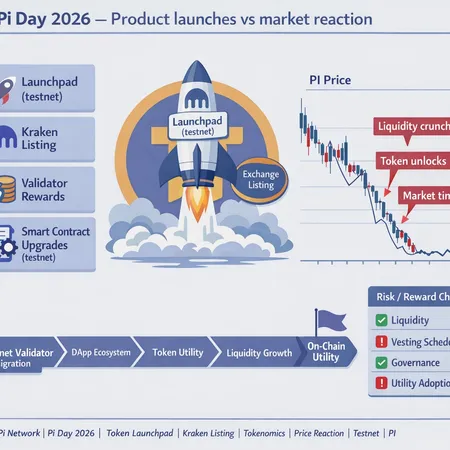
Blockonomi and Coinpedia provide a clear inventory of the Pi Day deliverables: a testnet token launchpad, smart contract engine upgrades, staking/validator reward schemes and a sizable rewards pool for pioneers. Coinpedia further details technical features such as smart-contract compatibility and a launchpad flow designed to accelerate token issuance, while Blockonomi summarizes the suite of releases announced on Pi Day 2026. The Pi core team framed the day as both a celebration and a transition toward on‑chain capability (Cryptopotato).
The headline items
- Testnet token launchpad: a sandboxed way for projects to mint and test tokens on Pi’s testnet and to trial economic parameters before mainnet.
- Smart contract upgrades: an enhanced VM and tooling to let developers deploy decentralized apps directly on Pi testnet, per technical summaries (Coinpedia).
- Validator and reward mechanics: new rules for validator (node) rewards and a large pioneer reward pool reported by Coinpedia to bootstrap participation.
- Exchange access/kraken listing messaging: public commitments and roadmap language about getting PI on major venues, referenced in the day’s communications.
Each of these elements is meaningful: a launchpad lets token projects spin up, smart contracts enable dApps, validators secure the network, and exchange access provides tradability. Together they form the skeleton of on‑chain utility — but a skeleton needs flesh (liquidity, apps, users) to support market value.
How the testnet launchpad and Pi tokenomics differ from established chains
Established smart-contract platforms (Ethereum, BSC, Solana) evolved under a known pattern: vibrant developer ecosystems, immediate liquidity on numerous exchanges, mature tooling, and clear mainnet token flows. Pi’s approach during Pi Day emphasizes cautious, staged rollout.
Key differences to note:
- Testnet-first issuance: Pi’s launchpad runs on testnet so projects can experiment without real token transfers. That reduces immediate tradability and speculative demand compared with chains that let projects list quickly on mainnet.
- Reward-centric distribution: Pi Network is allocating large pioneer rewards and validator incentives to onboard its social-heavy community. While this builds alignment, it introduces complex vesting and unlock schedules that matter a lot for price dynamics.
- Tighter control over supply and access: the core team’s staged plan aims to limit early sell pressure, but unless unlock schedules and circulating supply are crystal clear, markets react to uncertainty.
The testnet-first strategy is prudent from an engineering and regulatory perspective, but it also delays the liquidity that typically drives short-term price appreciation. For many traders, Bitcoin and other liquid markets show how immediate tradability fuels speculative rallies; Pi’s model purposely restrains that.
Why PI’s price fell despite Pi Day product news
Short answer: markets wanted tradability and clarity more than feature roadmaps. Coverage from Invezz explicitly notes that PI prices sank after the announcements — a reminder that good product news is necessary but not sufficient to move a token’s market value (Invezz). Here are the main drivers.
1) Liquidity mismatch and thin order books
Announcements that imply future tradability can paradoxically spur selling today. Many pioneers who earned PI earlier face uncertain liquidity and will sell when listing windows or unlocks are signaled. With limited exchange depth, even modest sell orders push the price down — a simple supply/demand imbalance.
2) Token unlocks and perceived dilution
Large reported reward pools (Coinpedia flagged a big rewards allocation) create the fear of incoming supply. Without a clear, timestamped unlock schedule and on‑chain proof of what’s circulating, traders price in worst‑case dilution.
3) Unclear listing mechanics and timing
An announced intention to list (even on a reputable venue like Kraken) is not the same as an active listing with deposits and order books. If Kraken listing timelines are vague, speculators treat the announcement as a signal that selling will be possible soon — encouraging preemptive selling.
4) Narrative vs. utility gap
Product upgrades improve future utility, but markets are forward-looking and sometimes impatient. If smart contracts and a launchpad are still on testnet, there’s no immediate revenue or transaction volume to justify higher prices.
5) Market context and risk aversion
Broader crypto sentiment matters. If macro risk or altcoin weakness dominates, even positive news can fail to lift or can accelerate downside. The Pi Day releases collided with a market that priced immediate liquidity as more important than staged technical milestones.
What investors and pioneers likely missed in the headlines
- The difference between testnet capability and live mainnet utility: testnet success reduces technical risk but doesn’t create spenders or merchants overnight.
- The scale and schedule of unlocks: many readers skimmed the size of the rewards and didn’t connect it to near-term dilution risk.
- The operational steps to listing: exchange announcements often have KYC, delisting criteria, and deposit/withdrawal tests — all sources of timing friction.
- The need for developer engagement: a launchpad is only useful if projects actually use it and if there are liquidity tools (AMMs, market makers) to bootstrap markets.
Roadmap to meaningful on‑chain utility (practical milestones)
Moving from product announcements to sustainable token value requires coordinated progress across technical, economic and adoption fronts. A practical milestone map:
- Transparent supply accounting: publish verifiable on‑chain or audited statements of total and circulating PI and a clear unlock timetable.
- Mainnet token bridge and deposit/withdraw rails: ensure tokens minted on mainnet can move to exchanges with clear custody procedures.
- Liquidity primitives: a set of audited AMMs, market‑maker partnerships, and liquidity mining programs to sustain order books.
- Developer incentives and tooling: bug‑bounty programs, grants, and SDKs that make it easy to deploy dApps on Pi.
- Anchor use cases: payments, micropayments, or NFT platforms where PI is used as a medium of exchange — real transaction volume beats speculative narratives.
- Security and audits: third‑party audits of smart contracts, validator software, and the launchpad flow to reduce counterparty risk.
- Measured exchange rollouts: coordinated listings with liquidity commitments and staged deposit windows to avoid frenzy-driven dumps.
Each of these steps moves Pi from a promising tech stack toward tangible demand for PI as more than a reward token.
Risk / Reward checklist for Pi pioneers (decision framework)
Use this checklist to decide whether to hold, buy or step back:
- Tokenomics transparency: Is there a public, auditable unlock schedule and clear definitions of "circulating" vs "total" supply? (High importance)
- Exchange logistics: Has a reputable exchange enabled deposits/withdrawals, and are there market‑making commitments? (High importance)
- Liquidity depth: Are order books deep enough that your position won’t move the market? (High importance)
- Smart contract audits: Have the core runtime, launchpad contracts, and reward logic been audited? (Medium–High)
- Developer activity: Are teams building on the Pi testnet and allocating tokens to developer grants? (Medium)
- Real transactional volume: Are apps driving on‑chain transactions or real-world payments using PI? (High)
- Regulatory clarity: Is the token distribution and KYC model compatible with likely exchange jurisdictions? (Medium–High)
- Team and governance clarity: Are governance rules, upgrade paths, and validator selection processes public and sensible? (Medium)
Checklist interpretation: if the first three items (tokenomics transparency, exchange logistics, liquidity depth) are not clearly met, expect elevated downside risk. If audits, developer activity and early apps are emerging, the longer-term risk profile improves.
Where value can compound — and where it can evaporate
Value compounding scenarios:
- Real utility adoption: PI becomes a functional medium of exchange for a set of apps or merchants.
- Developer-led network effects: successful tokens and dApps created via the launchpad attract users and liquidity.
- Clear, predictable supply economics: a well-communicated vesting and unlock schedule calms speculative pressure.
Value evaporation risks:
- Large unlocked supplies sell immediately upon listing.
- Poorly audited contracts lead to hacks and loss of trust.
- Slow developer traction leaves PI as a speculative token with no on‑chain demand.
Tactical moves for active pioneers
- Demand transparency: before scaling positions, insist on published unlock schedules and audit reports.
- Use risk sizing: treat presale/early balances as high-risk allocations — size positions so a total loss is acceptable.
- Watch order book depth: monitor initial exchange order books and trade in tranches rather than all at once.
- Engage with builders: if you want PI to succeed, contribute to developer calls, grants, or liquidity programs.
- Keep fiat rails ready: when real exchange listings open with deposits, having fiat or stablecoin ready helps you act without panic.
Platforms that help manage exposure to new tokens — from installment plans to P2P exchange tools — are evolving; even services like Bitlet.app illustrate the demand for user-friendly rails around tokens in emergent ecosystems.
Final read: did Pi Day 2026 deserve a price rally?
Pi Day 2026 delivered substantive technical progress and a credible path to more advanced on‑chain capability. But markets penalized the release because the announcements increased perceived future supply and because tradability remained aspirational rather than immediate. In short, the product narrative improved structural prospects; the market wanted liquidity and clarity first.
For long‑term oriented pioneers, Pi Day was a positive step — provided the core team follows through on transparent unlocks, audited code, developer incentives and measured exchange rollouts. For short‑term traders, the rational response was caution: buying into announcements without confirmed liquidity and clear supply mechanics invites volatility.
Sources
- Blockonomi’s Pi Day coverage and product list: https://blockonomi.com/pi-network-marks-7th-anniversary-with-major-ecosystem-releases-on-pi-day-2026/
- CryptoPotato on the core team’s Pi Day messaging: https://cryptopotato.com/pi-network-core-team-celebrates-pi-day-2026-heres-what-every-pioneer-needs-to-know/
- Invezz report on the price reaction after Pi Day: https://invezz.com/news/2026/03/15/pi-network-makes-major-announcements-on-pi-day-as-the-pi-coin-price-sinks/?utm_source=snapi
- Coinpedia deep dive on technical features and the reward pool: https://coinpedia.org/news/pi-day-2026-smart-contractstoken-launchpad-and-526-million-rewards-pi-networks-biggest-update-in-7-years/
For comparative context on how markets reward immediacy and liquidity, many traders still look to mature benchmarks like DeFi ecosystems and Bitcoin when sizing risk versus potential upside.