Bitcoin’s Tug-of-War: ETF Inflows vs. FOMC Risk — Positioning and Trade Plans
Summary
Executive snapshot
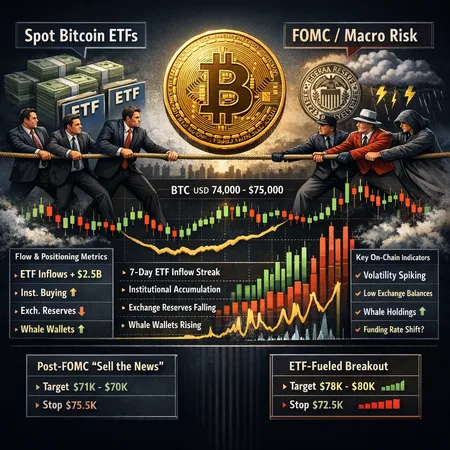
Bitcoin sits in a textbook tug-of-war. On one side, spot Bitcoin ETFs are recording a seven-day inflow streak that represents renewed institutional capital coming back into the spot market. On the other, the FOMC and its guidance on rates/liquidity creates a clear sell-the-news trigger while BTC trades around $74k–$75k. For many allocators and macro traders the question is simple: does persistent ETF demand absorb Fed-driven volatility, or will a liquidity event wipe out short-term gains and re-introduce a capitulation window?
For context, many discretionary and systematic desks now treat Bitcoin flows like any other high-conviction asset: combine flow signals with macro event risk and size accordingly. Bitlet.app users, for example, have been watching these same dynamics when balancing spot accumulation and option hedges.
What the ETF inflow streak actually means
The seven-day inflow streak reported by market trackers has two practical implications for positioning. First, multi-day inflows into spot ETFs are a direct, on-demand channel for institutional capital to convert cash into custody. Second, steady inflows reduce available free float on exchanges and raise the marginal buyer threshold that price needs to breach to trigger a fresh supply response.
Media and market analytics have highlighted this pattern: one analysis framed the run as a clear sign of institutional capital returning to Bitcoin ETFs after a period of intermittent flows, and trade desks comparing this streak to previous accumulation phases see it as a de-risked, durable demand signal (The Block, Cointelegraph).
A few caveats for allocators:
- Magnitude matters more than streaks. A seven-day streak of modest size changes the psychology; a streak of large daily inflows changes the supply/demand math. Monitor daily AUM deltas and cumulative seven- and 30-day inflows.
- ETF creation timing vs. market liquidity. Institutional ETF buying is often bucketed; when multiple desks buy on the same day, market-making flows can be lumpy and temporarily amplify volatility.
Macro backdrop: the FOMC as a volatility circuit-breaker
Price action around $74k–$75k is less an endorsement of a new bull leg than a pause — traders are flat to short gamma into the Fed. CoinDesk’s coverage shows BTC holding steady as traders grow cautious ahead of the meeting, with headlines warning that a dovish or hawkish surprise could flip the short-term narrative fast (CoinDesk: Bitcoin holds steady). Another piece captured the classic sell-the-news dynamics that often follow macro events, cautioning that rallies into Fed windows are vulnerable to quick reversals (CoinDesk: sell-the-news risk).
Why the Fed matters for BTC right now:
- Liquidity and real rates. Even without an immediate rate change, forward guidance and balance-sheet language shift dollar liquidity and nominal rate expectations — both important to risk assets.
- Volatility repricing. Option markets reprice quickly into FOMC, increasing implied vol and raising hedging costs for carry strategies.
This is a classic asymmetric risk environment: ETF flows are steady but not instantaneously deployable against a volatility shock.
Key flow and on-chain positioning indicators to watch
Here are practical metrics that should move your book:
- Spot ETF net inflows (7-day/30-day): Track absolute dollars and the share of new inflows vs. redemptions. Rising cumulative inflows tighten supply and raise the path-dependent price floor.
- Exchange BTC reserves: Declines imply less sell-side liquidity; a sharp drop means less buffer against large sell orders.
- Futures Open Interest (OI) and funding rates: Elevated OI plus positive funding suggests a long-biased futures market vulnerable to a short squeeze reversal if liquidity dries. Conversely, negative funding indicates short pressure.
- Options skew and implied vol term structure: Rising near-dated IV with a steep put skew signals fear and demand for downside protection (buying puts), which can cap rally momentum short term.
- Long-Term Holder (LTH) supply and realized profit levels: If LTHs are not selling and short-term holders are the marginal sellers, downside resilience is higher.
Combine these: strong ETF inflows + falling exchange reserves + neutral funding = structurally constructive, but the FOMC can flip the equation by causing rapid deleveraging.
Three tradeable scenarios and how to size/hedge them
Scenario A — Sell-the-news pullback (probability: material near term)
Catalyst: Hawkish Fed surprise or liquidity tightening rhetoric triggers stop cascades. Result: fast pullback to support band.
- Price path: $74k → $70k → $65k if liquidity gaps open.
- Positioning playbook:
- Tactical short via futures or inverse ETFs with tight, model-based size (e.g., initial risk-to-capital target 0.5–1% of portfolio). Keep stop-loss at break-even plus slippage threshold.
- Options hedge: buy near-dated puts (protective) or put spreads to cap cost. If delta-hedged, size to protect 2–5% portfolio drawdown depending on exposure.
- Use layered short entries on failed retests of $74k–$75k rather than all-in on a single trigger.
- Risk management: watch funding and OI; if long liquidations begin, widen stops and let smaller sizes absorb volatility.
Scenario B — Fed-driven consolidation (probability: elevated)
Catalyst: Mixed Fed language; no material liquidity shift. Result: range trade between $70k and $78k.
- Price path: choppy intraday movement with volatility spikes around headlines.
- Positioning playbook:
- Range strategies: sell premium via covered calls or short straddles with disciplined margin and buy-back rules (only for experienced options desks).
- Credit spreads: sell call spreads above $78k and put spreads below $70k to monetize elevated implied vol while capping risk.
- Tactical buying on pullbacks to the lower band, scaled and hedged with options.
- Risk management: reduce directional leverage; maintain cash buffers to add to positions after confirmed directional break.
Scenario C — ETF-fueled breakout (probability: plausible if flows accelerate)
Catalyst: Strong cumulative spot ETF inflows coupled with dovish Fed language or sticky liquidity that keeps yields subdued.
- Price path: decisive break > $78k, target $80k–$90k extension bands depending on momentum and ETF inflows continuing.
- Positioning playbook:
- Scale long spot with trailing entries on pullbacks; use laddered buys (e.g., 25% increments) rather than lump-sum.
- Use call spreads to gain upside exposure with defined cost; consider rolling into longer-dated calls as trend confirms.
- Reduce short exposure and shift hedges from put buys to call-write strategies to monetize the move.
- Risk management: rotate hedges into calendar spreads (long-dated protection) if buying aggressively; monitor ETF inflow cadence for signs of exhaustion.
Practical checklist for portfolio managers and macro traders
- Monitor seven-day and 30-day ETF inflows in real time — abrupt changes matter more than streak length.
- Watch exchange reserves and futures OI/funding every 6–12 hours into the FOMC window.
- Pre-position hedges: buy near-dated puts sized to limit portfolio drawdown to your risk tolerance; prefer put spreads if cost is a concern.
- Size directional trades to a small fraction of portfolio risk (0.5–2%), and layer entries.
- Use execution strategies that minimize market impact around ETF creation windows — block trades or algorithmic VWAP for large spot buys.
- If you run options, be mindful that implied volatility will spike into and recede after FOMC — plan gamma exposure accordingly.
Final thought — balance structural demand against event risk
The trend of institutional spot ETF accumulation is a structural tailwind for Bitcoin over the medium term. Yet the immediate path is squarely in the hands of liquidity and macro rhetoric. For allocators the pragmatic approach is a hybrid: respect ETF-driven scarcity by allocating on pullbacks, but protect those positions with event-aware hedges around FOMC windows.
This is not just theoretical: the market has behaved like this in multiple cycles — rallies driven by flow can be fragile against headline liquidity shocks. If you want a disciplined framework: quantify ETF inflows, cap directional exposure, and pre-buy protection sized to your risk budget.
Not investment advice — this analysis is intended to help institutional traders and portfolio managers frame positioning decisions during a high-conviction, high-volatility window.
Sources
- Analysis of US spot Bitcoin ETF seven-day inflows and institutional capital return — The Block
- Cointelegraph: Bitcoin ETF streak nears October run but inflows lag far behind
- CoinDesk: Bitcoin holds steady at USD74,000 as traders turn cautious before Fed meeting
- CoinDesk: Bitcoin’s rally runs into sell-the-news risk ahead of Fed decision