Solana’s Regulatory Turn: SEC Commodity Ruling, Whale Accumulation & Futures CVD
Summary
Introduction
The SEC’s decision to treat some crypto assets as commodities rather than securities has become more than a legal nuance — it’s a market mover. For SOL (Solana), the combination of clearer regulatory language, immediate ETF inflows and a visible pattern of large spot buying has created a distinct market microstructure: whale accumulation clustered at lower price bands while derivatives desks show futures selling pressure via taker CVD. For traders and on‑chain analysts, reconciling the regulatory signal with these market structure clues is essential for positioning and risk management.
For many market participants, Solana is no longer just a high‑throughput blockchain story; it is a traded asset whose outlook now depends on legal clarity, the behavior of large spot holders, and the balance between liquid supply and staking incentives.
Regulatory inflection: SEC language and immediate market reaction
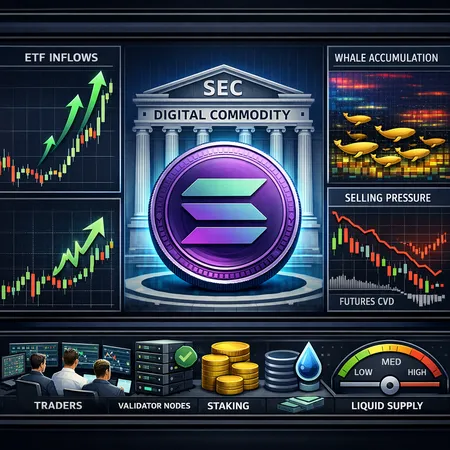
In recent commentary the SEC drew clearer lines around which tokens it views inside securities law and which sit outside it. That more explicit language — particularly naming chains like Solana in the category of non‑securities — produced an immediate market response: SOL registered a price spike and attracted renewed ETF flows as allocators re‑priced regulatory risk into the asset. Coverage of the price uptick and ETF inflows highlights the catalytic role regulatory clarity can play in reallocating capital across spot and passive products (Blockonomi report on post‑SEC price surge).
CryptoSlate’s reporting on the SEC’s redrawn rules provides useful context: the agency’s language effectively eases KYC pressure and clarifies enforcement focus on some tokens, which changes institutional comfort levels when deciding whether to allocate to chains like SOL (CryptoSlate analysis). In short: regulatory clarity lowered a major friction point for allocators, producing both headline price action and renewed interest from product flows.
On‑chain picture: whale accumulation versus futures selling
Price alone paints an incomplete picture. On‑chain cluster analysis and derivatives flow metrics reveal a more complex dynamic: selective accumulation on spot by large holders while futures takers continue to show net selling pressure. Blockonomi’s deeper dive into order‑size clusters and taker CVD documents exactly this divergence: spot order‑size clusters show accumulation at recent lower bands, but futures taker CVD—an indicator of who is initiating trades in the derivatives market—shows net selling by takers over the same period (Blockonomi on whale accumulation vs futures selling).
What the metrics mean
Whale clustering / spot order‑size clusters: these are large limit orders and executed block trades concentrated around specific price ranges. When clusters form near prior lows, it signals intentional accumulation or buy interest from entities with multi‑million dollar conviction. That tightens structural support at those levels and can reduce the pool of immediately available supply.
Futures taker CVD (cumulative volume delta): CVD aggregates who is aggressively buying or selling in the futures market. Persistent negative taker CVD means more aggressive sellers (often levered shorting or profit taking from longs) are dominating derivatives flow. That can exert downward pressure on price even while spot whales quietly accumulate.
The coexistence of these two forces is important: selective spot buying by whales can be very price‑supportive if derivatives sellers are hedged or shorter‑tenured; however, if futures selling is large and sustained, it can keep price range‑bound until leverage is flushed or hedges roll off.
Why this divergence matters for traders, validators and tokenomics
The regulatory change and the on‑chain divergence intersect with tokenomics in several ways that matter for market participants.
Liquid supply and staking dynamics: increased staking or accumulation by whales removes SOL from the liquid float. That compression can amplify price moves on inflows (for example, ETF purchases) because less available supply must be transacted to move the price. Traders should monitor staking inflows and unstake timings closely — unstaking windows create multi‑day liquidity events that can add volatility.
Staking incentives and validator economics: validators benefit from more stakes (more fees routed through the network, higher security), but extremely large concentrations of staked SOL can centralize voting power if not distributed. Validators face a balancing act: keep commissions attractive enough to earn delegation while ensuring decentralization stays intact. From a revenue perspective, higher on‑chain activity (DeFi usage, NFT drops) improves fee income, but SOL rewards alone may not offset delegation concentration risks.
Derivatives hedging and funding dynamics: when large spot buyers (whales) accumulate, they often hedge with futures or options. If hedges are placed imperfectly, persistent futures selling (negative taker CVD) can create a crowded trade on the derivatives side that eventually forces deleveraging, risking sharp short squeezes or cascade moves. Traders should watch funding rates and open interest alongside CVD to detect when dynamics may flip.
Ecosystem effects: clearer regulatory status reduces institutional friction, boosting products that increase capital demand for SOL (spot ETFs, index funds). That demand—if paired with reduced liquid supply from staking and whale accumulation—can materially change supply‑demand curves for months.
For those tracking broader market linkages, remember that activity on Solana often ties into wider DeFi flows (borrow/lend, liquid staking derivatives) and NFT liquidity events — all of which interact with token velocity and staking choices.
Practical takeaways and trade frameworks
Combine on‑chain clusters with futures CVD for entry zones: use large spot order‑size clusters as potential support targets, but size positions smaller if futures taker CVD remains strongly negative. Entry at cluster bands with tight risk controls (stop beneath the cluster) provides an asymmetric setup.
Monitor staking flows and unstake schedules: sudden increases in staking reduce tradable supply; conversely, large unstaking waves (whether from whales or exchanges) can release liquidity and pressure price. Keep an eye on delegation analytics and unbonding queues.
Watch derivatives metrics: funding rates, open interest, and taker CVD together show whether derivative sellers are likely hedged or creating naked pressure. A shift from negative to flat/positive CVD often precedes relief rallies if spot demand is present.
Consider event‑driven plays: ETF inflows, regulatory developments, major protocol updates or large NFT mints can catalyze rapid re‑pricing when supply is thin. Use defined option structures (verticals, risk reversals) to express views when directional conviction is high but tail risks remain.
Validator perspective: validators should communicate commission and performance transparently to attract balanced delegation. For large delegators, diversify across validators to reduce centralization risk.
Platforms like Bitlet.app that offer custody and trading tools can be useful for implementing strategies that span spot, staking and derivatives — but always align product usage with your risk and liquidity plans.
Sources
- https://blockonomi.com/solana-sol-gains-momentum-after-sec-declares-it-a-digital-commodity/
- https://blockonomi.com/solana-price-outlook-whale-accumulation-diverges-from-futures-selling-pressure-as-sec-grants-commodity-status/
- https://cryptoslate.com/sec-redrawn-crypto-rules-quietly-eases-kyc-pressure-on-bitcoin-xrp-and-solana/