WLFI's $5M "Super Node": How Access-for-Capital Reshapes Governance and Decentralization
Summary
What passed: the $5M "Super Node" and the lockup rule
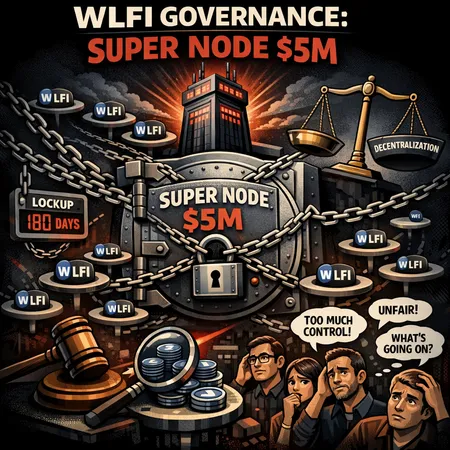
In mid‑March 2026 WLFI token holders approved a governance change that does two things: it creates an ultra‑high‑value "Super Node" access tier tied to large token lockups, and it formalizes a six‑month lockup requirement linked to voting power. Reports show the proposal passed with overwhelming support (99.12% approval) amid a heavy concentration of tokens behind major stakeholders — a detail flagged by coverage of the vote.
Under the new framework, holders who lock up roughly $5 million worth of WLFI can buy guaranteed, direct access to the core team and product decision channels: the market has dubbed these positions "Super Nodes." Multiple outlets describe the move as explicit access‑for‑capital — WLFI is effectively monetizing prioritized lines to the protocol team in exchange for large, on‑chain capital commitments (Cryptoslate covers the offering and marketing of these slots).https://cryptoslate.com/trump-backed-crypto-platform-wlfi-sells-5-million-access-while-pitching-democratized-finance
News summaries also clarify that a separate rule ties voting power gains to a six‑month lockup window, reshaping how influence over proposals is earned and retained: lock more, longer, vote stronger — at least until tokens unlock.https://www.newsbtc.com/news/wlfi-holders-face-new-6-month-lockup-rule-to-gain-voting-power/
How the access‑for‑capital model works in practice
Mechanics are straightforward but consequential:
- A holder commits WLFI tokens to a time‑locked smart contract or staking mechanism for a minimum of six months. The announced minimum for the Super Node tier is the dollar equivalent of $5 million in WLFI at the time of lockup.
- In exchange, the holder receives two benefits: (1) a labeled, privileged relationship with the team (direct meetings, privileged roadmap influence, or a fast track for proposals) and (2) boosted voting power for the duration of the lockup.
- After lockup expiration, tokens and (typically) any governance multipliers return to normal, unless the holder re‑locks.
The system is logically coherent: it channels large capital into the protocol and ties that capital to on‑chain commitment. Supporters argue this reduces short‑term speculative voting and creates a class of long‑horizon stakeholders. Detractors point out the inevitable effect: deep pockets buy faster access and outsized say while ordinary holders are left on the periphery.
Why this matters for decentralization and regulatory optics
At a governance level, decentralization is less a binary than a spectrum. This change moves WLFI toward concentrated influence in two ways: by creating explicit economic barriers to privileged access, and by linking voting power to high capital thresholds. When a small group can buy both voice and voting leverage, the network's governance becomes oligarchic in practice.
Regulatory optics complicate the picture further. Selling guaranteed access for capital blurs lines between community governance and investor rights. Regulators scrutinize whether tokens function more like securities or gatekept investment contracts when voting rights and team access are commodified. Projects that permit pay‑to‑play governance increase the likelihood of drawn regulatory attention — a risk compliance teams and boards cannot ignore.
Put simply: access‑for‑capital models may improve fundraising and align some stakeholders, but they also create clear signals that a protocol's decision‑making can be bought, which matters to users, counterparties, and regulators.
Community reaction: split, heated, and pragmatic
The reaction split into roughly three camps.
Defenders emphasize commitment: large lockups commit capital and reduce token flight risk. Some governance theorists note that requiring skin in the game can deter governance attacks and align interests around long‑term value creation.
Critics call the policy pay‑to‑play and worry about governance capture. Many on‑chain observers pointed to the vote's lopsided approval rate and the concentration of tokens behind big holders, suggesting the change entrenches existing power rather than democratizing influence — a critique echoed in contemporaneous coverage.https://www.coindesk.com/tech/2026/03/16/trump-backed-wlfi-passes-proposal-letting-usd5-million-stakers-buy-direct-access-to-team
Pragmatists focus on nuance: projects need sustainable funding and ways to lock contributors into long‑term incentives. Some argue the implementation details matter more than the headline — e.g., whether Super Nodes can transfer privileges, whether their votes are capped, and whether disclosures accompany each access sale.
The discussion has spilled into governance forums, X threads, and protocol calls. Observers from other ecosystems — including projects in the broader DeFi ecosystem — are watching closely for precedent. For many market participants, including traders who follow macro cues, Bitcoin still serves as a reminder that decentralized narratives are fragile when token economics concentrate power.
Defensive governance best practices: how to avoid capture while enabling funding
If a project is tempted by an access‑for‑capital model, here are defensive design principles to reduce centralization risk and legal exposure.
1) Cap maximal voting power
Hard caps on the percentage of total voting weight one address (or controlled cluster) can wield prevent outright capture. Combine caps with identity‑based checks where feasible.
2) Limit transferable privileges
Make Super Node benefits non‑transferable for the lockup period. If privileged access can be bought and sold, it creates a secondary market in governance influence.
3) Use vote decay and time‑weighted voting
Design multipliers to decay over time or tie them to active participation thresholds (e.g., on‑chain attendance), preventing a permanent plutocracy.
4) Consider quadratic or delegated voting hybrids
Quadratic voting dampens raw capital dominance; delegate systems with transparent delegation maps can surface where real influence lies.
5) Enforce stringent disclosure and transparency
Publish exact terms, identities (where legal), meeting minutes, and any financial arrangements connected to access. Transparent disclosure reduces the informational asymmetry that fuels capture concerns.
6) Legal and compliance review before launch
Treat access tiers as potential financial instruments. Legal teams should assess securities laws, anti‑bribery rules, and jurisdictional filing requirements. If the package looks like a promise of future returns tied to managerial activity, regulators will notice.
7) Introduce independent checks and multisig guardians
A neutral guardian committee or multisignature administrative controls can act as circuit breakers for changes that concentrate power too quickly.
8) Stake distribution and onboarding controls
Longer‑term fixes focus on tokenomics: progressive vesting schedules for large allocations, anti‑whale minting rules, and careful sequencing of token sales can reduce post‑launch concentration.
Tradeoffs and the path forward
There are tradeoffs. Projects need capital and ways to secure long‑term contributors; large lockups can deliver stability and deep alignment. But governance that looks like pay‑to‑play risks alienating users, invites regulatory scrutiny, and can damage reputations — costs that may outweigh immediate funding gains.
For token holders, governance committees, and compliance teams, the right path begins with candid risk assessment: quantify concentration, model governance scenarios, and stress‑test how privileged access might shift incentives. Transparency, caps, decay mechanics, and legal vetting are practical first steps to preserve both fundraising flexibility and decentralized legitimacy.
Platforms and market infrastructure providers — including services like Bitlet.app that monitor token mechanics and on‑chain flows — will be watching how WLFI's experiment plays out. The outcome will matter beyond a single token: it shapes expectations about what governance can be bought and how the industry balances capital with community.
Sources
- Coindesk — WLFI proposal passing and vote details: https://www.coindesk.com/tech/2026/03/16/trump-backed-wlfi-passes-proposal-letting-usd5-million-stakers-buy-direct-access-to-team
- CryptoSlate — WLFI selling $5M access while marketing democratized finance: https://cryptoslate.com/trump-backed-crypto-platform-wlfi-sells-5-million-access-while-pitching-democratized-finance/
- NewsBTC — New six‑month lockup rule and voting power implications: https://www.newsbtc.com/news/wlfi-holders-face-new-6-month-lockup-rule-to-gain-voting-power/