Solana's Liquidity Surge: Stablecoin Depth, Rising Open Interest, and the Institutional Push Toward $100
Summary
Executive snapshot
Solana has reached a new inflection point: record stablecoin liquidity and climbing open interest are changing the chain’s liquidity profile. These shifts are not purely speculative noise—custody products, institutional flows, and tighter market-making are driving structural changes that matter for allocators and DeFi strategists evaluating chain selection and liquidity risk. In this note I unpack the data, mechanics, opportunities, and key risks, and lay out what could keep institutions bullish on SOL.
What happened: record stablecoin liquidity and rising open interest
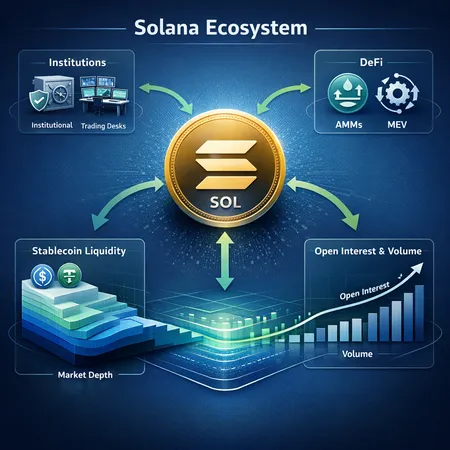
On-chain metrics show a material increase in stablecoins residing on Solana and a parallel uptick in open interest for Solana-native derivatives and perpetuals. Recent reporting highlights a spike in stablecoin liquidity and a climb in open interest that together deepen the chain’s tradable pool of capital and make larger, lower-slippage trades feasible for market makers and institutions Cryptonews report.
At the same time, institutional flows and custody offerings are increasingly visible in Solana narratives—coverage suggests allocators and prime brokers are viewing Solana as a viable institutional play as SOL approaches and tests higher price bands institutional coverage. These developments are accompanied by regulatory signals that market participants interpret as more favorable to institutional onboarding (see Sources). Together, these forces raise the probability that capital parked as stablecoins will be deployed into trading, lending, and leverage products on-chain.
Why stablecoin depth matters for markets and institutions
Stablecoin liquidity is the plumbing for day-to-day on-chain finance. Deeper stablecoin pools translate into:
- Lower slippage and tighter effective spreads on DEX swaps and OTC-like on-chain trades, making Solana more attractive for large tickets.
- Bigger base for lending markets and margin liquidity, which supports spot margin, isolated pools, and derivatives collateral.
- Higher on-chain capital available for market-making, which reduces short-term volatility and improves execution for institutional-sized orders.
From an allocator’s perspective, depth reduces transaction cost and execution risk. For market-makers and liquidity providers, it widens the opportunities for profitable quoting and inventory management.
Open interest, leverage and the derivatives layer
Rising open interest—especially in perpetual futures and margin positions—signals growing appetite for leverage on Solana. That has three practical implications:
- Price discovery and directional conviction: More open interest means more capital is taking directional risk on SOL and other tokens native to the ecosystem. That can amplify moves when positions are forced to liquidate.
- Funding-rate dynamics: Persistent long or short skews drive funding payments that affect trade profitability and hedging needs. Institutional desks will monitor funding curves closely before increasing allocation.
- Interplay with stablecoins: Stablecoins are often the principal settlement and collateral currency for these derivatives. Greater stablecoin depth lowers collateral frictions and allows larger positions to be financed on-chain.
These dynamics have helped push narratives that SOL could revisit the $100 level, as institutional entries plus easier leverage access create both flow and convexity on price.
Effects on DeFi activity, MEV, and price stability
Deeper stablecoin liquidity materially alters DeFi dynamics on Solana:
- DeFi activity: Lending, borrowing, and DEX volumes tend to rise when stablecoins are abundant. New strategies (e.g., yield conversions, vaults, and structured products) become economically viable.
- MEV (Maximal Extractable Value): More liquidity and larger on-chain trades increase arbitrage windows and the absolute dollar value available for MEV capture. That means both more arbitrage activity (which can tighten on-chain pricing) and more extractive strategies like sandwiching (which can raise execution costs for end users).
- Price stability: Net effect on volatility can be ambiguous. Greater depth generally dampens microstructure volatility because large orders are absorbed with less price movement. But if that same liquidity funds high leverage, a deleveraging event could produce outsized moves. In short: depth improves routine stability but also enables larger, system-level risk accumulation.
For institutional actors, the MEV picture is especially important. MEV extraction increases the realized cost of execution for passive counterparties and can erode strategy yield unless mitigations (private order flow, batch auctions, MEV-aware relayers) are used.
Where institutional flows and custody products fit in
Institutional adoption is not just about appetite; it's about operational plumbing. Custody, compliance, and settlement are the gatekeepers. Recent reporting highlights that custody products and institutional desks are increasingly supporting Solana exposure, which reduces onboarding friction and legitimizes larger allocations institutional flows and custody coverage.
Key institutional enablers include:
- Qualified custody providers offering segregated and insured custody for SOL and Solana stablecoins.
- Prime-broker style services and OTC liquidity that can source stablecoins on-chain without slippage.
- Derivatives venues with institutional margining and risk controls.
- Regulatory clarity or precedents that reduce legal tail risk around token classification (market participants are watching such signals closely; see discussion in Sources).
Platforms across the ecosystem—ranging from exchanges to wallet/custody vendors and services like Bitlet.app—are part of that operational layer that makes institutional flows practicable.
Key risks: concentration, contagion, and structural vulnerabilities
No liquidity regime is risk-free. The principal dangers to watch:
- Concentration risk: If stablecoin supply or market-making is dominated by a handful of market-makers, LPs, or centralized venues, a withdrawal or operational outage could produce sharp dislocations.
- Stablecoin issuer risk: Runs on a dominant stablecoin or a depegging event (on Solana or cross-chain) would rapidly reduce on-chain liquidity and stress lending books.
- Cross-chain contagion: Solana’s bridges and wrapped assets connect it to other chains. A shock elsewhere (e.g., a stablecoin event on another chain) can cascade via bridges and correlated LP positions.
- Smart contract and validator risks: Exploits, consensus-level outages, or coordinated validator behavior could freeze withdrawals or trading windows, exposing institutions to operational risk.
- MEV and front-running externalities: Higher MEV extraction can materially increase execution costs for large institutional orders and reduce realized returns if not managed.
For allocators, these are not theoretical. They translate into scenario analyses: how fast can I withdraw $100M from Solana liquidity under stress? What counterparties are responsible for custody and market-making? Where are the concentration points?
Catalysts that could sustain institutional adoption
Several durable catalysts would make the current momentum sticky rather than transient:
- Better institutional infrastructure: regulated custodians, insurance, and formal prime-broker services built for Solana markets.
- Regulatory clarity: formal guidance that reduces token-classification uncertainty and permits banks and asset managers to hold and service Solana exposure with known compliance boundaries.
- Deep, diverse market-making: a broader roster of high-quality LPs and brokers reduces counterparty concentration risk.
- Mature derivatives and risk-management tooling: robust margin engines, cross-margin solutions, and institutional interfaces for funding and clearing.
- Continued performance and reliability improvements at the protocol layer, diminishing the chance of outages or consensus-related disruptions.
Any one of these, stacked together, would materially raise the likelihood that institutions remain allocated to Solana through multiple market cycles.
Practical checklist for allocators and DeFi strategists
If you’re evaluating Solana for allocation or protocol deployment, monitor these on-chain and off-chain signals:
- Stablecoin supply and on-chain distribution on Solana (concentration by holder).
- Open interest and funding-rate curves across Solana derivatives venues.
- TVL composition and single-counterparty exposures in major lending pools.
- MEV revenue trends and the composition of MEV (arbitrage vs. sandwiching).
- Bridge flows and cross-chain wrapped stablecoin volumes.
- Custody partners’ terms, insurance, and settlement latency.
Operationally, plan withdrawal and stress scenarios, insist on counterparty transparency, and consider diversification across stablecoins and settlement rails. For DeFi strategies, design execution plans that account for MEV and use batching or private liquidity when necessary.
Bottom line
Record stablecoin liquidity and rising open interest make Solana materially more attractive for institutional-sized flows by lowering execution costs and increasing tradable capital. That improves the chain’s product-market fit for DeFi protocols and institutional desks, and helps explain bullish price narratives around SOL reaching higher price points. Yet deeper liquidity also enables leverage and concentrates risks; institutions must pair allocation with rigorous operational due diligence, concentration monitoring, and scenario planning.
For allocators assessing chain selection, the question isn’t just whether Solana has liquidity today, but whether that liquidity is resilient tomorrow. Track the metrics outlined above, validate custody and market-making counterparties, and account for MEV and contagion channels when sizing exposure.
Sources
- Cryptonews: Solana stablecoin liquidity hits record; open interest climbs — https://cryptonews.com/news/solana-stablecoin-liquidity-hits-record-open-interest-climbs/
- The Currency Analytics: Solana eyes $100 mark as institutions back blockchain play — https://thecurrencyanalytics.com/altcoins/solana-eyes-100-mark-as-institutions-back-blockchain-play-247807
- U.Today: SEC/CFTC guidance and market commentary — https://u.today/xrp-begins-era-as-commodity-under-us-laws-stuart-alderoty-reacts?utm_source=snapi