Can Public Companies Sustain a Bitcoin Treasury? Lessons from Fold (FFLD) and Evernorth’s XRPN Plan
Summary
Introduction
Public companies that convert cash flows into volatile crypto holdings face a unique collision of markets, accounting, and investor expectations. The question for corporate treasurers, CFOs, and retail investors is straightforward: can a public company sustainably pursue a Bitcoin treasury strategy without turning short-term volatility into permanent damage to equity value and credibility?
Fold’s 2025 results and Evernorth’s XRPN filing present two sharply different answers. Fold’s experience—massive headline losses amid revenue growth—serves as a cautionary tale. By contrast, Evernorth has proposed a treasury-first corporate design that makes crypto holdings the core product rather than an adjunct investment. For context, many readers will already follow Bitcoin as the primary market bellwether, but the ledger & accounting implications for public firms go well beyond price moves.
Bitlet.app’s products focus on payments and earning, not treasury-level exposures, but the mechanics discussed here are directly relevant for firms weighing larger allocations to BTC and similar assets.
Fold’s maiden-year: growth plus a $69.6M loss (what happened)
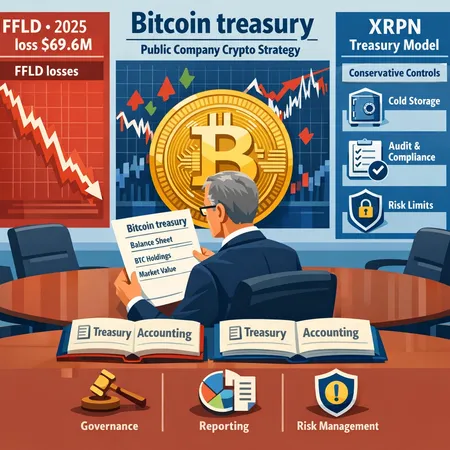
Fold’s public-year financials tell a mixed story: top-line growth accompanied by large operating losses. Reporting for 2025 flagged a $69.6 million loss in the maiden public year even as revenue expanded — a case many analysts have flagged as an example of how quickly a treasury experiment can turn into a dilutive story for shareholders. The Blockonomi write-up provides the granular recap of Fold’s figures and the market fallout, including a sharp decline in FFLD’s stock price after investors digested the scale of losses and ongoing cash burn.
Two dynamics were visible. First, Fold’s model included significant conversion of business activity into crypto exposure, which amplified balance-sheet volatility. Second, investors reacted to both cash burn and the novel risk profile—market participants are generally comfortable with conventional operating losses for growth firms, but pairing operating cash burn with meaningful exposure to BTC price swings changes investor comparables and valuation multiples.
The mechanics and accounting strains of a crypto-heavy treasury
Converting operating revenue or free cash flow into BTC is operationally straightforward (purchase, custody, repeat), but accounting and finance teams quickly run into harder problems. Volatility produces mark-to-market swings that affect income statements, equity, and key covenant metrics. Tax treatment, impairment rules, and the choice of classification under applicable accounting standards create asymmetric outcomes: some frameworks mandate impairment recognition without allowing upward revaluation, meaning large price recoveries don’t erase earlier hits to earnings.
Beyond P&L noise, there are practical frictions: liquidity management (ensuring money for capex, payroll, and debt service), custody and counterparty risk, and the cost of hedging if the firm chooses to manage exposure. The Fold example shows that even with revenue growth, the combined effect of operating losses plus crypto unrealized losses can strain balance-sheet confidence and investor patience.
Market reaction, governance and reporting obligations
When a public company takes on material crypto exposure, market reaction tends to be binary: some investors reward bold, differentiated strategy; many sell on rule-of-thumb risk aversion and uncertainty. With FFLD, stock sellers focused on the mismatch between operating volatility and treasury volatility. For boards and CFOs, that reaction is a governance warning: if treasury strategy is not part of a clear investor narrative, the market may treat crypto holdings as idiosyncratic risk rather than strategic upside.
Governance and reporting obligations expand materially. Public treasuries need: enhanced board oversight with crypto expertise, specific treasury policies (allocation limits, concentration limits by token and exchange counterparty), internal control frameworks for custody, independent audits of custodial relationships, continuous disclosure about valuation methodologies, and explicit stress-testing in quarterly reports. Regulators and auditors will expect documentation showing the rationale for holdings, how liquidity needs are prioritized, and how hedging or monetization pathways work under stress scenarios.
Disclosure is not just a compliance checkbox—it's a reputational line. Market participants watch 10-Qs and investor presentations for the treatment of crypto assets, and inconsistent or vague reporting can exacerbate sell-side skepticism. FFLD’s steep headline losses and subsequent stock slump underline why transparent, conservative disclosure is critical before scaling up a crypto treasury.
Evernorth’s XRPN plan: a contrasting corporate design
Evernorth’s S-4 and Nasdaq-related filings, and reporting covered in the press, outline a markedly different approach: the company proposes a treasury model where token holdings (XRPN in press coverage) are central to the business case and investor expectations. Coinpaper’s write-up on Evernorth highlights a $1 billion XRPN treasury proposal tied to a Nasdaq debut, and additional analysis discusses how the company frames its regulatory and accounting stance to make token holdings a core product.
A complementary analysis points out that Evernorth explicitly structured parts of its filing to highlight the regulatory characterization of the token as a commodity, which affects both investor perception and compliance pathways. See the Blockonomi piece that examines Evernorth’s S-4 and the regulatory framing used to argue for commodity-like treatment. That framing matters: a firm that is designed as a token-native treasury business sets different governance rules, investor-return expectations, and disclosure regimes from an operating company that incidentally holds crypto.
Comparing Evernorth to Fold is instructive. Fold appears to have been primarily an operating company (payments/rewards) that accumulated BTC exposure as an adjunct — a strategic tilt that surprised some investors when losses mounted. Evernorth proposes to be a treasury-first vehicle, which means shareholders buy exposure deliberately and the company’s valuation and reporting conventions can be aligned to that purpose from day one.
Practical steps before adopting a large crypto treasury
If your board or CFO is considering a material BTC allocation, follow a staged, conservative process.
- Define the business case. Be explicit whether crypto is a strategic asset for product/market fit or a financial investment. This determines investor messaging and comparable peers. 2) Limit size and set triggers. Start with caps (e.g., percent of cash, percent of market cap), and set automatic rebalancing or profit-taking rules tied to price moves. 3) Accounting & tax planning. Engage external auditors and tax counsel to document treatment, impairment rules, realized/unrealized gain reporting, and deferred tax impacts. 4) Liquidity and covenant modeling. Stress-test cash flows and loan covenants under severe crypto drawdowns to avoid covenant breach surprises. 5) Custody, insurance, and counterparty risk. Choose institutional custodians, segregated accounts, and consider insurance overlays for theft or operational loss. 6) Hedging and optionality. Evaluate listed futures, OTC swaps, or options to manage downside; hedging introduces basis risk and margin requirements that must be modeled. 7) Governance and disclosure. Update committee charters, add crypto expertise to the board/advisory, and bake clear disclosures into investor communications and 10-Q/10-K language. 8) Investor education. Treat major allocations as strategic changes that require proactive investor outreach—don’t let the market discover it in a footnote.
Taken together, these steps reduce the chance that headline unrealized losses overwhelm the business story. They also make the treasury strategy auditable and repeatable: two qualities capital markets reward.
So, is a Bitcoin treasury sustainable for public companies?
Short answer: sometimes. Long answer: sustainability depends on intent, design, and execution. A company that treats BTC as a strategic product or a core treasury asset (the Evernorth-style model) can align governance, disclosure, and investor expectations up-front. A traditional operating company that accumulates large BTC positions without changing investor messaging or governance risks the type of market backlash Fold experienced.
Sustainability requires (a) a clear narrative that investors can price, (b) conservative sizing and contingency liquidity, (c) robust accounting and tax planning, (d) institutional custody and insurance, and (e) continuous disclosure and scenario planning. Without these, even a rising BTC market can create a fragile perception that collapses on volatility.
For treasurers and CFOs, the actionable takeaway is pragmatic: you can build a viable BTC treasury, but do it with the same rigor you apply to FX, interest-rate, and commodity exposures. That means process, limits, auditability, and transparent communication. If you want more operationally focused tools or custodial pathways, platforms like Bitlet.app illustrate how consumer and payment use cases connect to broader crypto liquidity—but don’t substitute for treasury-level governance.
Conclusion
Fold’s $69.6M maiden-year loss is a real-world caution: converting operating momentum into balance-sheet crypto exposure can amplify downside in ways that rattle investors and management. Conversely, Evernorth’s XRPN filing demonstrates an alternative route: be a treasury-first entity so investor expectations and regulatory framing match the risk profile. For corporate leaders, the decision to build a Bitcoin treasury should be deliberate, governed, and sized to survive the inevitable crypto cycles.
Sources
- Fold’s maiden-year results and analysis: Blockonomi — Fold FFLD loses nearly $70M in maiden year
- Evernorth Nasdaq filing and $1B XRPN proposal: Coinpaper — Evernorth eyes blockbuster Nasdaq debut
- Evernorth S-4 and regulatory framing on XRP: Blockonomi — XRP token Evernorth’s Nasdaq SPAC merger targets $1 billion