Boltz’s Non‑Custodial USDT Swaps: Bridging Lightning and Stablecoins for Instant BTC Liquidity
Summary
Why Boltz’s USDT swaps matter now
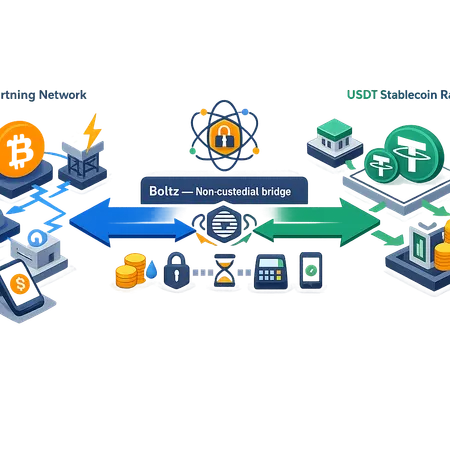
Bitcoin liquidity often sits split: BTC on Lightning for instant settlement and USDT on token rails for dollar liquidity and DeFi access. Boltz’s announcement of non‑custodial USDT swaps creates a bridge that lets a Lightning payment be atomically converted into USDT on another chain without an intermediary custody step, which matters for instant on/off ramps, merchant settlement, and smoother DeFi onboarding for BTC holders. The product launch is detailed in Boltz’s announcement and gives a clear signal that cross‑chain, non‑custodial plumbing is moving beyond simple BTC↔BTC Lightning swaps into token rails like USDT.
For product managers evaluating next‑gen on/off ramp rails, this is not just a novelty: it changes the UX baseline for how BTC users access dollar liquidity and how merchants can settle. For broader context on how fiat rails and on‑ramps remain ambiguous in practice, consider the ongoing discussions around services like Hyperliquid and their fiat access model, which illustrates why a non‑custodial, chain‑native swap option can reduce dependency on third‑party rails.
High‑level architecture: how a non‑custodial USDT swap works
At a conceptual level, Boltz’s model ties together three primitives:
- A Lightning invoice / HTLC on the Bitcoin/Lightning side.
- A hash‑locked or otherwise conditional transfer on the USDT token rail (ERC‑20, TRC20, etc.).
- A coordinated reveal of the secret (preimage) that makes both legs claimable in a limited time window.
The simplest pattern resembles a cross‑chain atomic swap: a secret x is created and its hash H = hash(x) is used to lock funds on both sides. When the Lightning payment executes, the recipient learns x and can use it to unlock the USDT payment on the token rail (or vice versa, depending on swap direction). Because the swap is constructed so each leg can only be claimed with the same preimage, neither party must hand custody to the counterparty at any time — the system is non‑custodial.
Technically this is implemented with a combination of Lightning HTLC semantics and on‑chain token locking. In practice there are multiple implementation patterns worth knowing:
HTLC‑based flow: a Lightning invoice encodes an HTLC conditioned on H. Separately, an on‑chain contract (or a custodial‑like aggregator using a hashlock) holds USDT conditioned on the same H. When the Lightning payment succeeds, the revealed preimage is used to claim USDT.
Adaptor‑signature flow: emerging workflows use Schnorr adaptor signatures (when available) to create atomicity without script‑heavy on‑chain contracts. Adaptor signatures can make swaps lighter on‑chain by embedding the secret in signature data rather than explicit hashlock contracts.
Service orchestration: an operator publishes swap offers and coordinates timing, fees, and settlement. Boltz operates as an orchestrator without custodial control over the funds if the swap primitives are implemented correctly.
Each approach has different tradeoffs around on‑chain costs, timelocks, and compatibility with token rails (ERC‑20 vs TRC20 vs Omni).
Cross‑chain settlement nuances
Stablecoins like USDT exist on multiple chains with different fee and finality characteristics. An ERC‑20 USDT lock will have different gas, confirmation time and reorg risk compared with TRC20. That means swap parameters (timelocks, refund windows, and fee allowances) must be tuned per rail. Boltz’s production service must therefore:
- Detect and adapt to the target USDT chain’s average finality time.
- Set appropriate hashing/time parameters so a Lightning HTLC doesn’t expire prematurely.
- Offer liquidity across multiple rails to give users routing and cost choices.
Lightning channel mechanics and liquidity requirements
Lightning is fast, but it’s directional: sending a payment requires outbound channel capacity at the payer’s side, while receiving requires inbound capacity. For a smooth user experience in swaps this matters twofold:
If a user wants to swap BTC (on Lightning) for USDT, their wallet must be able to route the outbound payment to the swap service. Failures in route finding or insufficient capacity cause user‑facing swap failures.
On the flip side, if a user receives BTC from a USDT→BTC swap, the service needs inbound capacity to route that BTC into the user’s wallet.
To address these constraints, swap providers rely on liquidity providers (LPs) and Lightning Service Providers (LSPs) to maintain routable capacity. In practice that means:
- LPs (or the swap operator) front liquidity so swaps can proceed quickly; they may rebalance channels using circular rebalancing, swaps for liquidity, or on‑chain interactions.
- Fees and incentives need to be set so LPs are compensated for routing risk, capital lockup and on‑chain costs.
If LPs don’t exist at adequate scale, swaps will either be slow or fail frequently — a key adoption barrier discussed below.
Use cases: who benefits and how
Instant BTC on/off ramps: convert Lightning BTC into USDT on a preferred chain and move that USDT into stablecoin rails or CeFi/DeFi. Compared to waiting for a BTC on‑chain confirmation and a custodial exchange, this is much faster.
Lightning‑native merchant settlement: merchants can accept Lightning payments and immediately receive USDT liquidity for payroll or treasury, removing BTC price exposure if desired.
DeFi onboarding for BTC holders: users who hold BTC but want to interact with token rails (AMMs, lending, yield) gain a non‑custodial path to USDT without needing centralized exchanges.
Atomic liquidity routing: protocols that want to stitch Lightning payments into cross‑chain rails (for example, pay in BTC, settle in USDT into a DeFi contract) can leverage swaps as building blocks.
These flows reduce friction for BTC users entering the token economy and create new product possibilities for wallets and merchant processors. Integrations with wallets and services (for example Bitlet.app) can further reduce the UX gap between Lightning and token rails.
Security and UX tradeoffs
Non‑custodial is desirable for custody risk, but it introduces complexity:
Timeouts and refunds: every swap needs conservative timelocks. Too short and parties risk losing funds to claim races; too long and funds are locked unnecessarily, hurting liquidity.
Route fragility: Lightning routing can fail due to insufficient capacity or dynamic fee changes. Good UX requires retry strategies, fee bumping and clear error messaging.
Chain‑specific risks: ERC‑20 approvals, smart contract bugs (if a locking contract is used), or token‑bridge oddities increase attack surface. Multi‑rail support multiplies the security matrix.
Privacy and metadata leakage: revealing preimages or interacting with on‑chain token transfers can create linkability between a user’s Lightning activity and their on‑chain token flows.
Finality asymmetry: Lightning payments are near‑instant final in normal operation, while some token rails have slower confirmations or potential reorg risk. The swap design must protect both parties using appropriate timeout sequencing.
From a UX perspective, non‑custodial swaps are inherently more complex than handing funds to a custodian and waiting. Users need wallets that can manage channel state, show expected wait times, and clearly explain refund windows. That said, the custody benefit is often worth the extra UI complexity for privacy‑conscious or security‑oriented users.
Adoption barriers — liquidity, fees and regulatory friction
- Liquidity providers and capital efficiency
A functioning swap market needs LPs with capital across Lightning and stablecoin rails. LPs face slippage, on‑chain fees for rebalance, and opportunity cost of locked capital. Incentive design (fee splits, market making rewards) will determine whether LPs provide enduring capacity.
- Fee economics
Swaps have multiple fee components: Lightning routing fees, swap operator fees, and token transfer gas or chain fees. For small amounts this can make swaps uneconomic unless the provider optimizes across rails (e.g., offering TRC20 USDT for low fees).
- Regulatory and KYC considerations
Even if a swap is technically non‑custodial, real‑world deployments sit inside legal jurisdictions. Operators or LPs that provide fiat rails or move funds into exchanges may face KYC/AML obligations. The Hyperliquid discussion about fiat access demonstrates how unclear rails (third‑party on‑ramps vs native rails) complicate compliance expectations and user privacy. In short, a technically non‑custodial bridge does not fully remove regulatory touchpoints if fiat conversion or centralized counterparties are involved.
- Stablecoin & issuer risk
USDT is issued by a centralized entity; counterparty and redemption risk remains. Product teams must weigh issuer risk and possibly support multiple stablecoins to mitigate concentration.
- Wallet and merchant integration complexity
For broad adoption, wallets must integrate swap flows seamlessly: preflight checks for channel capacity, liquidity route selection, and graceful fallbacks. Merchant stacks also need to handle settlement choices and optional reconciliation requirements.
Practical checklist for product managers and dev teams
- Define supported rails: which USDT networks will you support (ERC‑20, TRC20, others), and what are the fee/finality tradeoffs for each?
- Liquidity planning: model expected swap volumes, required LP capital, and rebalance frequency. Simulate worst‑case scenarios (routing failures, channel exhaustion).
- Security model: decide whether your swaps use on‑chain hashlock contracts, adaptor signatures, or a hybrid. Audit any smart contracts and test cross‑chain timeout sequences.
- UX flows: provide clear preflight diagnostics (channel capacity, estimated fees, refund windows) and build retry/fallback mechanisms.
- Compliance posture: map where your service touches fiat rails or custodial exchanges and plan KYC/AML flows accordingly. The Hyperliquid case shows ambiguity in on‑ramp design is costly.
- Monitoring & observability: track swap success rate, average settlement time per rail, LP utilization, and reorg/retry incidents.
- Partner integrations: collaborate with Lightning LSPs, wallet teams, and merchant processors. Consider offering developer APIs and SDKs for easy integration.
Where this fits into the broader ecosystem
Non‑custodial USDT swaps are a piece in the larger puzzle of connecting Bitcoin liquidity to token rails and DeFi. For many traders and builders, Bitcoin remains the primary bellwether — but access to tokenized dollars and DeFi composability is where many use cases live today. Bridges like Boltz reduce the friction between those worlds without forcing a centralized exchange hop.
However, these technical bridges do not magically remove regulatory or liquidity challenges. Operators must balance non‑custodial design with pragmatic integrations to fiat rails and custodial counterparties when necessary.
Conclusion — should your product team care?
If your roadmap includes instant settlement, merchant settlement options, or deeper paths for BTC users into tokenized money and DeFi, Boltz‑style non‑custodial USDT swaps deserve serious attention. They offer a way to convert Lightning payments into stablecoin liquidity quickly and without handing custody to a third party, but they also require investments in liquidity, UX, and compliance.
For technical PMs and dev‑savvy teams, the right next step is to prototype flows with targeted rails (choose one low‑fee stablecoin network first), instrument liquidity metrics, and evaluate LP economics. Given the continued ambiguity in on‑ramp design (fiat vs native rails), a non‑custodial swap layer can become a neutral plumbing piece that interfaces with custody, KYC, and fiat partners as needed.
Sources