Bitcoin vs Gold: How the 2026 Market Stress Rewrote Safe‑Haven Playbooks

Summary
Executive summary
The latest market stress in early 2026 produced a notable reallocation inside risk assets: gold rallied for six months, attracting capital that had previously been bullish on crypto. Analysts flagged structural similarities with the 2019 pre‑bull build for gold, while Bitcoin (BTC) saw meaningful short‑term pain and ETF outflows. This article unpacks the macro drivers behind the rotation, compares the dynamics to 2019, and provides portfolio frameworks — with concrete allocation approaches — for macro investors and wealth managers tasked with balancing BTC and precious metals exposure.
What happened: gold’s six‑month rally versus Bitcoin
From a flow perspective, the narrative is straightforward: as macro headlines intensified — real rates, tightening liquidity, and geopolitical shocks — many investors shifted toward perceived safe havens. CoinDesk’s analysis charts a six‑month gold rally that, in structure if not scale, resembles how gold behaved before its 2019 acceleration. The pattern was a steady accumulation phase driven by risk‑aversion, not just a single headline spike (CoinDesk analysis).
Bitcoin’s path diverged. U.S.-listed spot BTC and ETH ETFs recorded heavy outflows in a single day, bleeding nearly USD 1 billion according to reporting that tracked those flows. Sudden ETF redemptions amplify intraday selling pressure and can force deleveraging among traders holding leveraged exposures to BTC (Coindesk report on ETF outflows). The result: elevated volatility and a short‑term reassessment of BTC’s role as a portfolio hedge.
Why some investors rotated to gold
Several proximate and structural drivers explain the rotation:
Real yields and central bank messaging: when real yields rise or appear likely to rise, gold can benefit as investors anticipate currency and liquidity squeezes. The gold rally reflected not only fear but also tactical positioning against rising nominal and real yields in some jurisdictions.
Flight‑to‑quality amid geopolitical stress: unlike many crypto assets, gold retains deep liquidity in crisis moments. That liquidity premium matters to allocators managing downside risk.
Institutional flow mechanics: ETFs and asset managers often have mandate‑driven rules. When volatility spikes, rebalancing and liquidity-driven flows favor assets with established institutional plumbing. Meanwhile, BTC ETF outflows can temporarily depress price because of redemption mechanics and concentrated liquidity pools (see the ETF outflow coverage) (ETF outflows reporting).
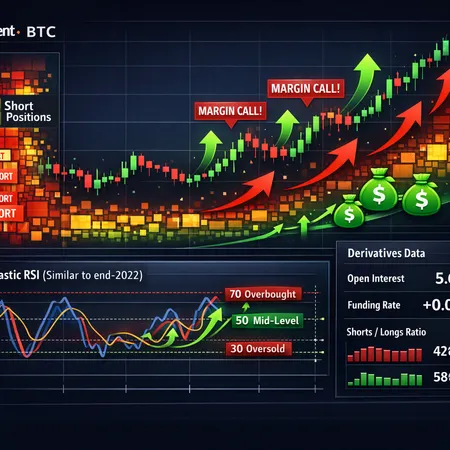
Market structure and leverage: crypto derivatives and margin desks can transmit stress quickly. coinspeaker’s review of the selloff highlighted how a cascade of liquidations and macro headlines reignited the Bitcoin‑vs‑gold debate, with 275k traders reportedly affected in short windows (Coinspeaker analysis).
These drivers don’t mean gold is superior to BTC for every objective — they simply explain why, in periods of acute stress, some capital has preferred the traditional safe‑haven route.
Historical parallels to 2019 — how useful is the comparison?
The analogy to 2019 is instructive but imperfect. In both episodes, gold benefited from a multi‑month positioning phase as macro crosswinds mounted. The similarity lies in momentum built through steady buying and narrative reinforcement — not one‑day fireworks. However, the market structure backdrop differs: crypto today is more institutionalized, with spot ETFs, larger derivatives volumes, and a deeper retail base than in 2019. That means the transmission of stress can be faster and flows more mechanical.
Put another way: 2019 shows how a slow, narrative‑driven gold rally can morph into broad market leadership. 2026 shows the converse — institutional products can accelerate rotational moves in either direction because the plumbing (ETFs, futures, OTC desks) is now more interconnected across asset classes.
Portfolio allocation frameworks: practical options for 2026
For macro investors and wealth managers, the question is not choosing a winner but how much to allocate to each asset class given objectives, constraints, and risk tolerance. Below are pragmatic frameworks, followed by example allocations.
1) Core‑satellite (recommended for wealth managers)
- Core (70–90%): Traditional ballast — equities, bonds, and a small allocation to gold (2–8%) as a macro hedge.
- Satellite (10–30%): High‑conviction plays including BTC (1–5% for conservative clients; 5–15% for growth‑oriented clients) and selective alternatives (real assets, strategic private exposures).
Rationale: keep gold as a stable hedging core while using BTC in the satellite to capture asymmetric upside. Rebalance quarterly or on policy drift >20%.
2) Risk‑parity adjusted (for systematic macro funds)
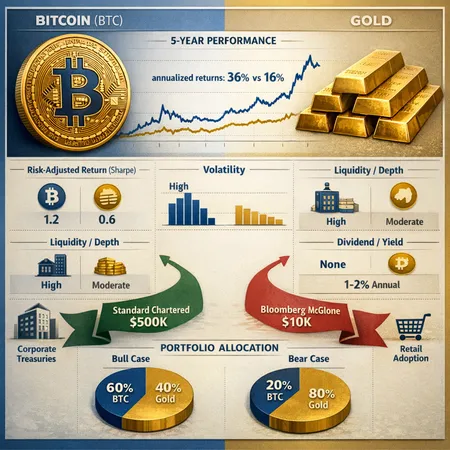
- Instead of fixed nominal weights, allocate to equalize volatility contribution. Given BTC’s 3–6x higher volatility than gold historically, its nominal weight would be much smaller to reach parity (e.g., 0.5–2% BTC, 4–10% gold depending on targets).
Rationale: preserves tail exposure to BTC without letting its variance dominate portfolio risk.
3) Constant‑mix tactical banding (tactical macro shops)
- Define bands: gold 3–12%, BTC 0–8%. When market stress increases and gold exceeds upper band, trim; when BTC falls below lower band, consider adding if conviction on long‑term thesis remains.
Rationale: enforces discipline, captures mean reversion, and institutionalizes risk management.
4) Glidepath / lifecycle approach (retail & end‑clients)
- Younger/high‑risk clients: BTC 5–8%, gold 2–4%.
- Mid‑career: BTC 2–5%, gold 3–6%.
- Near retirement: BTC 0–2%, gold 5–10%.
Rationale: shifts from growth to capital preservation as the time horizon shortens.
Implementation considerations: custody, liquidity and rebalancing
- Custody choices: For BTC, evaluate regulated custodians, insured cold storage, or ETF wrappers. For gold, compare allocated vs unallocated storage, sovereign gold bonds, or ETFs.
- Liquidity needs: gold markets are deep globally; BTC liquidity can vary across venues and deteriorate in stress. Include liquidity buffers if short notice redemptions are possible.
- Rebalancing cadence: quarterly rebalancing works for most allocators. In highly active mandates, monthly rebalance or volatility‑targeted triggers may be warranted.
- Risk budgeting: set a clear drawdown tolerance for the combined gold + BTC sleeve. Use stress tests that include simultaneous equity drawdowns and idiosyncratic crypto shocks.
A practical note: if managers use crypto services for client exposure, platforms like Bitlet.app illustrate how installment and P2P mechanisms can change retail access — but professional mandates should stick with institutional custody and audited product wrappers.
Correlation, diversification and the safe‑haven question
Bitcoin’s long‑term correlation to equities has fluctuated; during recent stress its correlation to risk assets increased, undermining claims of a steady negative correlation to equities or a gold‑like safe haven. Gold’s correlation to equities tends to be lower or negative in acute stress episodes, which explains its appeal during the six‑month rally.
Diversification is not simply adding assets but adding uncorrelated sources of returns. In many scenarios an allocation of small but meaningful BTC plus a modest gold position improves the portfolio’s return distribution versus either asset alone — provided rebalancing and risk controls are in place.
Example allocations (illustrative)
- Conservative macro mandate: Equities 40%, Bonds 45%, Gold 8%, BTC 1–2%.
- Balanced institutional mandate: Equities 55%, Bonds 30%, Gold 6%, BTC 3–4%.
- Aggressive growth mandate: Equities 60%, Alternatives 20% (incl. real assets), Gold 4%, BTC 6–8%.
Each example assumes active risk monitoring and a policy for rebalancing and liquidity.
Implementation checklist for wealth managers
- Define policy weights and risk budget for gold and BTC.
- Choose custody and product wrappers aligned with client fiduciary duties.
- Set rebalance rules and stress scenarios that include ETF outflows and derivative liquidation events (refer to recent ETF outflow dynamics).
- Communicate conviction and downside pathways to clients — explain why a small BTC exposure can coexist with a larger gold hedge.
Conclusion
The 2026 market stress underscored a simple truth: safe‑haven narratives evolve. Gold’s six‑month rally resembled prior positioning phases and benefited from liquidity and mandate structures. Bitcoin’s selloff and ETF outflows exposed the speed at which crypto flows can unwind.
For macro investors and wealth managers the practical takeaway is not binary choice but calibrated inclusion. Use a clear allocation framework, be explicit about rebalancing and liquidity, and treat BTC and gold as complementary tools — one providing deep, time‑tested crisis liquidity, the other offering asymmetric growth potential with a distinct risk profile.
Sources
- CoinDesk — Gold’s six‑month rally and parallels to 2019: https://www.coindesk.com/markets/2026/01/30/gold-s-six-month-rally-versus-bitcoin-shows-similarities-to-the-2019-cycle
- Coinspeaker — Crypto selloff explained and Bitcoin vs gold debate: https://www.coinspeaker.com/crypto-selloff-explained-bitcoin-vs-gold-and-275k-traders-affected/
- CoinDesk — U.S.-listed Bitcoin & Ether ETFs outflows: https://www.coindesk.com/markets/2026/01/30/u-s-listed-bitcoin-ether-etfs-bleed-nearly-usd1-billion-in-one-day
For broader context on digital asset markets and portfolio construction, many allocators are also watching developments in NFTs and DeFi activity and evaluating narratives around Bitcoin as part of multi‑asset allocations.