Why Chainlink’s Push into KRW Stablecoins Could Raise Oracle Demand and Support LINK
Summary
Executive overview
Institutional stablecoins change the game for oracles. When national or bank‑backed digital currencies are developed, the technical and compliance bar for data, proofs, and attestation rises sharply. That’s why Chainlink Labs’ decision to join a Korean KRW stablecoin alliance matters: it signals that a market leader in decentralized oracles is positioning to supply the exact services regulators and enterprises require. For product leads and on‑chain infrastructure investors — including teams at platforms like Bitlet.app — this creates a clearer line-of-sight from real‑world adoption to increased oracle demand and, by extension, token utility for LINK.
What institutional stablecoin standards actually need from oracles
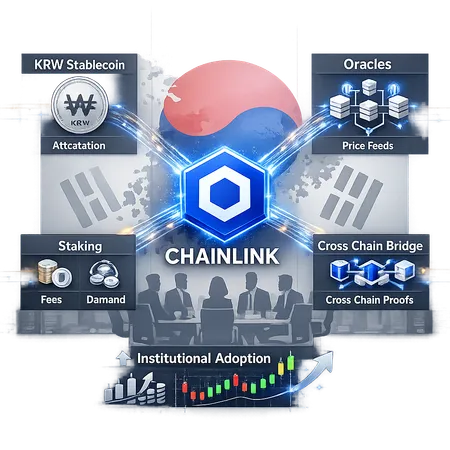
Institutions building stablecoins — whether fiat‑backed, hybrid, or algorithmic with regulated reserves — rely on oracles for three core capabilities:
1) Robust price feeds and reference data
Institutional issuers require high‑assurance price feeds for collateral valuation, rebalancing, liquidations, and accounting. That means low‑latency, tamper‑resistant inputs with multi‑source aggregation, provenance, and monitoring. Simple single‑source APIs aren’t acceptable; enterprise flows need signed, auditable price attestations and fallback logic.
2) Attestation and auditability
Regulated stablecoins need verifiable attestations of reserve status, mint/burn events, and compliance signals (e.g., KYC/AML proofs). Oracles must provide cryptographic attestations — signed statements that can be independently verified on‑chain and off‑chain — and integrate with auditor workflows so on‑demand proofs satisfy regulators.
3) Cross‑chain proofs and interoperability
Modern stablecoins rarely live on a single chain forever. Issuers need secure cross‑chain proofs (light clients, Merkle proofs, or interoperable messaging) so a reserve attestation on one network is trusted on another. This multiplies oracle complexity: it’s not just price delivery, it’s secure message relay with finality guarantees.
Taken together, these requirements favor mature oracle architectures with proven decentralization, SLAs, and cryptographic attestation features — capabilities Chainlink emphasizes in its enterprise offerings.
Why Chainlink Labs joining a KRW stablecoin alliance is strategically significant
Blockonomi covered Chainlink Labs’ entry into a Korea‑led KRW stablecoin alliance, aimed at advancing local digital asset standards and infrastructure. This move has several pragmatic implications:
- It shortens enterprise sales cycles. Being part of a standards body places Chainlink at the table when protocol specs and compliance checklists are written, increasing the chance Chainlink tech becomes a normative requirement.
- It showcases enterprise readiness. Active participation signals that Chainlink’s tooling (price feeds, verifiable randomness, cross‑chain proofs, attestations) is considered production‑grade by regional stakeholders. See coverage of the announcement here: Chainlink Labs joins KRW stablecoin alliance.
- It drives network effects. If Korean banks or fintechs standardize around Chainlink primitives, downstream DeFi and custodial services will prefer integrations that already meet local regulatory expectations.
For those watching enterprise adoption, this is more than PR: it’s a route to predictable oracle demand from regulated mint/burn and attestation flows.
On‑chain signals that support a LINK rebound thesis
A speculative view needs empirical signals. Several on‑chain indicators and market observations point toward rising interest in LINK earnings and scarcity dynamics:
- Rising oracle request counts and node revenue. Increased usage of Chainlink’s oracle services — measured by request counts and node payments — translates into recurring demand. Higher on‑chain request throughput often precedes fee growth that benefits node operators and, indirectly, token holders.
- Accumulation and exchange flows. Lower exchange reserves and healthy accumulation by long‑term wallets can indicate reduced selling pressure. Historic rebounds in LINK have often followed similar balance dynamics.
- Staking and collateral demand. As institutional users ask for staked‑security guarantees, staking models (where LINK is posted as collateral or insurance) create locked demand. Coinspeaker highlights technical and market reasons analysts expect LINK to rebound; those include accumulation, technical patterns, and improving fundamentals (Coinspeaker analysis).
- Integration velocity. New partnerships, like the KRW initiative, are leading indicators for future oracle call growth. Each stablecoin deployment requires continuous attestations, price oracles, and cross‑chain proofs — all recurring revenue sources for oracle providers.
These signals aren’t guarantees, but they form a coherent narrative: enterprise activity begets oracle usage, which tightens token economics when usage models require LINK collateral or fee settlement.
Technical and demand‑side implications for LINK token economics
How does greater oracle usage translate into token demand? There are several mechanisms to consider:
Demand channels
- Fee denominated in LINK: If oracle requests are paid in LINK (or node operators prefer LINK settlement), more usage directly increases token velocity into operational hands.
- Staking/collateral needs: Enterprise SLAs may require node operators or relayers to stake LINK as collateral for performance guarantees. This withdraws LINK from liquid supply and raises the cost of running an attack or misbehavior.
- Long‑term reserves for auditors/custodians: Stablecoin custodians and auditors may choose to hold LINK as part of integrated tooling or to participate in governance, increasing non‑circulating balances.
Supply dynamics
- Lockups and vesting from enterprise integrations can reduce effective circulating supply. If institutional deals involve multi‑year commitments with collateralized LINK, the open market float tightens.
- Buyback or burn models (if any are adopted by services that monetize oracle fees) could further reduce supply, but those are speculative and depend on individual service economics.
Elasticity and price sensitivity
Token price sensitivity will depend on how much of the oracle economic loop requires LINK specifically versus fiat or other tokens. The more the industry standardizes on LINK for settlement, staking, or attestation, the more direct the link between usage growth and token scarcity/valuation.
Short‑term and medium‑term catalysts for LINK price appreciation
Short‑term (weeks to months)
- KRW stablecoin pilots and announcements. Public trials or pilot launches in Korea that name Chainlink as a provider would be immediate demand signals.
- On‑chain usage spikes. Noticeable increases in oracle request volumes, node revenues, or LINK transfers to staking/lock contracts can act as short‑term bullish data points.
- Market technicals and accumulation. If exchange outflows continue and large holders accumulate, price momentum can follow.
Medium‑term (3–18 months)
- Enterprise rollouts and regulatory acceptance. As corporate and banking partners deploy production stablecoins with Chainlink attestations, predictable recurring demand will develop.
- Staking maturity and collateralization frameworks. If staking is widely adopted as the canonical security model for oracles, LINK demand for collateral will become structural.
- Cross‑chain adoption. As more networks require secure cross‑chain proofs, Chainlink’s interoperability tooling could broaden its footprint, increasing total oracle calls.
These catalysts combine product adoption, macro market conditions, and protocol economics. The highest‑conviction scenario is one where regulated stablecoin issuance, by design, requires decentralized attestations and cross‑chain proofs that favor Chainlink’s feature set.
Risks and counterarguments
- Competition and vendor lock‑in. Other oracle providers (or bespoke bank solutions) could gain traction if they offer lower cost or tighter integration with legacy systems. Institutional partnerships don’t automatically translate to market dominance.
- Centralized designs. Some national stablecoins could choose highly centralized attestations that rely on banks’ own signing infrastructure, reducing third‑party oracle demand.
- Regulatory headwinds. Changes in token regulation or restrictions on tokenized collateral could complicate LINK‑denominated models.
- Overhang from vesting/treasury flows. Large team or treasury unlocks can reintroduce supply, muting scarcity benefits.
Balancing the bullish indicators with these risks is essential for any investor or product lead building an oracle adoption thesis.
Practical signals to watch for product leads and infrastructure investors
- Formal mentions of Chainlink in stablecoin technical specs or pilot documentation (e.g., KRW alliance minutes or RFCs).
- Oracle request and node payout dashboards showing month‑over‑month growth.
- Exchange reserve charts for LINK and concentration metrics for large wallets.
- Announcements of staking product rollouts or collateral requirements in enterprise SLAs.
For teams evaluating oracle integrations — whether for DeFi rails or fiat rails — these signals help differentiate marketing noise from structural adoption. See more on oracle use cases in DeFi and why enterprises gravitate toward secure, auditable feeds from Chainlink.
Conclusion
Chainlink’s participation in a KRW stablecoin alliance is a concrete example of how enterprise standards and regulatory conversations can pull decentralized infrastructure into mainstream financial rails. Institutional stablecoins need high‑assurance price feeds, cryptographic attestation, and secure cross‑chain proofs — all services oracles provide. If these projects standardize around Chainlink primitives, on‑chain demand for LINK via fees, staking, and collateralization could become a material token‑economic driver. That said, competition, centralized alternatives, and regulatory shifts remain real risks. For investors and product leads, the right approach is to watch on‑chain usage metrics, enterprise pilot updates, and staking adoption as the primary signals that oracle usage — and LINK demand — is genuinely expanding.