XRP Microstructure & Near-Term Outlook: Liquidity, Volume Crash, and Trade Plans
Summary
Why microstructure matters for XRP now
Active traders know that what lives under the hood — custodial concentration, orderbook depth, and real trading volume — often matters more than headlines. This analysis focuses on structural liquidity in XRP, explaining how large custodial balances on a few exchanges create a market that looks liquid on aggregated charts but can be shallow at execution depth. For context, many market participants still consider XRP a mid‑cap, market‑structure play rather than purely a narrative asset, so microstructure signals deserve prime attention when sizing exposure.
Exchange concentration: the data and the implications
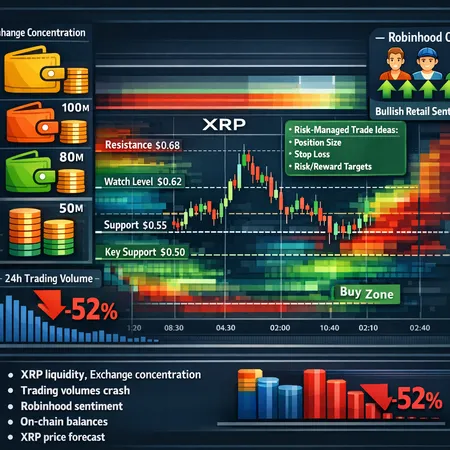
On‑chain and custodial analytics show that a handful of accounts control large XRP balances. Recent reporting highlights that Bithumb, Binance and Uphold hold some of the largest XRP accounts, a concentration that raises two practical issues for traders. First, when a major custodial account moves funds off‑exchange or between wallets, the visible supply in exchange orderbooks can evaporate quickly; second, large custodial balances increase the potential for outsized, exchange‑level flows that create transient liquidity vacuums. See the concentration piece for the raw accounts and distribution details: Bithumb, Binance and Uphold dominate XRP holdings.
From a risk lens, concentrated custodial balances are not proof of manipulation, but they are an amplifier: if one of those custodians executes a large transfer or internal rebalancing, the market impact can be non‑linear — especially when trading volumes are low.
The 52% trading‑volume crash in 24 hours: signal vs noise
A reported 52% collapse in 24‑hour XRP volumes is a clear microstructure alarm bell. The immediate consequences are predictable — wider spreads, thinner top‑of‑book liquidity, and higher slippage for market orders — but the deeper concern is how quickly directional moves can be exaggerated in such regimes. The volume drop is documented here: XRP volumes crash 52% — is this concerning?.
Practically, a >50% drop in volumes within a day usually means: (1) more false breakouts as opportunistic liquidity takers push price through weak levels, (2) larger execution costs for sized entries/exits, and (3) increased chance of stop‑run events where liquidity gaps pull stops and cascade volatility. Traders should treat signals from technical indicators with more skepticism when volumes are this depressed.
Reconciling Robinhood retail bullishness with on‑chain concentration
Retail platforms have their own internal probability models and sentiment aggregators. One popular retail metric flagged a 73% chance XRP breaks $2.75 by 2026 on Robinhood‑driven sentiment, a forward-looking probability that embeds strong bullish conviction among retail users. The source for that projection is summarized here: Robinhood: 73% chance XRP breaks $2.75 in 2026.
Two points to reconcile: (1) time horizon: Robinhood odds are multi‑year and capture narrative, adoption, and macro moves, not immediate liquidity. (2) execution risk: even if the long‑run probability is high, concentrated custodial balances and episodic volume collapses make short‑term trading riskier. In other words, sentiment and price probability are not substitutes for on‑chain liquidity. Retail optimism can carry prices higher over months, but when executing sized trades, microstructure — who holds the coins, where they sit, and daily volumes — controls realized slippage and drawdown.
For comparative perspective, remember that broader market leadership (for example, movements in Bitcoin) still sets correlation regimes and margin environment for altcoins; a bullish retail view needs an accomodative macro backdrop to convert into sustained, low‑impact liquidity.
Price forecasts and scenario alignment (short to medium term)
Multiple outlets are pointing to recovery ranges for XRP in the near to medium term; one recent technical outlook places plausible recovery targets around $2.20–$2.40 for a near‑term bounce scenario. See the prediction summary: XRP targets $2.20–$2.40 recovery.
How to read these numbers into scenarios:
- Bear‑liquidity scenario: If concentrated custodial flows coincide with low volumes, a flash drawdown could breach structural supports and revert XRP back toward local lows before steady accumulation resumes. This has the highest execution risk.
- Baseline recovery scenario: Re‑rating with improved volumes and larger exchange inflows pushes XRP through resistance bands and toward the $2.20–$2.40 zone. Retail odds (Robinhood) suggest a path to even higher levels, but that’s conditional on macro and on‑chain deposit patterns normalizing.
- Bull case: Broader adoption, regulatory clarity, or a renewed altcoin rally combine with growing on‑exchange liquidity to propel price beyond $2.75 in 2025–2026.
Match your time horizon to these scenarios: short‑term traders should prioritize microstructure, while medium‑term investors can weight retail odds higher but still hedge execution risk.
Risk‑managed trade ideas and watchlist levels
Below are structured ideas for active traders; each setup assumes you risk a small, defined portion of portfolio capital (recommendation: risk 0.5–2% of total capital per trade unless you have a higher risk tolerance). Use limit entries where possible and prefer venues with proven XRP orderbook depth.
- Mean‑reversion (short horizon)
- Setup: Volatility spike + volume collapse → price overstretched intraday from a short‑term VWAP or 50‑MA.
- Entry: Limit buy at shallow support zone (example: $0.60–$0.70 depending on current price environment).
- Stop: 3–5% below entry (or beyond a liquidity gap).
- Target: 1.5–3× reward‑to‑risk; scale out into resistance.
- Notes: Avoid market orders; slippage can kill returns in low‑volume windows.
- Breakout (momentum, medium horizon)
- Setup: Sustained pickup in volumes with custodial inflows onto exchanges and confirmed breakout above a weekly resistance.
- Entry: Aggressive — market on confirmed breakout with volume > 30‑day average. Conservative — buy on pullback to breakout level.
- Stop: Just below breakout (use ATR to set stop away from noise).
- Targets: $2.20 first target, $2.40 extension; align size to R:R and consider taking partial profits at each level.
- Hedged directional (options or paired trade)
- Setup: If you expect a multi‑month rally but fear short‑term liquidity squeezes, pair a long spot position with out‑of‑the‑money put protection or short a correlated hedge (e.g., a small short in broad altcoin ETF equivalents).
- Execution: Buy spot size you’re comfortable holding; purchase puts that cap downside for the period of elevated microstructure risk.
- Notes: Options cost is insurance — factor premium into break‑even calculations.
- Event‑driven (exchange flow watch)
- Setup: Monitor large on‑chain custodial transfers from the top custodians; if a large deposit hits an exchange, prepare for sell pressure; a large withdrawal may precede reduced visible sell liquidity.
- Execution: Predefine rules: if >X million XRP deposit to major exchange, reduce size or widen stops; if >X million withdrawal, consider opportunistic long entries.
Watchlist levels (examples tied to current predictions):
- Key near support: $0.50–$0.70 (watch for liquidity gaps)
- Immediate resistance band: $1.00–$1.30
- Primary medium targets (aligned with the forecast): $2.20 (first), $2.40 (secondary)
- Bull target (retail‑driven path): $2.75+
These levels should be updated to live market quotes — treat them as ranges, not absolutes. When trading across exchanges, prefer venues with the deepest orderbooks and lowest slippage; for execution tools and installment/earn options consider providers like Bitlet.app as part of a broader liquidity and custody plan.
Execution checklist and monitoring rules
- Venue selection: route larger orders to exchanges showing the deepest visible depth and lower taker fees. Consider splitting large orders into multiple limit fills across venues.
- Volume confirmation: require a volume pickup (e.g., 1.5× 30‑day average) to validate breakouts; if volume is down >50% (as recently), treat breakouts as higher risk.
- On‑chain watchlist: follow top custodial addresses and set alerts for large transfers; a single large transfer can change the expected execution cost materially.
- Position sizing: cap individual trade risk to maintain liquidity; in thin markets a small position can still face outsized slippage — plan for that.
- News and macro: altcoin rallies or regulation headlines can change correlation regimes; reassess exposure when Bitcoin volatility spikes.
Final thoughts
XRP's path higher is plausible — retail sentiment and some medium‑term forecasts point to multi‑dollar scenarios — but structure matters for outcomes. Custodial concentration among a few exchanges combined with episodic volume collapses turns nominally liquid markets into environments where execution risk rules returns. Traders who blend sentiment-driven, timeframe‑appropriate views with strict microstructure hygiene (venue choice, order type, stop discipline, and hedging) will navigate this regime best.
Sources
- Bithumb, Binance and Uphold dominate XRP holdings — Coinpaper: https://coinpaper.com/14008/bithumb-binance-and-uphold-dominate-xrp-holdings-controlling-the-largest-accounts?utm_source=snapi
- XRP volumes crash 52% — is this concerning? — U.Today: https://u.today/xrp-volumes-crash-52-is-this-concerning?utm_source=snapi
- Robinhood: 73% chance XRP breaks $2.75 in 2026 — U.Today: https://u.today/robinhood-73-chance-xrp-breaks-275-in-2026?utm_source=snapi
- XRP targets $2.20–$2.40 recovery — Blockchain.News: https://blockchain.news/news/20260125-price-prediction-xrp-ripple-targets-220-240-recovery-by