Sui Outage and the Reliability Question for High-Throughput Blockchains
Summary
What happened: the Sui halt in plain terms
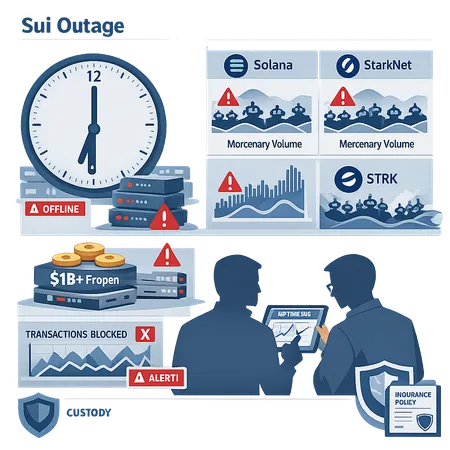
On the afternoon of the incident, the Sui network stopped producing blocks for almost six hours, a pause that left more than $1 billion of on-chain value functionally inaccessible while validators recovered. The Sui Foundation acknowledged the halt and began triage and publicly communicating progress as engineers worked toward a safe resumption of block production. Early reports and the Foundation’s statements framed the event as a software/consensus liveness problem that prevented normal validator participation and block finalization (see the primary report for chronology and initial confirmation).
This is not an abstract outage: for builders and counterparties the clock matters. Downtime erodes market confidence, blocks settlements, and can create latent economic risk when transactions can’t be completed or liquidations can’t execute.
Why high-throughput designs can be brittle
Many modern chains tout high throughput — fast blocks, parallel execution, and aggressive optimization of latency. Those design goals are attractive: faster UX, cheaper per-op fees, and richer dApp experiences. But throughput is often bought with trade-offs that increase operational complexity:
- More complex consensus or execution sharding increases the surface for subtle bugs.
- Tighter timing and aggressive leader rotation make networks more sensitive to clock skew, network jitter, and background GC or resource spikes on validators.
- Optimizations that assume near-perfect validator health reduce tolerance to degraded nodes.
In short, the systems are fast — until some component fails. When it does, failure modes can be sudden and systemic. The SUI outage illustrates that even a currently active ecosystem can reach a standstill quickly when validator liveness or a consensus path is disrupted.
Root cause and the Sui Foundation’s response (what we know)
The Sui Foundation confirmed the halt and pushed communications describing mitigation and recovery steps. Public-facing updates focused on coordination with validators and staged restarts rather than a single “instant fix,” which is typical when preserving chain safety matters more than liveness. A measured, consensus-preserving recovery minimizes the risk of state divergence, even if it takes longer to bring the network back online.
A full postmortem will be essential. For now, stakeholders should treat the incident as a reminder that design choices and software bugs can convert technical incidents into material financial exposure. For a timeline and primary reporting, see the coverage of the outage.
Comparative context: Solana, mercenary volume, and how activity can be misleading
Sui’s halt is not an isolated lesson. Solana has a history of high-profile service disruptions that temporarily halted the network, and those outages led projects and institutions to rethink dependency on a single high-throughput chain. Another angle worth studying is the way market activity metrics can be gamed or misread.
A recent investigation into Solana’s public attack on StarkNet exposed how "mercenary volume" — coordinated or ephemeral trading activity — can artificially inflate perceived network usage and, by extension, valuations. That episode reminded the market that raw throughput or volume numbers are noisy signals: high numbers may reflect short-term, mercenary flows rather than sustained, resilient demand. Read the investigation for details on how mercenary trading distorts on-chain health signals.
Together these cases suggest two distinct but related hazards:
- Operational fragility: a bug or validator failure creates downtime risk.
- Signal fragility: on-chain metrics can be amplified or manipulated, giving false confidence about decentralization or economic depth.
Tickers to watch in these conversations: SUI (the asset affected by the outage), SOL (Solana’s token implicated in past outages and volume debates), and STRK as part of the StarkNet context.
Where institutional counterparties and dApp teams are exposed
Operational outages don’t just inconvenience users — they can create real balance-sheet risk and legal exposure for institutions that act as market makers, custodians, or lenders:
- Custodial risk: funds locked on-chain during a halt may be unreachable, complicating reconciliation and client withdrawals.
- Liquidation risk: margin engines expecting continuous on-chain price feeds and settlement may fail to enforce risk limits.
- Counterparty exposure: counterparties relying on timely finality for settlement or clearing may accumulate unrecognized credit risk.
- Insurance gaps: many insurance products exclude periods of prolonged downtime, or their trigger language is ambiguous around "consensus halts."
For engineering and product teams, the outage should provoke a re-evaluation of assumptions: does your product assume uninterrupted finality? Are your SLAs and incident playbooks aligned with the real-world reliability of the underlying chain?
Practical steps: reassessing SLAs, custody, and insurance
Below are concrete, actionable items that engineering teams, product leads, and risk officers can adopt to reduce exposure to downtime risk.
1) Rework availability SLAs to measurable on-chain metrics
Instead of vague uptime claims, define SLAs tied to observable metrics: block production rate, mean time to finality, and RPC response percentiles for your critical endpoints. Make them part of vendor and node-provider contracts so you can enforce remediation or compensation.
2) Multi-provider and multi-chain custody strategies
Avoid single-point custodial risk. Use multiple independent RPC providers and custody partners where possible, and maintain on- and off-chain recovery keys in secure, auditable HSMs. Consider dynamic redemption policies: if on-chain settlement is unavailable for X hours, trigger off-chain fallback settlement agreements with counterparties.
3) Hardened read-only mirrors and watchtowers
Run independent read-only replicas and watchtowers that monitor mempool, consensus rounds, and validator liveness. These systems provide faster detection and clearer incident timelines, and they can feed failover systems or trigger contractual dispute processes.
4) Contractual clarity for insurance coverage
Work with brokers and underwriters to get explicit language about consensus halts, organizer upgrades, and software bugs. Insurers will price coverage, but clarity in wording reduces surprises during claims.
5) Circuit breakers and off-chain fallback protocols
Design application-level circuit breakers: if the chain’s finality slips beyond a threshold, pause protocol-critical actions like liquidations or large automated settlements until manual review. Maintain off-chain settlement rails or arbitration mechanisms baked into contractual terms to permit orderly resolution during prolonged outages.
6) Staging, upgrade discipline, and chaos testing
High-throughput chains can be brittle under upgrades. Adopt strict staging, phased rollouts, and canary validators for your own validators or node fleets. Run regular chaos tests and simulate network partition scenarios to validate runbooks.
7) Continuous monitoring of economic signals versus raw volume
Differentiate between sustainable user activity and mercenary volume. Track user retention, unique wallet counts doing meaningful actions, and depth of limit-book-like activity rather than aggregated trade counts. This reduces the risk of over-allocating capital to chains that look busy but aren’t resilient.
Aligning product development with realistic reliability expectations
For product teams, the practical work is to design UX and user disclosures around the real-world behavior of underlying chains. If your settlement can be delayed for hours, make that transparent, and build user flows that limit exposure to replay, reorgs, or failed liquidations.
Engineers should treat the chain as an external dependency with measurable SLOs, and implement graceful degradation. For example, wallet UIs can show a countdown to finality and warn users when the chain’s liveliness degrades. On the backend, systems can queue operations and notify users if execution windows are missed.
Conclusion: price the risk, then manage it
The Sui outage is a reminder: high throughput is not a substitute for demonstrated resilience. For institutional players and teams building in these ecosystems, the task is twofold. First, accurately price downtime and the noisiness of on-chain signals into capital allocation and product SLAs. Second, adopt concrete engineering and contractual countermeasures so that when a chain pauses, you remain operational and your customers are protected.
Operational risk is not zero-sum: with clearer SLAs, stronger custody practices, and disciplined monitoring, teams can still take advantage of the performance benefits of high-throughput chains while limiting catastrophic exposure. Platforms and services — including analytic and custody aggregators like Bitlet.app — will increasingly factor these trade-offs into product design and risk evaluation.
Sources
- Primary reporting on the Sui outage: Sui blockchain halted for nearly 6 hours
- Investigation into Solana–StarkNet mercenary-volume dynamics: Solana’s public attack on StarkNet exposes mercenary volume distortions
For teams evaluating chain choices, consider studying on-chain and off-chain indicators side-by-side: for many traders and builders the distinction between raw throughput and resilient availability will determine where capital and production apps go next. For projects building on Sui or integrating with broader DeFi stacks, this incident should trigger immediate operational reviews.