Ossifiability and the Walkaway Test: Ethereum’s 7-Step Plan for Long-Term Resilience
Summary
Why ossifiability matters now
Ethereum’s conversation has shifted from “how fast can we iterate?” to “how resilient can we make the protocol?” The term ossifiability — deliberately making protocol rules hard to change — has entered the roadmap because developers and researchers want Ethereum to survive without continuous, centralized maintenance. That idea pairs tightly with the walkaway test, a proposed litmus test asking: can the system continue to operate safely if a large portion of the core team stops coordinating?
For many readers this is more than an academic exercise. Long-term investors and protocol researchers want to know whether ETH’s economic security and the broader stack will remain robust in scenarios where active development slows or leadership disperses. For developers, ossifiability raises gnarly design trade-offs: freeze-and-secure versus adapt-and-improve.
The technical idea: what is ossifiability?
At its core, ossifiability means locking in state-transition rules and certain contract/VM behaviors to minimize future, high-risk changes. Technically this can take several forms:
- Formal, compact specifications of execution and consensus that clients can independently audit.
- Narrow, explicit upgrade windows and hard-to-execute privileged upgrade paths.
- Reducing or removing on-chain mechanisms that allow unilateral, rapid protocol changes (multisigs, upgrade keys, etc.).
- Stronger emphasis on client diversity and deterministic behavior so different implementations converge on the same state without opaque coordination.
The goal isn’t to stop all progress; it’s to make protocol changes deliberate, well-specified, and hard to weaponize. As BeinCrypto’s analysis of Ethereum’s ossifiability roadmap notes, ossification is a critical phase with clear security and governance benefits, but it also forces the community to accept greater friction for future upgrades (see that technical breakdown here).
The walkaway test: a resilience litmus
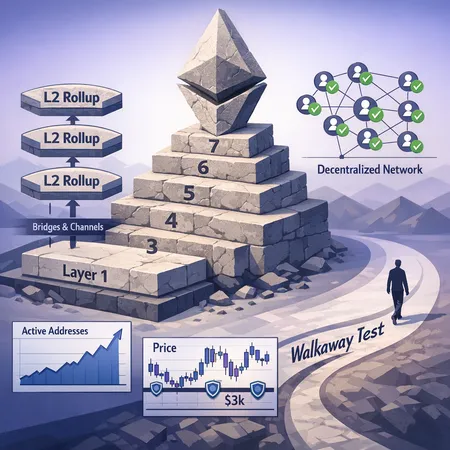
The walkaway test is a practical thought experiment: if key contributors literally walked away, could validators, clients, and the wider ecosystem still reach consensus and operate safely? Vitalik and other researchers have pushed this from a concept to a concrete checklist and roadmap.
The recent proposals and commentary frame the test not as a single pass/fail criterion but as a set of requirements: minimize privileged governance keys, make upgrade paths require broad agreement and long notice, and ensure the execution and consensus layers are independently verifiable. Coverage of Vitalik’s 7-step plan summarizes these ideas and stresses operational independence between maintainers and the live chain (CoinPedia and U.Today provide readable rundowns of the proposals).
What the seven-step plan emphasizes
Rather than quoting line-by-line, it’s useful to distill the concrete categories of work the seven-step plan targets:
- Strengthen client diversity and continuous integration so multiple independent implementations can keep the chain running.
- Harden specification, tests, and formal verification to reduce reliance on informal tribal knowledge.
- Remove or reduce privileged keys and emergency upgrade mechanisms that create single points of failure.
- Define clearer upgrade windows, governance signaling, and long notice periods for breaking changes.
- Improve bootstrapping and decentralization of infra (e.g., block explorers, archive nodes) so new teams can pick up maintenance.
- Encourage tooling and standards for reproducible builds, deterministic clients, and better cross-client test vectors.
- Create explicit operational criteria for the walkaway test and iterate on them with the community.
These items are concrete steps developers can map to repositories, client roadmaps, and protocol-layer EIPs. The emphasis is on institutionalizing practices so “walking away” becomes a survivable scenario, not a catastrophe.
Trade-offs: decentralization vs. agility
Ossifiability strengthens some aspects of decentralization (reducing centralized control over upgrades) while restricting agility (making future improvements slower). That tension matters:
- Pros: Less risk of malicious or accidental central changes, stronger long-tail resilience, easier forensic reproduction of client behavior. Ossifiability reduces single points of failure in governance and implementation.
- Cons: Harder to deploy emergency fixes, slower to roll out new features (e.g., expressive VM improvements), and potentially greater reliance on off-chain coordination for major changes.
Protocol designers must choose which primitives deserve ossification (consensus rules, basic state transitions) and which should remain upgradeable (higher-level standards, opcodes with opt-in semantics).
Implications for L2s and the wider stack
Ossifiability at the base layer changes expectations for Layer 2s. If execution semantics become more stable, L2 designers get a more predictable settlement layer — that's a net positive. But there are important nuances:
- L2s that depend on specific EVM behaviors or execution gas dynamics will benefit from a stable base. Predictability helps fraud-proof timing, prover assumptions, and long-term economic models.
- Conversely, a frozen base layer means L2 innovation must live entirely above that layer (via contract patterns or L2-specific upgrades), which may increase complexity for rollups and optimistic designs.
- Interoperability assumptions (e.g., calldata costs, precompile behavior) must be stable; otherwise L2s face systemic risk if assumptions silently change.
For client implementations, ossifiability increases the burden of correctness: clients must match the canonical spec precisely because divergence is costly. That in turn incentivizes more independent client teams and better tooling — precisely what the seven-step plan calls for.
(For context on how developers are talking about these resilience tests, see this U.Today summary of Vitalik’s proposals.)
Client diversity, testing, and developer risk
One of the clearest lessons from recent blockchain incidents is that common-mode failures in client software are disastrous. Ossifiability raises the bar: if the protocol is hard to change, then making a client bug unlikely becomes critical. The roadmap items that reduce developer risk include:
- Expanding cross-client fuzzing and formal verification suites.
- Investing in robust CI/CD pipelines and reproducible builds.
- Funding and supporting independent client teams so no single repo holds the keys.
- Adopting stricter merge criteria, clearer release notes, and enforced upgrade channels.
These investments increase short-term development friction but reduce long-term systemic risk — a trade-off many researchers and large ETH holders now prefer.
How on-chain signals fit the resilience narrative
Ossifiability isn’t just theoretical. The economic layer of Ethereum also contributes to resilience, and recent metrics have been supportive. On-chain analysis shows ETH defending the $3k area as a critical psychological and economic support level, while active addresses have been rising — a sign of broadening participation and utility (Crypto.News coverage here).
Why do these signals matter for ossifiability? A protocol is more likely to remain viable without active core maintainers if there is a deep and distributed set of economic actors who benefit from its continued operation: validators, exchanges, L2 operators, dApp teams, and users. Growth in active addresses is one proxy for that distributed interest; price support around significant levels (like $3k) speaks to an economic substrate that would encourage diverse parties to maintain and operate infrastructure even if some teams withdraw.
Practical checklist for developers, researchers, and investors
- For developers: prioritize deterministic specs, strengthen cross-client tests, and avoid shortcuts that introduce privileged upgrade paths.
- For protocol researchers: contribute to formal verification efforts, design upgrade windows and signaling mechanisms that meet the walkaway criteria, and publish reproducible test vectors.
- For investors and operators: monitor active addresses and on-chain health metrics, support client diversity by running or funding alternative clients, and factor ossifiability into long-term risk models for ETH exposure.
Bitlet.app users and ecosystem participants should see ossifiability as a maturity signal: the network is preparing for scenarios where coordination is harder, not easier.
Conclusion: ossifiability is a discipline, not destiny
Ethereum’s push toward ossifiability and the formalization of the walkaway test represent a cultural and technical shift: from rapid, sometimes ad-hoc innovation to deliberate, testable stability. That shift will shape how upgrades are proposed, implemented, and accepted — and it will force clear choices about what parts of the system remain flexible.
The seven-step plan frames a pragmatic route: invest in client diversity, testing, reduced privilege, and reproducibility. Those steps increase resilience but come at the cost of agility. For developers and researchers, the work is concrete and ongoing; for long-term investors, recent on-chain signs (active addresses and ETH price support) make the case that Ethereum's economic layer can underpin a more ossified future.
For a deeper technical dive on ossifiability and the roadmap, see the analysis linked in the sources below.
Sources
- https://beincrypto.com/ethereum-ossifiability-roadmap-analysis/
- https://coinpedia.org/news/vitalik-buterin-wants-ethereum-to-survive-without-him-reveals-7-step-plan/
- https://u.today/vitalik-buterin-stuns-with-new-resilience-test-for-ethereum-details?utm_source=snapi
- https://crypto.news/ethereum-bulls-defend-key-3k-support-after-breakout-from-downtrend/