Memecoin Revival 2026: SHIB, BONK, PEPE — What’s Driving the Rally and a Disciplined Playbook
Summary
Overview: why memecoins are back on the radar
Memecoins re-entered the spotlight in early 2026 after a stretch of muted activity. The moves aren’t being underwritten by macro fundamentals or protocol upgrades — they’re social and flow-driven. Retail rotations, influencer cycles, concentrated whale buys and liquidity shifts on DEXes have combined to create explosive short-term moves in tokens like SHIB, BONK and PEPE.
Two things to keep in mind up front: first, memecoin rallies are fragile — they can extend quickly but reverse faster. Second, participating successfully requires a rules-based approach that accepts high drawdowns and tail risk. For many traders, Bitcoin still sets broad risk sentiment, but by design memecoins often decouple and move to their own beat during speculative bursts.
What’s driving the 2026 rallies: retail flows, social catalyzers and liquidity
Three forces explain most of the recent momentum.
Retail rotations and easy on-ramps. Low-friction fiat rails, exchange listing whispers and app-driven discovery push new money into cheap-per-token assets. Retail allocation chasing quick returns is the most visible driver of volume spikes.
Social catalysts and narratives. Viral campaigns, influencer endorsement cycles and meme proliferation on platforms like X and Telegram push attention and create feedback loops. These narrative surges are often tied to short-lived FOMO rather than durable utility.
DEX liquidity and concentrated buys. Many memecoins trade primarily on decentralized exchanges where concentrated buys by a few wallets can materially shift price. That concentration amplifies moves and can create technical breakouts that later lack sustainable liquidity.
AmbCrypto’s recent survey of the memecoin scene highlights these supply-and-attention dynamics across tokens like BONK, SHIB and PEPE, and raises the question: are memecoins actually “back” or just re-entering cyclical attention? The reality is both — the structure that produced earlier rallies still exists, and small changes in distribution or platform support can produce outsized price action are discussed in detail in AmbCrypto’s coverage.
Case study — SHIB: price action, technical setup and narrative context
SHIB opened 2026 with strong momentum but has shown the classic memecoin pattern of rapid gaps followed by consolidation. Reports from market outlets noted SHIB’s strong start and team responses as the rally briefly stalled, emphasizing community support and on-chain activity as the main prop for price action (see the U.Today piece on SHIB’s 2026 start).
Technically, SHIB’s most actionable setups during these bursts have been:
- Volume-confirmed breakouts off multi-week ranges — a real breakout shows a spike in decentralized exchange volume and a lower ask-depth to the most recent resistance.
- Short-term VWAP and moving average confluence — intraday momentum traders lean on the 20–50 period moving averages to time entries and cut losses.
- RSI divergence as a warning — because rallies are velocity-driven, early RSI failure often precedes sharp retracements.
On-chain signals that mattered for SHIB included net inflows to major DEX pools, a rise in new wallet interactions, and burn or distribution events that temporarily removed supply from circulation. U.Today quoted team members urging calm as the rally found resistance, a reminder that developer or community commentary can stabilize psychology but rarely changes supply dynamics by itself U.Today coverage on SHIB’s start to 2026.
BONK and PEPE: higher beta, higher structural risk
BONK and PEPE frequently trade with much higher intraday beta than SHIB. Compared with top-tier memecoins, mid-tier tokens often have
- Lower liquidity depth, making them more responsive to single-wallet buys or sells.
- Less predictable narrative beds, so an influencer post or new listing can produce outsized rallies or collapses.
Technically, these tokens are best approached with micro-position sizing and clear liquidity checks: always examine the DEX pool depth, slippage for your intended trade size, and recent concentration metrics (how much of the supply sits in top wallets). AmbCrypto’s analysis underscores that the memecoin landscape now includes a spectrum from large community projects to tokenized jokes with short lifespans, so selection matters AmbCrypto memecoin overview.
On-chain metrics and concentration — what to watch
On-chain metrics are the clearest early-warning and confirmation signals for memecoin players. Watch these specifically:
- Exchange flows (in/out): sudden inflows to exchanges often precede sell pressure; persistent outflows to cold wallets or DeFi staking pools can signal accumulation.
- Top-holder concentration: if the top 10 wallets hold a large share, a single whale can produce outsized volatility. High concentration increases tail risk.
- Active addresses and new wallets: explosive growth in new addresses interacting with a token can confirm a retail-led move — but also suggests a fragile, FOMO-driven base.
- Liquidity pool depth and slippage curves: check the token/WETH or token/USDC pool sizes on popular DEXes; low depth equals high execution risk.
- Tokenomics events: supply unlocks, scheduled emissions or planned burns materially change the risk profile.
Use on-chain dashboards to cross-verify narratives. A viral tweet without accompanying inflows or new wallet growth is more likely to be a short-lived pump.
Comparing top-tier vs mid-tier memecoin dynamics
Top-tier (SHIB-like) traits: larger market cap, broader distribution, occasional ecosystem activity (burns, staking wrappers), better exchange support. These typically have somewhat deeper liquidity and slower decays — but still can crash hard.
Mid-tier (BONK/PEPE-like) traits: extreme volatility, concentration risk, highly narrative-driven. They can produce spectacular short-term gains but also total capital loss.
Risk-adjust your playbook by token tier: top-tier memecoins are still speculative but can be treated with slightly wider tactical allocations; mid-tier tokens require micro-sizing and shorter holding windows.
A disciplined playbook: sizing, entries and exits for retail and discretionary allocators
Below is a practical framework you can adopt or adapt.
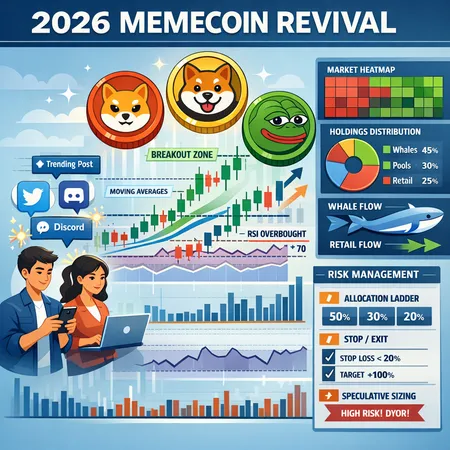
Sizing rules (percent-of-portfolio):
- Conservative retail: 0.5–2% of total net worth across all memecoins. Treat positions as lottery tickets.
- Active discretionary allocator: 1–5% of total crypto allocation (not total net worth). Keep cumulative memecoin exposure capped.
- Aggressive/speculative trader: 5–10% of crypto allocation, but break positions into many micro-trades and accept high churn.
Position construction (laddering and scale):
- Base tranche (25–50%) on a technical setup (e.g., breakout confirmed by volume and on-chain inflows).
- Add tranches (25% each) on pullbacks to area-of-support or on renewed on-chain accumulation.
- Cap your total exposure to the pre-defined sizing limit and don’t chase beyond it.
Entry signals (combine at least two):
- Price breakout with volume surge and new active wallets increasing.
- Large net outflows from exchanges (indicates accumulation off-exchange).
- Favorable liquidity depth for intended trade size (slippage < 1–3%).
Exit rules (strict, rule-based):
- Initial stop-loss: 25–40% from entry for top-tier memecoins; 40–60% for mid-tier where whipsaws are common. Tighten if you’re leverage-exposed.
- Profit-taking tiers: scale out 20–30% of the position at 2x, another 30–40% at 5x, and take the remainder off by 10x or hold a small residual as a lottery ticket.
- Trailing stop: convert the position to a trailing stop (e.g., 30–50% trail from peak) after a major move to protect gains.
- Event-driven exits: pre-define exits on token unlocks, major centralized exchange listing, or regulatory signals.
Psychology and portfolio management tips:
- Treat memecoins as event-driven options — high potential reward but likely zero utility. Accept that many positions will lose everything.
- Log every trade and review outcomes monthly; discipline comes from pattern recognition.
- Keep taxes and trading fees in mind — high turnover erodes returns.
Practical checks before you click buy
- Can you sell the full intended position without moving the market? If not, reduce size.
- Does on-chain activity back the narrative (new wallets, liquidity movement)? If not, suspect hollow momentum.
- Are top wallets unusually concentrated? If yes, view as elevated tail risk.
- Do you have a clear stop and profit plan that you’ll actually follow?
Tools and platforms: use reputable DEX analytics and on-chain dashboards to confirm flows, and consider fiat/crypto apps for managing small, scheduled buys. Platforms like Bitlet.app can simplify installment or small-position buys, but keep the same discipline about sizing and exits.
Final thoughts — participate with humility and rules
The 2026 memecoin revival shows how quickly capital and attention can reshuffle in crypto. Rallies in SHIB, BONK and PEPE are symptomatic of a market where retail flows and social catalysts — not fundamentals — drive short-term returns. That means opportunity exists, but so do larger-than-normal tail risks.
If you decide to participate, do so with a clear, rules-based playbook: small sizes, entry confirmations from both technical and on-chain metrics, and explicit exit and profit-taking rules. Track concentration and liquidity closely, and accept that losses are a normal part of this game.
For more reading on memecoin market structure and recent waves, see AmbCrypto’s landscape piece and the U.Today report on SHIB’s early-2026 action.