Wyoming's FRNT: How a State‑Issued Stablecoin on Solana Rewrites the U.S. Stablecoin Debate
Summary
Executive summary
Wyoming's FRNT marks the United States' first state‑issued public stablecoin and was launched on Solana as a dollar‑pegged token. That experiment matters not because it will immediately replace bank‑backed stablecoins, but because it introduces a legally distinct pathway — state issuance — to the policy menu in Washington. For compliance officers and policy analysts, comparing FRNT with private institutional bids like World Liberty Financial’s USD1 (pursuing an OCC/national trust or bank charter) sharpens the tradeoffs between sovereign legitimacy, custodial guarantees, and technical interoperability on chains such as Solana.
This article explains the legal precedents behind FRNT, contrasts its design and likely adoption pathways with the WLFI/OCC charter route, and draws actionable implications for regulators, supervised entities and market infrastructure providers (including platforms like Bitlet.app that integrate stablecoins into payment rails).
What Wyoming did, and why it’s different
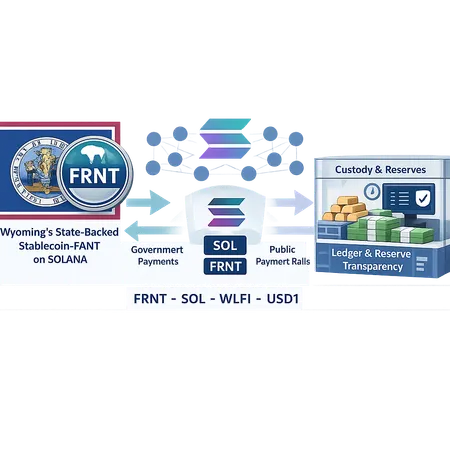
In late 2025 Wyoming announced the public issuance of FRNT, a state‑backed dollar token deployed on the Solana network. Coverage emphasized both the novelty of a U.S. jurisdiction issuing a dollar‑pegged token and the choice of Solana as the settlement layer for speed and low cost. Early on‑ramps and market access were described in press reports, underscoring a rapid pilot orientation rather than a full national rollout (TheNewsCrypto; CoinTribune).
Why is this different from private stablecoins? The crucial legal difference is source of authority: FRNT inherits a form of public‑sector imprimatur from a sovereign (a U.S. state), whereas private efforts rely on bank charters, trust structures, or commercial law. That changes the political narrative — and the compliance checklist — even before we discuss reserve mechanics or custody.
Legal precedent and constitutional questions
State issuance of a dollar‑pegged token raises three legal axes that will shape litigation and legislation.
Federal preemption and currency powers. The Constitution grants Congress authority over money and coinage; states issuing instruments that function as money invites federal scrutiny and potential preemption challenges. Historically, states have issued scrip or local currencies in constrained situations, but a widely‑circulating digital dollar token pushes into untested territory. Expect litigation that asks whether FRNT is simply a tokenized debt, a voucher, or an instrument that materially implicates federal monetary power.
Regulatory classification: bank deposit vs. digital asset. Regulators will ask whether FRNT is a deposit liability (subject to bank regulation) or a digital token (subject to securities, commodities or money‑transmission rules). The state‑issued label complicates this analysis: states can authorize certain financial instruments for use within their jurisdictions but cannot unilaterally displace federal bank regulation for national banking activities.
Sovereign immunities and state authority. A state issuer may invoke sovereign protections that private firms cannot. However, sovereign issuance does not automatically confer federal deposit insurance or assure acceptance across banks. Market participants — particularly custodians and banks — will weigh counterparty and operational risk rather than legal niceties alone.
These legal contours will shape how FRNT scales beyond Wyoming and how federal agencies respond.
FRNT vs. the private OCC/national‑charter route (WLFI’s USD1): apples and oranges
World Liberty Financial’s USD1 follows the private route: WLFI has publicly applied for OCC trust or bank charters to run a regulated stablecoin program, emphasizing chartered custody, banking supervision and traditional clearance rails (coverage: TheNewsCrypto; Invezz).
Contrast points:
Legal footing and supervision. WLFI’s approach seeks federal bank supervision via OCC or national trust charters. That pathway trades the novelty of state imprimatur for the safety and predictability of federal regulation, including examinations, capital requirements and potentially deposit insurance pathways. FRNT, by contrast, trades these federal guardrails for a state‑sanctioned issuance model that may be faster to deploy but less reassuring to national banks.
Custody and deposit promises. A chartered stablecoin like USD1 can plausibly integrate with insured deposit segregation and bank custody models. Regulators and counterparties often treat chartered programs as closer substitutes to bank deposits. FRNT will need to answer how reserves are held, audited, and protected in insolvency scenarios — questions that private charters address through regulated custodians.
Political optics. WLFI will emphasize consumer protection and bank‑grade controls; Wyoming will emphasize public innovation and local sovereignty. For policymakers, these narratives map to different coalition pressures: state policymakers and crypto‑native communities on one side; banks, prudential regulators and consumer advocates on the other.
Both models are credible, but they answer different policy objectives.
Adoption paths: where FRNT is likely to matter first
Adoption will follow predictable utility and trust dimensions. FRNT’s immediate natural use cases are local government payments, intra‑state clearing and pilot programs where state acceptance reduces counterparty friction.
Government payments and benefits. States can pilot FRNT for vendor payments, grant disbursements, or targeted benefits — use cases that avoid national banking integration and can be limited to recipients who accept on‑chain tokens. This reduces political friction and gives a sandbox for operational testing.
Payroll and municipal suppliers. Municipalities pay recurring vendors and contractors. Tokenized payments on Solana can lower microtransaction costs and speed settlement, especially when vendors already use on‑chain rails.
Interoperability hubs and marketplaces. Solana's high throughput and low fees make it attractive for fast settlement of small payments; FRNT can serve as a rails choice for state digital marketplaces and local DeFi primitives. However, broad merchant acceptance and bank on‑ramp/off‑ramp integration are the gating items for mass adoption.
Cross‑jurisdictional limits. For now, expect FRNT acceptance to be patchy across banks and interstate commerce. Major clearing banks may refuse to accept FRNT as a reserve asset without federal guidance or legal clarity.
These adoption pathways contrast with USD1, which expects to plug into national banking rails, offering broader merchant and institutional acceptance from day one if charters are granted.
Custody, reserve transparency and auditability: trust engineering
The baseline concern for any dollar‑pegged token is whether it is actually backed and redeemable. Here the two models diverge in observable ways.
Reserve custody. WLFI’s charter pathway emphasizes custody at regulated banks or trust companies subject to supervision. That creates a clearer mitigation for counterparty failure. FRNT will need to publish where reserves are held — possibly in state treasuries or third‑party custodians — but without federal supervision that custody is a weaker signal to national counterparties.
Transparency and attestation standards. To build market confidence, FRNT should commit to frequent, high‑quality audits or real‑time proof‑of‑reserves mechanisms. Regulators and counterparties will prefer SOC reports, bank confirmations, and on‑chain attestations that map liabilities to specific reserve accounts. For policy analysts, the question is not only whether audits exist, but who audits and what remedies exist if reserves are misrepresented.
Insolvency and legal remedies. A federally chartered USD1 program can point to bank supervision and existing insolvency regimes; a state token raises questions about creditor priority, state immunity claims and cross‑border enforcement if reserves are held in multiple jurisdictions.
Operationally, platforms integrating these tokens (including Bitlet.app and others) must update KYC, sanctions screening and reconciliation processes depending on the issuer model.
Interoperability and the choice of Solana
Wyoming chose Solana for FRNT’s settlement, a decision with practical and policy consequences.
Solana offers high throughput, low latencies and inexpensive fees — attractive for government micropayments and high‑frequency settlement. That technical profile reduces friction for vendor payments, tokenized benefits and local commerce pilots. However, Solana’s architecture also means that FRNT sits in a non‑EVM ecosystem, which affects wallet compatibility, custodial integrations, and bridge‑based liquidity with EVM chains.
From a policy perspective, interoperability expectations will be central: will FRNT be a closed, Solana‑native token, or will state issuers require cross‑chain bridges and wrapped versions to ensure acceptance across broader markets? Closed issuance reduces systemic exposure but constrains liquidity. Open, bridged issuance improves utility but increases counterparty risk and complexity for compliance teams.
For compliance officers, practical issues include verifying FRNT holdings across Solana addresses, mapping on‑chain attestations to reserve bank accounts, and ensuring chains of custody across bridges if cross‑chain transfers are permitted. The choice of Solana also implies that SOL market dynamics — congestion, validator economics and outage risk — become part of FRNT’s operational risk profile.
You can read more about Solana’s ecosystem impacts in related coverage such as Solana and how DeFi settlement models inform state projects like FRNT via DeFi.
How state issuance reshapes the regulatory debate in Washington
FRNT reframes several long‑running arguments on stablecoin policy.
It undermines a bipartisan premise that only federally chartered entities can safely issue widely‑used dollar tokens. If a state can credibly issue a token that vendors and residents accept, Congress faces pressure either to codify a federal pathway that accommodates state programs or to preempt them.
It sharpens the conversation around functional vs. formal regulation. Regulators will need to decide whether to regulate based on function (does the token perform like a deposit?) or form (who issued it?). FRNT favors a function‑based argument that public issuers performing monetary roles deserve stricter oversight — but that oversight might need to be coordinated across state and federal lines.
It accelerates the race to define reserve and audit standards. The market will demand interoperable, transparent attestations to accept FRNT outside Wyoming. Congress and agencies may respond with minimum audit and custody requirements that apply to all issuers, effectively raising the bar for both state and private stablecoins.
It creates a political vector for states to influence federal policy. If several states emulate Wyoming, a patchwork of public tokens could force Congress to create uniform rules, potentially harmonizing obligations for charters, reserves and redemption rights.
Regulatory outcomes to watch: legislative standard‑setting for reserve audits; clarification from the OCC, FDIC and Treasury on treatment of state‑issued tokens; and potential rulemaking that addresses cross‑jurisdiction acceptance and insolvency priority.
Practical compliance implications and recommendations
For policy analysts and compliance officers evaluating FRNT and competing models, here are focused actions and risk controls to consider.
Require high‑frequency attestations and public mappings between on‑chain FRNT supply and audited reserve accounts. Prefer third‑party bank confirmations with clear legal remedies.
Establish acceptance policies. Banks and custodians should set explicit counterparty and settlement limits for state‑issued tokens until federal guidance clarifies reserve treatment and insolvency regimes.
Update KYC/AML manuals to account for public issuers: provenance rules, on‑chain identity heuristics on Solana, and bridge monitoring if off‑chain conversions occur.
Stress‑test operational dependency on Solana: incorporate validator outages, congestion and bridge failures into business continuity plans.
Engage policymakers proactively. Institutions should provide data to federal rulemakers showing real‑world settlement benefits and risks, helping shape pragmatic federal responses rather than reactive bans.
Policy pathways Washington might pursue
Policymakers have multiple realistic responses:
Create a federal charter path that accommodates both private bank‑backed stablecoins and state pilot programs, with unified reserve and audit standards.
Preempt state issuance for tokens that function as money, compelling state programs to partner with chartered banks or national custodians.
Define minimum technical and operational standards (including cross‑chain risk mitigation) while leaving issuance authority to states and private entities — a lighter touch but riskier for systemic stability.
The politically plausible outcome is a hybrid: federal minimums on reserves and audits, coupled with a charter pathway for private firms and carve‑outs for limited state pilot programs.
Conclusion
Wyoming’s FRNT is not merely another stablecoin; it is a policy experiment. By issuing a state‑backed dollar token on Solana, Wyoming has introduced a credible alternative to the bank‑charter model that World Liberty Financial and others are pursuing with USD1 and OCC trust/bank applications. Each path — state issuance and federally chartered private issuance — answers different priorities: rapid public innovation versus bank‑grade supervision and predictability.
For compliance officers and policy analysts, the practical task is preparing for both worlds: designing controls that verify reserves and custodial protections, adapting operations to Solana’s technical profile, and engaging with federal rulemakers to ensure standards are clear and enforceable. How Washington responds will determine whether the U.S. embraces a plural ecosystem of public and private digital dollars or consolidates issuance under federally supervised institutions.
Sources
- Wyoming launches FRNT on Solana: TheNewsCrypto
- Wyoming FRNT public issuance and Kraken access: CoinTribune
- World Liberty Financial applies for OCC charter to launch a stablecoin trust/bank: TheNewsCrypto
- World Liberty Financial seeks US bank charter to support USD1 growth: Invezz