Tokenizing Cash: How Banks and Brokers Are Bringing Money‑Market Funds On‑Chain
Summary
Why tokenize cash now?
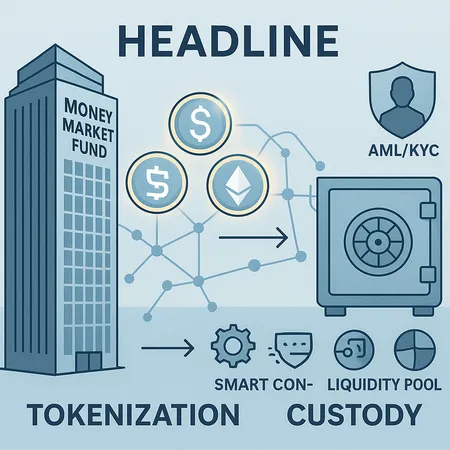
Tokenization turns a cash‑like claim (stablecoins or shares of a money‑market fund) into a transferable on‑chain token. The current wave isn’t academic: large banks and brokerages are shipping live products that convert familiar cash equivalents into blockchain‑native instruments. JPMorgan’s new Ethereum tokenized money‑market fund is a flagship example of a bank issuing a regulated fund with an on‑chain wrapper, offering investors a familiar product in token form (Coinpedia). At the same time, broker rails are becoming crypto‑native — Interactive Brokers now allows clients to fund accounts directly with USDC and USDT, making stablecoins practical as settlement rails for institutional flows (AltcoinBuzz).
Collectively these moves change the plumbing: asset managers can think in terms of on‑chain settlement, programmable liquidity, and 24/7 operations rather than traditional batch processing. For many, Ethereum is the natural settlement layer today because of liquidity and infrastructure, and tokenized cash products frequently reference USDC or USDT as on‑chain cash equivalents (and ETH as the network gas token).
What institutions are building — real examples
JPMorgan: tokenized money‑market fund on Ethereum
JPMorgan’s tokenized money‑market fund demonstrates how a traditional fund structure can be represented on‑chain to enable instantaneous transfers of fund shares between wallets. The offering keeps the regulatory wrapper of a money‑market fund while exposing those shares as transferable tokens — a step toward bridging institutional asset management practices with programmable settlement (Coinpedia).
Interactive Brokers: fiat rails meet stablecoins
Practical adoption will hinge on funding rails. Interactive Brokers letting clients deposit using USDC and USDT is a pragmatic example of brokerages enabling token‑native cash flows: firms can now move tokenized cash into brokerage accounts without an intermediate fiat conversion, shortening time to execution and settlement (AltcoinBuzz).
Standard Chartered + Coinbase: institutional services at scale
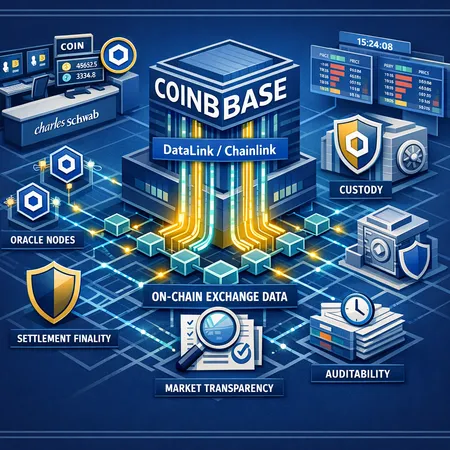
Institutional adoption also requires custody, trading and client servicing integrated together. The Standard Chartered and Coinbase collaboration to provide trading, custody, staking and lending solutions for institutional clients shows how banks and exchanges are combining strengths to offer regulated, end‑to‑end services for institutional crypto exposure (DailyHodl).
Custody models: what changes with tokenized cash
Custody for tokenized cash can be structured several ways, and the choices have legal and operational consequences:
- Bank/regulated custodian custody (wrapped on‑chain): The bank issues or sponsors the token and holds the underlying assets off‑chain, while the token circulates on‑chain. This model preserves the traditional custody chain but gains blockchain transferability (JPMorgan’s model fits here).
- Independent qualified on‑chain custody: A regulated custodian or institutional custodian holds private keys using MPC or HSM setups. This model reduces counterparty exposure to issuers but requires trust in the custodian’s operational security.
- Exchange/custodian hybrids: Exchanges like Coinbase offer custody plus trading rails; partnerships with banks (e.g., Standard Chartered + Coinbase) marry client onboarding and regulatory controls with on‑chain execution.
For asset managers, custody selection must consider legal title, insolvency remoteness, and operational recovery processes. The custody choice also determines who performs on‑chain AML/KYC checks and who answers regulator inquiries.
AML/KYC and compliance: on‑chain constraints and opportunities
On‑chain tokens don’t remove the need for AML/KYC — they change where and how those checks happen:
- Upstream onboarding: Traditional KYC remains mandatory for institutional clients. When funds or stablecoins flow on‑chain, the issuer or custodian must assert that tokens were only minted or redeemed for KYC‑verified counterparties.
- Travel rule and messaging: Brokers and custodians must map chain transactions to regulated messaging flows; some firms add attestation layers or transfer metadata off‑chain to meet travel‑rule obligations.
- Sanctions screening: On‑chain analytics tools make it easier to detect sanctioned addresses, but privacy‑preserving layers complicate real‑time blocking.
Compliance teams will demand auditable flows: evidence of asset backing (for tokenized funds or stablecoins), proof of KYC on counterparties, and reconciliation between on‑chain balances and off‑chain books.
Benefits of on‑chain settlement for asset managers
- Instant (T+0) settlement: Reduces counterparty and settlement risk and frees up liquidity intraday.
- Operational efficiency: Automated redemptions, programmable fee flows and composability with DeFi primitives for short‑term liquidity operations.
- Transparency and auditability: On‑chain provenance simplifies reconciliation when custody and legal structures are aligned.
- New strategies: Tokenized cash enables intra‑day yield optimization, instant rebalancing, and automated collateral movements.
These advantages are why broker funding in USDC/USDT and bank tokenized funds are major enablers: you combine stable, regulated product economics with on‑chain rails.
Operational and smart contract risks to manage
Tokenization adds new failure modes that asset managers must treat with the same rigor as market risk:
- Smart contract risk: Bugs in token contracts, fund wrapper code or redemption logic can cause freezes or loss. Conduct thorough audits, multi‑party reviews and consider immutable upgrade constraints.
- Liquidity risk: On‑chain liquidity can be fragmented; heavy redemptions or market stress could create slippage between token price and net asset value (NAV).
- Oracle and pricing risk: If tokenized funds rely on oracles for NAV or yield feeds, oracle compromise can distort pricing and triggers.
- Operational key risks: Custody key loss, mis‑wired transfers and bridging failures remain possible; recovery procedures and insurance are essential.
- Regulatory interplay: Token classification differences (securities, money‑transmission, deposit substitutes) across jurisdictions can interrupt service and require parallel compliance programs.
Because of these risks, combining traditional legal protections (custody agreements, fund prospectus language) with on‑chain safeguards (timelocks, multi‑sig, pause functions) forms best practice.
Designing a low‑risk pilot for tokenized cash
Asset managers should treat tokenized cash pilots like any new product launch: narrowly scoped, measurable, and reversible.
- Define the objective: Is the pilot about settlement speed, intraday liquidity management, or reducing counterparty exposure? Pick one clear KPI (e.g., settlement time or collateral reuse rate).
- Choose partners: Work with a regulated token issuer or a bank experienced in tokenized funds, a qualified on‑chain custodian, and a custody/trading partner (the Standard Chartered–Coinbase model is instructive for service bundling) (DailyHodl).
- Select rails and instruments: Decide between stablecoins (USDC/USDT) for fungible cash or a tokenized money‑market fund for yield exposure. Interactive Brokers’ USDC/USDT rails show how funding flows can be practical for execution (AltcoinBuzz).
- Implement custody & compliance: Contract with custodians offering MPC/HSM backups, and ensure AML/KYC attestations are codified and auditable.
- Limit exposure: Start with a small AUM tranche, limited counterparties, and predefined failure scenarios with rollback procedures.
- Monitor and measure: Track settlement times, reconciliation variance, redemption latency, smart contract gas costs and compliance exceptions.
- Iterate and expand: Use pilot outcomes to adjust SLAs, custody rules and legal frameworks before scaling.
Practical checklist for CIOs and Heads of Ops
- Confirm legal status of the token (fund share vs. stablecoin) in relevant jurisdictions.
- Insist on third‑party smart contract audits and on‑chain monitoring tools.
- Verify custodian insolvency and key recovery playbooks.
- Map AML/KYC attestations to chain transfer processes.
- Define liquidity stress tests and run tabletop exercises for smart contract/bridge failures.
- Ensure insurance coverage and counterparty limits align with new on‑chain exposures.
Conclusion — measured optimism
Tokenized cash and money‑market funds are not a panacea, but they offer tangible improvements in settlement efficiency, operational automation and composability. The recent practical steps by JPMorgan, Interactive Brokers and the Standard Chartered–Coinbase partnership indicate institutional crypto is moving from experimentation to production. Asset managers that pilot thoughtfully — with the right custody, compliance and operational safeguards — can extract real efficiencies while containing the novel risks of on‑chain finance.
Platforms across the ecosystem, from exchanges and custodians to service providers like Bitlet.app, will matter less than getting the legal and operational foundations right. For asset managers, the time to test a controlled pilot is now: the rails are live, but safe adoption requires planning, partners and measurable KPIs.
Sources
- JPMorgan debuts Ethereum tokenized money‑market fund: https://coinpedia.org/news/breaking-jpmorgan-debuts-ethereum-tokenized-money-market-fund/
- Interactive Brokers adds USDC and USDT account funding: https://www.altcoinbuzz.io/cryptocurrency-news/interactive-brokers-adds-usdc-and-usdt-account-funding/
- Standard Chartered and Coinbase build institutional services: https://dailyhodl.com/2025/12/15/standard-chartered-and-coinbase-building-bitcoin-and-crypto-trading-custody-staking-and-lending-solutions-for-institutional-clients/