The New Institutional Era for Bitcoin: How Rate Cuts, ETF Flows and Big Custody Moves Rewire Cycle Dynamics

Summary
Executive summary
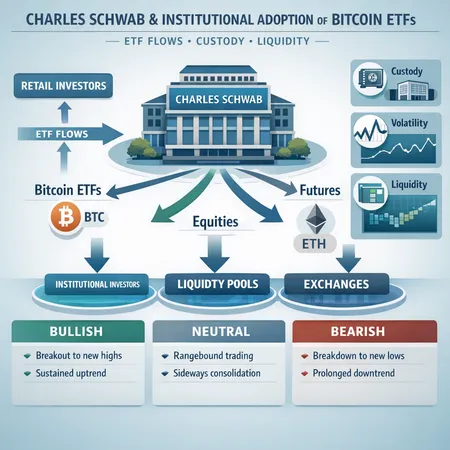
Across Q3–Q4 macro moves and market headlines there is rising evidence that Bitcoin is entering a new institutional era. High-profile theses — most notably Cathie Wood’s argument that a buy-and-hold institutional cohort could replace the old four-year retail-led cycles — now sit alongside concrete flow data: spot ETF subscriptions immediately after a Fed rate cut, large transfers to regulated custodians, and corporate treasury management decisions.
This article documents those datapoints, explains why they can mute traditional cycle amplitude, and draws practical positioning ideas for portfolio managers and long-term allocators as we move into 2026. Along the way we consider custody concentration, liquidity implications, and how macro sensitivity may evolve.
Evidence: headline signals that institutional demand is real
Cathie Wood’s institutional thesis
Cathie Wood has publicly argued that Bitcoin’s past four-year boom-bust cycles may give way to a buy-and-hold institutional regime — a structural change driven by ETFs, allocation from long-only managers, and corporate treasuries that hold rather than trade aggressively. Her framing matters because it moves the debate from ‘if’ institutions enter to how their behavior alters market mechanics. Read her perspective for context here: Cathie Wood on a new institutional era.
ETF inflows accelerated after Fed easing
Macro matters: the immediate market reaction to a third Fed rate cut included a meaningful rush into spot Bitcoin ETFs. Reporting noted more than $220M in spot ETF inflows in the hours after the Fed moved, illustrating how sensitive flows are to monetary policy and investor liquidity. See the coverage on ETF inflows tied to the Fed decision here: Fed rate cut and ETF inflows.
Large custodian flows — BlackRock’s transfer to Coinbase Prime
Institutional demand shows up not just in ETF NAVs but on-chain and in custody movements. A recent transfer of 2,196 BTC from BlackRock to Coinbase Prime is an example of how large managers are routing reserves into regulated custody. Those flows matter because when large blocks move into a limited set of custodians, the market’s liquidity topology shifts. Source: BlackRock transfer to Coinbase Prime.
Corporate treasury behaviour: Satsuma’s BTC sale
Institutional logic also includes corporate treasury management. Satsuma’s sale of 579 BTC as part of listing and treasury reshaping shows companies will both buy and sell Bitcoin to manage corporate objectives — and those sales can be material to short-term liquidity. Reported coverage: Satsuma Bitcoin sale.
Price context: BTC reacting to policy and flows
Market snapshots from the Fed episode showed BTC holding around $90k as traders parsed policy and ETF flows — a reminder that price can stabilize near new ranges even as flows accumulate. See one market snapshot here: BTC price steadies above $90k.
Why these flows can mute historical cycle patterns
Three mechanics explain why institutional accumulation could reduce the amplitude of retail-style boom-bust cycles:
- Steadier, persistent demand — ETFs and long-only mandates tend to accumulate incrementally, smoothing order flow compared with retail panic buying. The post-Fed ETF inflows illustrate how programmatic demand can arrive quickly but persistently.
- Larger granularity of holdings — Institutions often target multi-year holds and treasury allocations, which reduces the fraction of supply that is actively traded each cycle. That makes sharp supply squeezes less frequent.
- Regulated custody concentration — As custodians like Coinbase Prime, and large managers like BlackRock, take custody of material blocks, the market’s on- and off-chain liquidity profile changes. Large holders sitting in regulated custody can either act as a stabilizing reservoir or a source of concentrated liquidity shocks if forced to unwind.
Together these factors reduce the frequency of extreme drawdowns driven by retail liquidation cascades. But reduced frequency does not equal elimination: event-driven spikes (macro surprises, regulation shocks, or large treasury liquidations) will still produce volatility.
Implications for volatility, custody and macro sensitivity into 2026
Volatility: baseline decline, punctuated spikes
If institutional demand continues to grow, realized volatility may trend lower as the pool of sell-side liquidity fragments and buy-side accumulation becomes regular. Expect lower baseline volatility, but a higher likelihood that single events (a major custodian failure, sudden unwind by a leveraged entity, or a large corporate sale) create acute, sharp dislocations.
Custody: concentration risk and operational importance
Custody becomes a first-order risk vector. Transfers like BlackRock’s 2,196 BTC move into Coinbase Prime highlight two realities:
- Regulated custodians will hold a large share of institutional BTC, increasing operational and counterparty importance.
- Concentration raises systemic reliability concerns — outages, legal freezes, or even reputational runs could create market stress disproportionate to on-chain supply.
Portfolio managers must therefore evaluate custody depth, insurance, segregation, legal recourse, and site reliability. Services like Coinbase Prime are now core plumbing; a robust custody due diligence checklist is mandatory.
Macro sensitivity: policy still matters
Institutional demand is sensitive to liquidity and policy. The Fed’s cut and subsequent ETF inflows are a live demonstration: easier monetary policy can turbocharge allocations into risk assets including BTC. Expect BTC to be correlated with global risk-on flows around macro inflection points, even as long-term institutional holders dampen short-term churn.
Practical positioning — conservative allocators vs. opportunistic traders
Below are actionable ideas tailored to different mandates. These are not investment advice; they are frameworks to adapt to a more institutional market structure.
For conservative allocators and pension-like mandates
- Staged entry with DCA into spot ETFs or segregated custody: Use dollar-cost averaging across macro events to avoid timing risk; consider spot ETFs for ease of compliance and reporting, or direct custody with top-tier providers for balance-sheet ownership.
- Limit exposure sizing by risk budget: Start with a modest strategic allocation (e.g., 1–3% of total portfolio) and model drawdowns under a range of volatility regimes. Reassess toward 3–5% only after establishing robust custody, governance, and liquidity playbooks.
- Prefer custody-first execution: For large mandates, prioritize custody providers with strong insurance, SOC reports, and legal segregation. Document withdrawal timelines — when Bitcoin sits in a single custodian, the ability to access it matters.
- Use staged rebalancing windows tied to macro signals: Align top-ups with scheduled macro events (Fed meetings) when correlations may temporarily compress expected returns.
For opportunistic traders and allocators with active sleeves
- Anticipate lower baseline volatility but trade event-driven setups: With institutions smoothing flows, mean reversion trades may shrink; volatility around catalysts (ETF announcements, on-chain big transfers, corporate treasury sales) will create alpha.
- Monitor on-chain custody flows in real time: Track large transfers to custodians and exchange inflows as possible leading indicators. A sudden uptick in BTC moving to exchanges or a corporate sale hitting the market can be a short-term opportunity.
- Hedge tactically with options: Use put spreads or collar structures to protect against tail downside while maintaining upside exposure. The options market will be key if implied vols compress.
- Exploit liquidity windows: Large institutional buys may lag execution; limit orders, iceberg strategies, and algorithms that minimize market impact will outperform simple market buys.
Execution checklist and risk controls
- Custody due diligence: check insurance, segregation, regulatory jurisdiction, operational uptime, and withdrawal cadence.
- Liquidity mapping: model how a 1–5% shift in institutional demand would flow into markets and spot ETF NAVs; simulate slippage.
- Concentration monitoring: set alert thresholds for large transfers to single custodians and corporate wallets.
- Macro-run scenarios: stress-test portfolio allocations under tightening and easing cycles; include a Fed-surge-plus-corporate-sale scenario.
Bottom line: a structural shift — but not the end of volatility
Institutional adoption, bolstered by ETFs and big custody movements, is changing how BTC supply and liquidity behave. Cathie Wood’s buy-and-hold thesis matches observable behavior: programmatic ETF inflows after policy easing, BlackRock’s custodial transfers, and corporate treasury actions show real, durable demand.
That said, the new regime is different, not risk-free. Lower baseline volatility and muted retail cycles may coexist with concentrated custody risk and sharper event-driven spikes. For allocators, the practical response is clear: focus on custody, staged entry, and scenario-driven sizing. For active traders, alpha will shift toward event-driven tactics and sophisticated execution.
Institutional flows will likely be a dominant theme into 2026 — and the managers who treat custody, liquidity topology, and macro sensitivity as primary drivers will be the ones who benefit. For hands-on tools, platforms such as Bitlet.app can help investors think about staging allocations and operationalizing treasury strategies in regulated environments.
Sources
- Cathie Wood: Forget Bitcoin's old cycle — a new institutional era has begun — https://www.newsbtc.com/news/bitcoin/forget-bitcoins-old-cycle-a-new-institutional-era-has-begun-cathie-wood/
- Fed rate cut and ETF inflows report — https://www.coinspeaker.com/third-fed-rate-cut-lights-fire-under-bitcoin-etfs-crypto-fomo/
- BlackRock 2,196 BTC transfer to Coinbase Prime — https://www.cointribune.com/en/blackrock-alarms-the-market-with-a-massive-bitcoin-transfer/?utm_source=snapi
- Satsuma 579 BTC sale and treasury moves — https://www.proactiveinvestors.co.uk/companies/news/1084232/satsuma-shares-jump-after-board-overhaul-and-40m-bitcoin-sale-1084232.html?CCAPI
- BTC price reaction to Fed decision — https://coingape.com/markets/bitcoin-price-steadies-above-90000-as-markets-react-to-fed-rate-cut-whats-next/
For portfolio managers recalibrating allocations, keep watching ETF flows, custodial concentrations, and corporate treasury behavior — and remember that the toolkit for risk management is as important as the decision to allocate.
For many investors, Bitcoin is no longer just a speculative bet; it's evolving into a strategic allocation that requires institutional-grade controls and execution.