PYUSD’s Run from $1.2B to $3.8B: What It Means for Stablecoin Liquidity and Competition
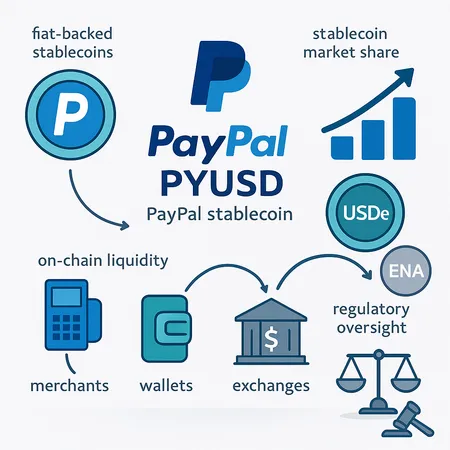
Summary
Quick overview: PYUSD’s meteoric market‑cap growth
In a matter of months PayPal’s stablecoin PYUSD jumped from roughly $1.2 billion to about $3.8 billion in market capitalization. That spike is not just a headline number — it signals a shift in where and how fiat‑pegged liquidity forms and moves. According to coverage of the move, PYUSD’s rapid adoption has been fueled by distribution through existing PayPal rails and a push into merchant settlements, creating an early network effect that many protocol‑native stablecoins lack (Cryptopolitan report).
For product managers and analysts this raises two immediate questions: is this growth principally on‑chain liquidity that traders can tap, or is it reserve liquidity sitting in custodial rails? And what does it mean for smaller or algorithmic stablecoins that are already losing ground?
Drivers behind PYUSD’s rapid growth
PYUSD’s expansion is multi‑factorial. The high‑level drivers are merchant reach, payments‑rail integration, perceived counterparty strength, and distribution mechanics that prioritize fiat settlement.
Merchant reach and payments distribution
PayPal possesses a massive merchant network and an embedded payments UX. When a stablecoin is integrated into merchant checkout flows or to settle balances within a payments ecosystem, adoption can accelerate without consumer crypto literacy — that’s a different growth vector than organic DEX or CEX flows. For many merchants, the simplest path to stablecoin settlement is the one that minimizes engineering lift and legal complexity, and PayPal offers that plug‑and‑play value.
PayPal rails and off‑chain settlement dynamics
The real advantage for PYUSD is PayPal’s rails: deterministic settlement, fiat on/off ramps, and custodial custody relationships with banks and custodians. That creates a supply that is effectively monetized within PayPal’s internal ledger before it ever touches an on‑chain liquidity pool. The result: large nominal supply and usable liquidity within a payments ecosystem, though not all of it is immediately available on DEX order books or cross‑chain bridges.
Brand, reserve perception and partner integrations
PayPal’s brand and institutional relationships reduce friction for enterprise adopters. Even if reserve composition is similar to other fiat‑backed coins, perceived counterparty strength matters for merchant onboarding and treasury usage. Integration partners and custodians also extend reach: the path from a merchant balance denominated in PYUSD to fiat settlement inside traditional banking can be shorter and cheaper than for many protocol-native stablecoins.
Where PYUSD fits relative to contracting niche/algorithmic stablecoins
While PYUSD grows, some niche and algorithmic models are shrinking. Ethena’s USDe is a useful contrast: recent reporting shows USDe supply contracting even as fiat‑backed stablecoins have collectively added billions, underlining a market bifurcation between payments‑oriented fiat coins and speculative algorithmic offerings (Cointelegraph analysis).
That divergence arises from fundamentals: fiat‑backed coins offer straightforward redemption mechanisms and institutionally recognizable custody frameworks; algorithmic models rely on market confidence in their peg mechanics, liquidity incentives and tokenomics which can be fragile under stress.
Practical consequences of contraction
- Liquidity fragmentation: as capital flows into large fiat‑backed rails, DEX liquidity for niche tokens can dry up, raising slippage and trading costs.
- Risk transfer: failures in algorithmic designs tend to produce on‑chain contagion; fiat‑backed rails concentrate counterparty and reserve risks off‑chain.
- Market segmentation: a two‑tier market can form — merchant/treasury stablecoins versus speculative protocol coins.
Implications for fiat‑backed stablecoin dominance and market share
PYUSD’s growth strengthens the thesis that payments ownership drives market share. Fiat‑backed stablecoins issued by regulated entities or embedded into payment ecosystems may capture disproportionate transactional liquidity even if on‑chain trading liquidity remains concentrated elsewhere (e.g., USDT, USDC).
This concentration has three knock‑on effects:
- Settlement gravity — Merchants and treasury desks will prefer coins they can redeem quickly for fiat, increasing the real‑world utility of payment‑aligned stablecoins.
- On‑chain vs off‑chain gap — A large fraction of supply can live effectively off‑chain inside custodial ledgers, so on‑chain metrics understate economic liquidity available to payments ecosystems. For analysts, that means digging beyond DEX TVL and order‑book depth to understand usable supply.
- Competitive moat — Payment providers with existing rails will be able to bundle stablecoin liquidity with other services (remittances, merchant payouts, BNPL), making it tougher for new protocol incumbents to dislodge them.
On‑chain liquidity is still essential for trading, DeFi use cases and cross‑border flows, but the dominant form of transactional liquidity may become tightly coupled to payment platforms.
Merchant and remittance use cases: why PYUSD matters
Stablecoins succeed where they solve frictions. Two natural product overlays for a payments‑backed stablecoin are merchant settlement and remittances.
Merchant settlements: Merchants want predictable fiat value, low settlement latency, and simple accounting. PYUSD can be integrated into payout rails so that merchants receive stablecoin balances that are redeemable into fiat on demand — reducing FX exposure and settlement delays.
Remittances: Remittance corridors value cost, speed and regulatory clarity. A PayPal‑issued stablecoin could reduce corridor costs by minimizing correspondent banking steps when both sender and receiver are within PayPal’s network, though cross‑rail transfers still require bridges and compliance checks.
These use cases favor coins with strong off‑chain settlement guarantees and trusted custodians, not necessarily the deepest DEX liquidity. That’s why merchants or remittance firms might prefer PYUSD over a smaller on‑chain native token with thinner real‑world redemption options.
Regulatory and liquidity‑risk considerations
The growth of PYUSD changes the risk map. Bigger, payment‑native stablecoins invite more regulatory attention while also concentrating reserve counterparty risk. Key considerations:
- Reserve transparency and auditability: Regulators and counterparties will demand clear, frequent proof‑of‑reserves and independent attestations. Lack of transparency increases systemic risk if redemption pressure spikes.
- Redemption mechanics: How fast can large holders redeem into fiat? Delayed or restricted redemptions are real liquidity risks for merchants relying on fiat conversion.
- Concentration risk: If a significant share of merchant settlements sits with a single payment provider’s stablecoin, operational outages or regulatory action pose outsized economic disruption.
- Interoperability and bridge risk: Many payments occur cross‑chain using bridges. Those components introduce smart‑contract and custodial risk and can bottleneck liquidity during market stress.
Analysts should track on‑chain metrics (DEX depth, bridge flows) and off‑chain indicators (merchant settlement volumes, custodial flows, redemption latency). The apparent safety of fiat backing can mask settlement fragility during runs.
Likely market structure outcomes
Given current dynamics, several plausible outcomes stand out:
- Consolidation around payments‑aligned fiat stablecoins — Coins with strong rails and sponsor brands (including PYUSD) will capture merchant and treasury share, narrowing market churn.
- Two‑tier stablecoin ecosystem — One tier for payments and remittances (fiat‑backed, custodial), another for DeFi-native use (DEX liquidity, composability). Cross‑tier bridges will be battlegrounds for liquidity and regulation.
- Increased regulatory oversight — Rapid adoption by a major payments firm will accelerate jurisdictional scrutiny on reserve practices, AML/KYC flows, and systemic risk buffers.
- Service bundling — Payment providers will package stablecoins with settlement, custody, and FX services — raising switching costs for enterprise customers.
These outcomes suggest a more centralized economic footprint for payments liquidity but a persistent technical and composability space for decentralized counterparts.
What product managers and stablecoin analysts should watch now
- Reserve composition updates: frequency and depth of attestations, and whether reserves are cash, commercial paper, or other instruments.
- Redemption queue behavior: how large merchant or partner redemptions are handled during stress.
- On‑chain depth vs off‑chain supply: ratio of circulating on‑chain PYUSD to supply held in custodial PayPal balances.
- Bridge throughput and slippage: how easily PYUSD converts across chains and the friction/costs involved.
- Regulatory filings and enforcement actions: any changes to custody rules, insured deposit requirements, or capital buffers.
Operational playbook items: instrumented monitoring of liquidity across CEX/DEX, contractual SLAs for settlement latency with payment sponsors, and contingency plans for redemption freezes or bridge failures. Platforms such as Bitlet.app and others integrating stablecoins should model not just tokenomics but rails availability and legal recourse.
Conclusion — a payments narrative reshaping stablecoin market share
PYUSD’s jump from $1.2B to $3.8B market cap is more than a numbers story: it’s an early signal that payment‑rail integration and merchant reach can rapidly reallocate transactional liquidity toward fiat‑backed, custodial stablecoins. That reallocation produces both conveniences (cheaper merchant settlement, faster remittances within a network) and risks (reserve concentration, regulatory scrutiny, off‑chain liquidity masks).
For product teams and analysts, the practical response is simple: expand your monitoring beyond on‑chain indicators, prioritize reserve transparency and redemption mechanics in vendor selection, and treat rails ownership as a strategic competitive advantage in the evolving stablecoin landscape.
Sources
- https://www.cryptopolitan.com/pyusd-stablecoin-surges-to-3-8-billion-mc/
- https://cointelegraph.com/news/ethena-usde-contracts-as-fiat-stablecoins-add-billions?utm_source=rss_feed&utm_medium=rss%3F&utm_campaign=rss_partner_inbound
For further context on on‑chain liquidity dynamics and macro market signals, on‑chain order books and DeFi metrics remain useful complements to payments data — and for macro correlation, remember that for many traders Bitcoin still acts as a bellwether for risk appetite.