Dissecting Bitcoin Risk: Options Expiry, Whale Deposits, Sentiment and Tactical Hedges
Summary
Executive snapshot
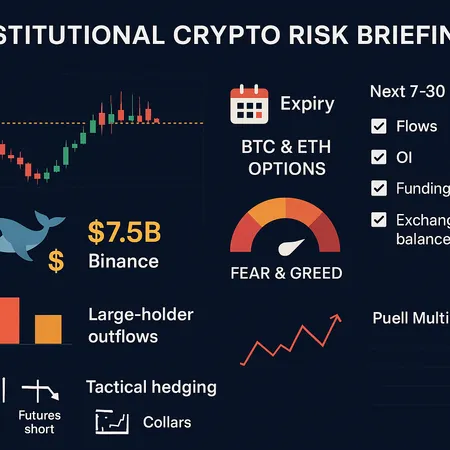
Experienced derivatives traders and institutional risk managers need a short, actionable read: a large BTC/ETH options expiry is concentrated around specific strikes (a max pain clustering), whale deposits to Binance have spiked (~$7.5B reported), and sentiment indicators are skewing toward fear — all of which elevate the probability of short-term downside and pin risk. Below I explain the mechanics, why it matters now, and practical hedges and monitoring signals to use over the next 7–30 days.
1) Options expiry mechanics and the current picture
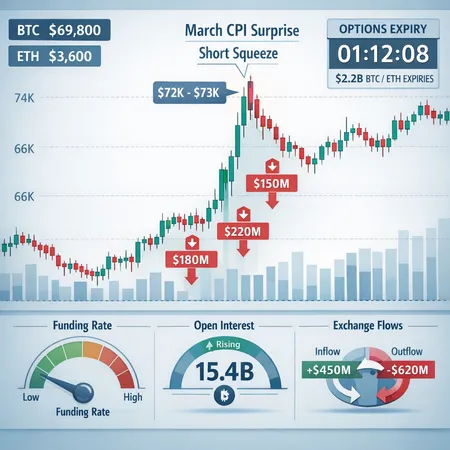
An options expiry becomes a focal point when open interest (OI) clusters near a narrow range of strikes. Large clusters create gamma corridors where market-makers and delta-hedgers must trade underlying BTC aggressively as price moves, amplifying volatility. Recent reporting shows a major BTC and ETH expiry with concentrated OI around what traders call max pain — the strike that would maximize losses for option buyers and theoretically minimize option sellers’ pain if the price pins there at expiry. See the detailed expiry overview for context in this piece on the upcoming event.
Why that clustering matters now: with concentrated OI, even moderate flows can cause outsized spot moves because dealers scramble to rebalance delta. If price approaches a large cluster before expiry, expect higher intraday gamma and sudden squeezes as hedges are established or flipped.
2) Whale deposits and exchange inflows: $7.5B to Binance
On-chain trackers and reporting indicate roughly $7.5 billion of BTC was deposited to Binance within a recent 30‑day window. Large exchange inflows from whales frequently precede sell-side pressure — either because whales intend to liquidate or because they want liquidity to support options/futures positions. Coverage that aggregates these exchange flow figures highlights the correlation between big inflows and increased downside volatility.
Two relevant takes: one report quantified the $7.5B in deposits as a raw flow signal, and another linked similar deposit spikes to evidence of renewed selling pressure and market fear. For risk managers, the simplest rule is: large sustained exchange inflows raise the prior probability of distribution (selling) in the short term. Combine that with clustered OI and you have a setup where the market is vulnerable to a move toward the strikes with concentrated exposure.
3) Sentiment and on-chain miner metrics: amplifiers of downside
Sentiment indicators matter because they change how participants react to flow. The Fear & Greed Index has been stuck in extreme fear territory for an extended run, which historically correlates with weaker bid resilience and higher odds of panic selling during stress. Separate but related, miner economics — measured by metrics like the Puell Multiple — signal when miner revenue relative to historical norms is elevated or compressed. A stretched Puell Multiple can suggest miners are realizing profits; a depressed one can indicate selling pressure if miners need liquidity.
When extreme fear coincides with exchange inflows and clustered options OI, the market’s ability to absorb a large sell shock weakens. That blend — positioning + flow + negative sentiment — is why many desks treat this as a higher-risk window rather than a routine expiry.
4) How expiry mechanics, flows and sentiment interact (what can go wrong)
Put these elements together and several adverse scenarios emerge:
- Pin risk: price becomes magnetized toward the max pain strikes as market-makers hedge, increasing the chance of the underlying being squeezed to that band at expiry.
- Volatility squeeze → crash: concentrated short-delta hedging by dealers can flip into a short-covering spiral if a directional move accelerates, producing fast downside moves and cascading liquidations, especially if leverage in futures is high.
- Distribution prior to expiry: whales deposit to exchanges and sell into bid weakness, depressing price into option clusters and making expiry outcomes worse for longs.
The practical upshot: treat the next few days as a period with asymmetric downside risk even if macro fundamentals remain unchanged.
5) Tactical hedging strategies (traders and allocators)
Below are direct, implementable strategies tailored for either derivatives traders or institutional allocators holding large BTC exposures. Include costs, liquidity, and execution pragmatics.
Short-term trader tactics (0–7 days)
- Protective put buys (short-dated): buy near-term puts that cover exposures through expiry. If cost is high, consider diagonal spreads to reduce premium.
- Put spreads (bear put): buy a lower-strike put and sell a nearer strike to finance cost; useful when you expect a limited drawdown or want cheaper tail protection.
- Collar (sell call / buy put): if you have a long spot position and want to finance protection, sell short-dated calls at strikes outside the clustered OI and buy puts at or below max pain levels.
- Delta-hedged futures: for traders comfortable delta-hedging, sell spot or buy protective options and maintain a delta-neutral stance using futures; be ready to add gamma scalps if volatility rises.
Execution notes: with concentrated OI, liquidity at certain strikes can evaporate—use limit orders or OTC venues for large option fills. If expiries are large, skew and IV can inflate; tighten fill tolerance and size tranches.
Institutional hedges and portfolio-level approaches (7–30 days)
- Laddered protection: layer protection across maturities (near-term puts for immediate coverage, longer-dated puts for tail insurance) to smooth premium decay and avoid a single roll cost spike.
- Put spreads funded with short-dated call overwriting: institutional allocators can sell short-dated, out-of-the-money calls repeatedly to reduce net cost of hedges while monitoring margin and assignment risk.
- OTC bespoke structures: negotiate bespoke barrier puts or knock-in options to pay only if a threshold (e.g., exchange outflows > X, funding spikes) is breached; this can provide disaster protection at lower cost.
- Portfolio rebalancing and cash buffers: reduce gross BTC exposure or increase cash buffer ahead of expiry; cash gives optionality to buy into forced dislocations.
Sizing and governance: cap protection to the portion of the book where downside equity is most painful; model cost vs. tail risk under stressed scenarios and log approvals for notional and counterparties.
6) Monitoring checklist for the next 7–30 days
Actionable indicators and suggested thresholds to watch daily or intraday:
- Exchange balances and inflows: watch net BTC inflows to Binance and other major exchanges; sustained multi-hundred-thousand BTC inflows or large single whale transfers (as flagged by trackers) raise red flags. A sudden spike to the exchange balance after a period of outflows is especially meaningful.
- Open interest by strike (OI heatmap): track OI clusters and changes within 48–72 hours of expiry; large roll volumes or shifts in OI indicate repositioning.
- Max pain vs. spot distance: measure the distance between spot and the largest OI concentration; <3–5% is a magnet zone.
- Funding rates and leverage: monitor perpetual funding; sharp positive funding combined with heavy longs can trigger forced deleveraging if funding flips.
- Options skew and IV term structure: watch put-call skew and front-month IV spikes; rising skew signals demand for downside protection.
- Miner behavior and Puell Multiple: track changes in Puell Multiple and unusual on-chain miner outflows; if miners increase sell-side volume, treat as elevated supply risk.
- Fear & Greed and on-chain sentiment: flag extreme moves into fear as lowering market liquidity tolerance.
- Liquidation stack and concentrated leverage: if concentrated long leverage exists at key futures exchanges, a move toward OI clusters can cascade.
Set automated alerts for large exchange deposits, OI rebalancing > X BTC in 24h, and >Y% IV move in front-month options.
7) Practical scenario playbook (quick moves)
- Scenario A — price approaches clustered strikes before expiry with rising exchange inflows: tighten hedges, add near-term puts or convert some spot to collar, reduce directional futures size.
- Scenario B — price is pinned at max pain at expiry and funding explodes: avoid one-off aggressive conversions; use sized put spreads and staggered roll-offs to reduce slippage.
- Scenario C — deposit spike but OI disperses (rolls out): watch for wash trades; if OI disperses into longer-dated maturities, immediate gamma risk eases but medium-term volatility may rise.
Conclusion
The confluence of a large BTC/ETH options expiry, concentrated open interest near max pain, significant whale deposits to Binance (~$7.5B), and bearish sentiment indicators elevates asymmetric downside risk in the short term. That does not mean price must crash, but it raises the cost of complacency. Use layered, size‑conscious hedges, monitor exchange flows and OI closely, and favor instruments and venues with reliable liquidity and execution. For traders and allocators using platforms like Bitlet.app for trade execution or risk overlays, ensure you coordinate OTC fills and exchange exposure reductions with counterparties to avoid large market impact.
Sources
- Major BTC and ETH options expiry with open interest clustering near max pain — on expiry mechanics and OI clustering
- Bitcoin whale deposits reach $7.5 billion on Binance in 30 days — exchange flow report
- Renewed selling pressure as whale deposits spike — analysis of selling pressure tied to inflows
- Bitcoin Fear & Greed Index stuck in extreme fear — sentiment context
For continued monitoring, combine these public sources with your firm’s execution and on-chain trackers and watch the OI heatmap closely in the hours before expiry. For many desks, Bitcoin remains the core hedge instrument — but execution and structure choice will determine whether protection is effective or merely expensive.