Memecoin ETFs: Why Dogecoin’s Wall Street Debut Didn’t Spark Big Institutional Flows
Summary
Why the Dogecoin ETF debut felt both important and underwhelming
The arrival of a memecoin ETF on Wall Street is a symbolic moment: a mainstream product built around a token once born as a joke. Yet the headlines about the Dogecoin ETF split into two camps. Some outlets called the debut a flop because inflows were effectively negligible; others pointed to measurable first‑day volume and a quick price pop in DOGE. Both observations are accurate and illuminate different parts of the same story.
On the one hand, CryptoSlate argued the debut “flopped” with no meaningful inflow, a useful reminder that listing ≠ demand in institutional balance sheets. On the other, Blockonomi reported Grayscale’s Dogecoin ETF had roughly $1.41M in first‑day volume, and Benzinga captured the on‑the‑ground market action showing DOGE trading higher around launch. That mix — small but visible trading versus absent deep institutional allocations — is the lens we should use to analyze memecoin ETFs going forward.
The difference between headline volume and sustainable institutional adoption
Institutional adoption is more than the ticker going live and a few million in day‑one trading volume. Large asset managers and pensions allocate based on liquidity, custody standards, compliance, and predictable risk profiles. A few reasons a Wall Street product launch doesn’t automatically equal sustained inflows:
- Authorized participants and arbitrage: ETFs rely on Authorized Participants (APs) to create and redeem shares. If APs can’t easily source or hedge the underlying memecoin because of thin order books or counterparty limitations, NAV arbitrage breaks down and spreads widen.
- Marketing vs. mandate fit: Many institutional allocators have strict mandates. A spicy new product may be interesting, but it must pass governance, custody, and suitability checks before allocations occur.
- Short attention span and headline trading: Retail traders and momentum funds can generate noticeable first‑day volumes and price spikes without creating long‑term buy‑and‑hold flows.
- Regulatory and custody friction: Custody solutions for memecoins are now better than before, but some institutions still require additional legal and operational work to onboard these assets.
These factors help explain the apparent paradox: you can see trading volume (Blockonomi, Benzinga) while meaningful long‑term institutional adoption stays muted (CryptoSlate). For many traders, Bitcoin remains the primary market bellwether; memecoins sit in a different risk bucket, and that affects how big allocators respond.
Liquidity anatomy of memecoins: on‑chain activity vs exchange depth
Talking about liquidity for a memecoin like DOGE means interrogating several layers:
- On‑chain liquidity: DEX volumes, wallet activity, and token transfer flows can show real user demand. These numbers sometimes spike around product launches or social media events. But on‑chain activity doesn't always translate into exchange order‑book depth that institutions need for large trades.
- Centralized exchange order books: For institutional-sized orders, you need tight order books on major venues with deep bids and asks. Memecoins often show shallow depth outside of headline windows, which increases slippage and execution risk.
- Market microstructure: High volatility and large bid‑ask spreads create risks for APs performing creation/redemption. If it costs too much to acquire the underlying token or hedge exposure, APs may step back, widening the ETF’s premium/discount band.
That mismatch — lively on‑chain chatter and brief momentum but thin institutional liquidity — is why a memecoin ETF can trade millions of dollars on day one yet not attract large, persistent inflows. This is also where platforms that monitor cross‑market liquidity (including retail tools like Bitlet.app) can help traders estimate slippage and realistic execution costs.
When an ETF is a product — not a guarantee of safety
An ETF packages exposure, compliance, and custody into a familiar wrapper, but it doesn’t erase the underlying asset’s risk characteristics. For memecoins the following are especially relevant:
- Volatility: DOGE and similar tokens can swing double digits in a day. ETF holders must accept that the vehicle will reflect that volatility, and ETF spreads can widen during stress.
- Tracking mechanics: Single‑asset memecoin ETFs are simple in concept but tricky in practice if the ETF must source illiquid tokens every creation cycle.
- Counterparty risk: Who provides custody? Which APs are active? If the pool of APs is small, the ETF’s ability to maintain tight spreads and reasonable NAV locking is impaired.
- Investor base: Early volumes may be retail‑led. Institutional demand tends to be stickier, not just headline driven.
Put bluntly: an ETF can make access easier, but it doesn’t convert memecoin fundamentals into institutional‑grade assets overnight.
Practical checklist for traders evaluating memecoin ETFs
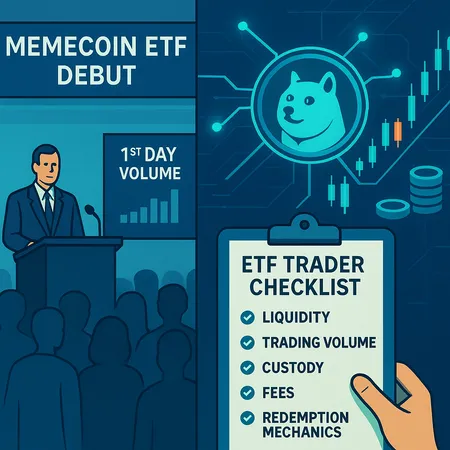
If you’re a retail trader or part of an institutional desk deciding whether a memecoin ETF is an investable vehicle or a marketing event, use this checklist before allocating capital:
- Liquidity mapping: Check order‑book depth across major venues, not just headline volumes. Model expected slippage for your trade size.
- Creation/redemption mechanics: Who are the APs? Can they source DOGE quickly and at reasonable cost? Look at ETF prospectus details.
- Expense and tax considerations: Fees, trading costs, and tax treatment can erode short‑term strategies, especially given memecoin volatility.
- Tracking error and spreads: Monitor premium/discount behavior intraday and during volatile periods. Backtest how the product tracked DOGE in prior price moves or comparable launches.
- Execution rules: Use limit orders, TWAP/VWAP algorithms where appropriate, and size orders to avoid signaling large trades.
- Risk limits and exit plan: Set position size limits relative to portfolio volatility and define clear stop‑losses and exit triggers.
- Operational checks: Confirm custody provider, audit firms, and whether exchanges used for NAV calculation are reputable.
- Behavioral hedge: Expect narrative‑driven spikes. Don’t confuse FOMO‑driven intraday gains with durable adoption.
This practical stance helps separate price action from investability. Media coverage (and even a few million in day‑one volume) is not the same as a durable institutional market.
How to read the first‑day signals: nuance matters
The Grayscale/Blockonomi numbers ($1.41M first‑day volume) and Benzinga’s market color showing DOGE trading higher are useful signals — they tell you there was immediate interest, liquidity to trade, and price responsiveness. But CryptoSlate’s observation that there were effectively no institutional inflows is a different, complementary data point: large, lasting allocations weren't visible right away.
For traders, the takeaway is simple. Treat early headlines as a combination of: short‑term liquidity events + marketing amplification + initial retail/momentum participation. Only over subsequent weeks and months will you see whether APs, custodians, and institutional allocators ratify the product with deeper flows.
Final thoughts: ETF debut ≠ institutional stamp of approval
Memecoin ETFs are an important evolution — they lower barriers to access and formalize custodial and regulatory frameworks. But a launch should be viewed as a product introduction, not an automatic shift of the asset into institutional prime time. Watch liquidity profiles, AP behavior, and premium/discount dynamics. Model slippage for the trade sizes you care about, and use the checklist above.
If you trade these vehicles, stay disciplined: use execution algorithms, size appropriately, and keep a clear exit plan. And keep a sideways glance at the broader crypto ecosystem — activity on DeFi platforms, NFT markets, and macro flows often presages how memecoins behave in the weeks after an ETF debut.
Sources