How BitMine’s 3.63M ETH Reveal and Giant Whale Longs Could Amplify Volatility Around $2.8K–$3K
Summary
Executive summary
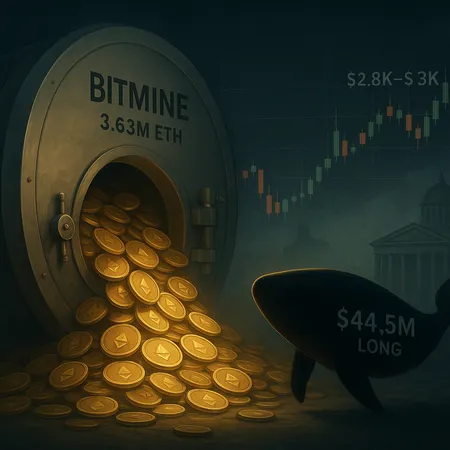
BitMine’s public disclosure that it holds 3.63 million ETH reignited a simple but unsettling question: what happens to price dynamics when a single corporate treasury controls a multi‑billion‑dollar portion of a liquid market? Add to that several large whale longs opened around the $2.8K–$3K region, and the potential for amplified volatility becomes very real. This investigation breaks down the disclosure, evaluates the evidence of large speculative positions, and offers practical governance and risk guidance for portfolio managers and on‑chain analysts tracking ETH.
Dissecting BitMine’s 3.63M ETH disclosure
BitMine’s filing — notable chiefly for the size of the holding — states a 3.63M ETH treasury and discloses an average buy price that other observers quickly questioned. Reporting of large treasuries is not new, but transparency around average acquisition cost matters: if the stated cost basis is materially higher or lower than reality, market expectations about potential selling pressure change.
The reporting details and the ensuing controversy are covered in reporting that highlights conflicting claims about the declared average price and what that implies for disposition incentives and mark‑to‑market decisions. For context, at roughly $2.8K per ETH, 3.63M ETH represents about $10.2 billion of nominal exposure (and about $10.9 billion at $3K) — large enough to meaningfully affect liquidity if sold publicly or if used as collateral in concentrated ways. See reporting on the disclosure and the debate for the specifics of the stated averages and the pushback: BitMine’s disclosure and the buy‑price contention.
Evidence of concentrated speculative bets: whale long positions
Concentration risk comes not only from treasuries that hold spot ETH, but also from leveraged speculative positions that can interact with spot flows. In recent weeks, on‑chain and market surveillance picked up sizable long positions opened by whales: one report documented a $44.5M Ether long opened after an October crash, and another noted a roughly $40M whale flipping long while ETH lingered near $2.8K. These trades are indicative of big players willing to take directional exposure right in the price band where BitMine’s holdings sit. See coverage here: whale opens $44.5M Ether long and $40M whale flips long near $2.8K.
Why this matters: large long positions typically use leverage (perpetual futures, margin, or options). If price moves against them, forced liquidations can create cascading spot liquidity demands that interact poorly with concentrated treasuries — pushing price through technical levels or creating squeezes that quickly move through the $2.8K–$3K band.
How concentrated treasuries and whale activity can amplify price moves near $2.8K–$3K
There are at least three transmission mechanisms by which concentration and whale leverage make a market more fragile around a price band that doubles as a psychological resistance or support level:
- Liquidity evaporation: large sell orders from a treasury or liquidation cascades from leveraged longs can eat through on‑book liquidity very quickly, producing outsized price gaps.
- Stop clustering and cascade mechanics: many market participants place stop losses and liquidation triggers in similar ranges (e.g., just below $2.8K). A concentrated shock can trip these stops, producing nonlinear downside.
- Reflexivity between spot holders and derivatives: a big spot seller can lower perceived liquidity and increase funding pressure on perp markets, which can in turn make leveraged positions more vulnerable to liquidation — a feedback loop.
The interaction is asymmetric. A large, well‑executed OTC sale by a treasury may have limited market impact if handled properly, but panic selling or rushed liquidation magnifies harm. Conversely, concentrated buying or a short squeeze can push ETH through resistance and create rapid upside moves, which also exacerbate volatility for market makers and passive liquidity providers.
This dynamic is why traders now watch the $2.8K–$3K band closely: it’s where both the reporting on BitMine’s holding and multiple whale longs appear to place marginal pressure.
Quantifying concentration risk: metrics and heuristics for managers
For portfolio managers and on‑chain analysts, the first job is measurement. Useful metrics include:
- Treasury share of circulating supply: convert treasury ETH into percent of free float (i.e., exclude locked protocol reserves). For a 3.63M treasury, this is non‑trivial and deserves a headline number in board‑level risk reports.
- On‑chain realized price distribution: the histogram of acquisition prices for large wallets helps estimate potential sell thresholds and the probability of “pain selling.”
- Exchange inbound/outbound flow vs. treasury size: how much spot liquidity would need to be taken from order books to absorb hypothetical sales? Compare daily volumes to the treasury notional in local price bands.
- Derivatives open interest and liquidations map: monitor perp funding, options open interest around strike levels near $2.8K–$3K, and any abnormal clustering of margin activity.
- Concentration of custody and counterparty risk: which custodians or OTC desks service the treasury? Are there single‑point failure distress scenarios?
A practical rule of thumb: if a treasury exceeds a meaningful fraction of daily traded volume (e.g., >20–50% of ADV in a stress window), it cannot be ignored. That threshold shifts dynamically with realized liquidity depth and market structure changes from DeFi market‑making or centralized exchange order book depth. On that point, DeFi pools may provide apparent liquidity, but AMM depth is thin at scale versus centralized order books — a distinction managers must make when modeling slippage.
Scenario analysis: three cases and expected market mechanics
Scenario 1 — Coordinated OTC distribution: the treasury sells in staged OTC blocks at pre‑arranged prices. Market impact is minimized; volatility increases modestly. Risk mitigation: ensure staggered auctions and use block trades.
Scenario 2 — Forced public sell under stress: macro shock triggers margin calls across the market. Treasury or leveraged holders dump into thin books; stops trigger; a cascade pushes ETH well below $2.8K before liquidity normalizes. This is the worst short‑term outcome for price stability.
Scenario 3 — Buys and squeezes: whales add leveraged longs and, combined with positive news or ETF flows, create a squeeze that pushes price through $3K quickly. Short sellers are crushed and funding spikes, producing a fast‑moving rally followed by volatility.
Each scenario has different implications for counterparties, market makers, and liquidity providers. Managers should stress test portfolios for a range of slippage, execution lag, and recovery times.
Governance and risk takeaways for holders and funds
For funds, treasuries, and managers, practical steps to reduce tail risk include:
- Transparent reporting and realistic cost‑basis disclosure: clarity reduces market speculation about forced selling and saves the fund reputational risk. BitMine’s case demonstrates why average price claims will be scrutinized.
- Staged liquidity buffers: keep a portion of treasury in more liquid forms or commitments (e.g., stablecoin reserves, staggered OTC release schedules) rather than all spot ETH if selling is a credible governance option.
- Execution discipline: avoid headline‑making block sales on public books; favor negotiated OTC trades and dark‑pool style execution when unwinding large size.
- Hedging strategies: use options and structured collars to cap downside in stressed markets. For directional exposures correlated with treasury size, delta‑neutral hedges or size limits on leverage reduce cascade risks.
- Active monitoring and stress tests: simulate the interaction of treasury sales with derivatives OI and funding, maintaining a dashboard of on‑chain and off‑chain liquidity metrics.
- Counterparty diversification: don’t rely on a single custodian, prime broker, or OTC desk for exit options.
- Governance coordination with DeFi counterparties: many protocols and LPs hosting treasury liquidity need active communication channels to coordinate soft closures or rate adjustments if a treasury rebalances.
Funds should also codify size limits relative to market depth and embed mandatory approval for any public sell actions beyond predefined notional thresholds.
Practical tooling and signals to watch
On‑chain analysts and PMs should combine real‑time data feeds (exchange order book depth, perp funding, options skew) with wallet‑level monitoring to detect moves. Alerts to set:
- Surges in exchange inflows from large wallets or custody addresses.
- Sharp rises in concentrated derivatives OI clustered at near‑term strikes around $2.8K–$3K.
- Sudden reduction in AMM depth in major DeFi pools supporting ETH pairs.
- Rapid changes in funding rates or open interest spikes that often precede liquidation events.
Bitlet.app and other portfolio platforms can be useful for tracking allocations and running stress sims, but the onus remains on managers to calibrate execution vendors and hedging strategies.
Conclusion: concentration is not just a balance sheet fact — it’s a market‑structure risk
The BitMine disclosure and recent whale longs are a reminder that on‑chain concentration and leveraged positions interact with market microstructure in ways that can multiply volatility — especially around psychologically important bands like $2.8K–$3K. For portfolio managers and on‑chain analysts, the answer is not panic but measurement: quantify treasury influence, map derivatives exposures, stress test scenarios, and put governance guardrails in place. That combination of transparency, execution discipline, and hedging is the most effective way to reduce tail‑risk when a handful of players control outsized shares of the Ethereum market.