Chainlink Outlook: Can LINK Reclaim $19? Technicals, Oracle Demand, and Trade Plans
Summary
Quick snapshot: where LINK stands now
Chainlink is trading in the mid-$14s as of the published price call that projects a recovery toward roughly $19.32. That projection is plausible if LINK can defend its near-term technical floors and on‑chain signals show renewed utility — most notably rising oracle demand and fee capture for operators. For traders and analysts, the next 2–8 weeks should answer whether this is a measured rebound or a relief bounce inside a deeper drawdown.
Technical setup: critical levels, structure, and what matters
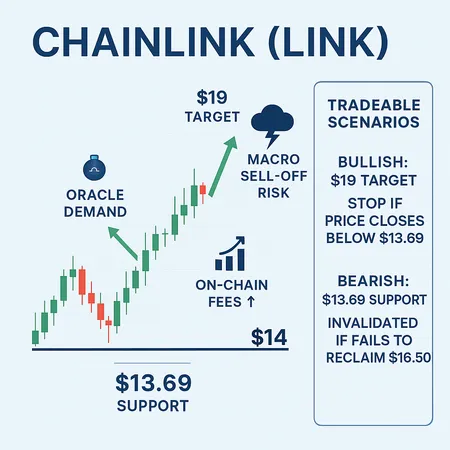
The most important technical detail to carry forward is the immediate support flagged near $13.69 — the level many market models and technical watchers treat as the short-term line in the sand. A clean hold and recovery from that price preserves the thesis that LINK can attempt to re-test the $18–$20 supply zone where sellers historically reappear. The external price note projecting a return to ~$19.32 summarizes this exact path, assuming support holds and momentum returns (Chainlink price prediction and recovery view).
Key technical points to watch:
- Support: $13.69 (immediate), then a deeper buffer near $11–12 if bearish pressure intensifies.
- Resistance: $17–19 is the first major friction band; beyond that, prior highs around $23–25 become relevant.
- Trend context: LINK is behaving like many altcoins — rangebound inside a lower-high regime since the last major top. A weekly close above the mid-$17s would tip the structure toward a cleaner recovery.
Avoid anchoring to one indicator. Use volume confirmation on any bounce; a spike on lower timeframes without expanding traded volume is more likely short-lived.
On-chain fundamentals: oracle demand and fee metrics that matter
Price action will follow real utility over time. For Chainlink, the clearest on‑chain fundamental is oracle demand — the number and complexity of data requests, cross-chain messaging volume (e.g., CCIP-related flows), and node operator fee capture. Rising requests and higher per-request fees are bullish signals because they translate directly into perceived value and developer confidence.
What to monitor on-chain and off-chain:
- Request counts and unique consumer contracts: a steady uptick suggests real product adoption across DeFi and Web3 use cases.
- Gas/fee capture trends for node operators: improving fee metrics mean participants reap incentives, reducing chances of node churn.
- Integrations and partnership announcements: new oracle consumers (or major DeFi protocols) are catalysts for renewed flows.
None of these are binary triggers — instead they change the probability distribution for a sustained move higher. If oracle demand recovers alongside a return of DeFi activity and re‑risking, LINK’s rally toward the $19 level cited by some models becomes far more defensible.
Macro and market risks: why Bitcoin matters here
Altcoin recoveries are rarely independent of Bitcoin's trajectory. The recent broader market drawdown and themes of a 'Bitcoin bloodbath' have meaningfully increased downside risk for altcoin rebounds; severe BTC weakness usually drags LINK and other oracles lower, regardless of on‑chain improvements (context on the broader market drawdown).
Practical macro checks:
- BTC daily closes and realized volatility spikes — if BTC sustains a panic range lower, treat bullish LINK setups as higher-risk fades.
- Risk-off liquidity events: order book depth in ETH and USDC pairs can evaporate and amplify moves.
- Funding rates and derivatives deleveraging: rapid negative funding and long liquidations often precede deeper altcoin dips.
In short, bullish LINK views require at least a neutral-to-bullish macro backdrop. Without it, even healthy on-chain growth may be priced out temporarily.
Realistic catalysts that could drive a $19+ move
- Renewed DeFi re‑risking: if lending, derivatives, or synthetic assets increase activity and require reliable oracles, LINK benefits directly.
- Visible uptick in oracle request volume and node fee capture: measurable weekly increases in requests are a concrete demand signal.
- Product upgrades or CCIP adoption news: major integration or cross‑chain flows can reframe the narrative about Chainlink’s role in multi‑chain infrastructure.
- Macro tailwinds: BTC stabilizes and risk appetite returns, allowing capital to rotate back into altcoins.
These are near-term realistic catalysts. None guarantees a straight run to $19, but combined they improve odds materially.
Tradeable scenarios with clear invalidation rules
Below are four structured scenarios tailored for intermediate traders and on‑chain analysts. Each includes a thesis, tactical entry, targets, and explicit invalidation rules.
Scenario A — Conservative swing: Buy the structural support
- Thesis: LINK holds $13.69 and reclaims $15 with volume; on‑chain demand stabilizes.
- Entry: Build a position between $14.00–$15.00 (scale in across the range).
- Targets: Partial take-profit at $17, more at $19; final trim if price approaches prior supply near $23.
- Invalidation/stop: Close below $13.50 on a daily basis (or a decisive break and retest under $13.69). If price closes below $12.00, exit fully — that moves the structure into a deeper bear regime.
Scenario B — Aggressive dip buyer
- Thesis: Short-term capitulation gives an asymmetric entry; expect a reflex bounce to $16–18.
- Entry: Enter smaller sized position near $13.00–$13.69 (add only with a clear volume spike or on‑chain uplift signal).
- Targets: $16 first, then $18–19 as stretch.
- Invalidation/stop: If price breaks $13.69 without immediate recovery and closes daily below $13.00, cut risk. A second-level invalidation is a sustained close below $11.50.
Scenario C — Momentum breakout play
- Thesis: LINK pushes above $17 with expanding volume, signaling a structural repair and a run to $19–23.
- Entry: Take a position on a daily close above $17 with above-average volume.
- Targets: $19.3 (model target) first, then $23–25 for swing traders.
- Invalidation/stop: If momentum stalls and price falls back below $16.00 with contraction of volume, exit partial or full. A daily close below $15.00 invalidates the breakout.
Scenario D — Risk-managed short / hedge (for macro-driven downside)
- Thesis: Macro shock (sharp BTC drop) will drag LINK toward lower support bands.
- Entry: Small short or options hedge once BTC breach thresholds or LINK closes decisively under $13.69.
- Targets: $12, then $10–11 depending on macro severity.
- Invalidation/stop: If BTC stabilizes and LINK reclaims $14.50–15.00 with momentum, unwind hedge.
Position sizing guidance: keep exposure per scenario consistent with your total portfolio risk (e.g., 1–3% of portfolio per trade for conservative traders; smaller for leveraged trades).
Practical execution and risk controls
- Use limit entries and stagger buys to avoid catching a falling knife.
- Watch funding rates on perpetuals: sustained negative funding suggests momentum is against longs.
- Tie trade decisions to both price structure and on‑chain signals — a price bounce without improved oracle demand is a higher-failure trade.
- Consider using trailing stops to preserve profits if price moves quickly to target bands.
Conclusion: balanced odds, conditional thesis
A recovery to the ~$19 area is credible as a technical and model-based target — particularly given the price projection at ~$19.32 — but it is not guaranteed. The short-to-medium term outcome depends on two linked conditions: (1) LINK must hold the immediate support near $13.69 and (2) on‑chain oracle demand (and fee metrics) should show stabilization or growth. If both occur while macro conditions remain neutral-to-bullish, traders can favor the conservative swing or momentum breakout scenarios. Conversely, a daily close below $13.50–13.69 increases the probability of a deeper retracement and should act as a clear invalidation for most bullish plans.
For those tracking metrics, combine on‑chain dashboards with order book and derivatives data: the first signs of re‑acceleration in request volume are as important as the technical structure. Lastly, keep position sizing discipline front and center — volatility around oracles and altcoins can be sudden, and tools like options or small hedge positions can help manage those tail events.
Bitlet.app users and other traders should use these scenarios to decide whether to add, reduce, or hedge positions in LINK based on their risk tolerance and time horizon. For more onacles / market category context, see Chainlink and the broader implications for DeFi.
Sources cited: Chainlink recovery projection and level discussion from industry coverage, and market-wide context on the recent Bitcoin-led drawdown that raises altcoin downside risk (Chainlink price projection and support notes, Bitcoin broader drawdown and implications).