Why Altcoin ETFs Haven't Stemmed the Selloff: Solana's Push, XRP's Debut, and What to Track
Summary
The accelerating race for altcoin spot ETFs — what changed
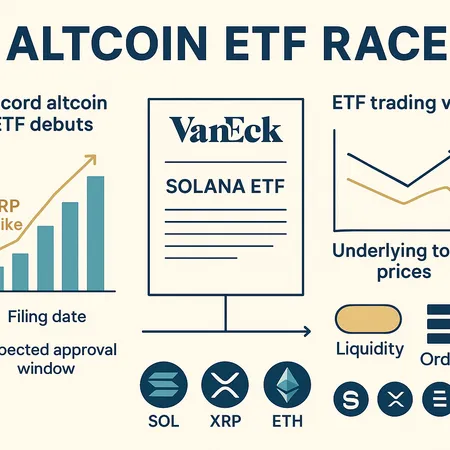
The narrative around altcoin ETFs moved from theoretical to tactical in recent weeks. VanEck’s fresh SEC filing for a Solana spot ETF has signaled that major asset managers are prepared to push beyond Bitcoin and Ethereum into the next wave of tokenized products, and filings are starting to pile up in public view. Reporting on VanEck’s move framed it as a near-term shove toward an SEC decision window rather than a distant possibility (Blockonomi).
At the same time, actual product launches for altcoin ETFs are producing headline-grabbing trading figures. An XRP ETF debut printed unusually high secondary-market activity, highlighting investor curiosity but also introducing an awkward truth: strong ETF volume does not automatically translate to rising spot prices for the underlying protocol. That divergence — ETF trading versus token price action — is the central puzzle for researchers and portfolio managers today.
VanEck’s Solana ETF filing: timeline and implications
VanEck’s filing (summarized in the Blockonomi piece) shows the typical sequence: file with the SEC, await comment and potential objections, then either receive approval or a longer review. Historically, spot ETF timelines have varied — the SEC’s approach to crypto ETFs has been incremental, and precedents (BTC, ETH) suggest approval windows can compress once the agency signals a consistent framework, but there is no guaranteed fast path.
What to expect next:
- Formal SEC review and possible comment period. This can take weeks to months.
- Market participants (market makers, APs) will refine their arbitrage and custody plans; that operational readiness matters more than the mere filing.
- If approved, initial inventories and AP behavior will determine whether the ETF creates immediate spot-buy pressure or simply trades as a derivative proxy.
For Solana (SOL) specifically, the question is whether the Solana ecosystem’s on-chain liquidity and exchange orderbook depth can absorb creation flows without large slippage. Recent technical weakness in SOL prices — including a breakdown below key support zones — shows the token can be vulnerable to continued selling pressure even as ETF structures are being built (NewsBTC analysis).
ETF debuts: record volumes without price relief (the XRP example)
New altcoin ETFs have smashed debut records for secondary trading volume, but that does not equal immediate spot buying. The Canary Capital-managed XRP ETF posted roughly $58 million in first-day volume, a notable sign of investor interest on the exchange layer (crypto.news). At the same time, reporting has pointed out a broader pattern: altcoin ETF launches can hit high trading prints while the underlying token prices drift or fall (Coinpedia).
Why the mismatch?
- Secondary-market volume in an ETF mainly reflects exchange trading between buyers and sellers of ETF shares, not direct acquisition of the underlying token. High turnover can be liquidity and speculation on the product itself.
- Creation/redemption mechanics (where APs create ETF shares by delivering basket constituents or receive redemptions for underlying tokens) are where ETFs touch the spot market. If most activity is intra-ETF trading with limited net creations, underlying spot demand remains muted.
- APs and market makers may prefer to hedge exposure synthetically (using futures, swaps, or borrowing/lending) rather than buying large parcels of spot tokens, especially if on-chain liquidity is thin or custody/friction costs are high.
In short: an eye-popping ETF debut is a signal of interest, not proof of durable buy-side pressure for SOL, XRP, ETH, HBAR, or other altcoins.
The plumbing matters: fund flows, creation activity, and on-chain liquidity
For ETF inflows to support token prices, three plumbing pieces must line up: net fund flows into ETF shares, AP creation/redemption activity that sources actual spot tokens, and sufficient on-chain/exchange liquidity to absorb buys without crushing prices.
Key mechanics to watch:
- Net ETF fund flows and AUM acceleration. Sustained net inflows over days/weeks are stronger evidence than a single-day volume spike.
- Creation vs redemption data. Creations that require APs to buy spot tokens are direct demand. Redemptions can release supply back to the market.
- Authorized Participant behavior. Are APs buying spot on exchanges, or are they hedging synthetically (futures, swaps)? Synthetics add little to spot demand.
- Exchange reserves and orderbook depth. Falling exchange balances often precede price rallies because they indicate tighter available sell-side liquidity.
- DEX pool depth and slippage. For chains like Solana, AMM liquidity in token/USDC and token/USDT pools matters more than single exchange orderbooks in some cases.
- Stablecoin supply and on-chain transfer activity. Large inflows of stablecoins to exchanges and DEXes can fund effective buying pressure.
Monitoring these signals provides a clearer signal than ETF trading volume alone. For example, if an XRP ETF prints big volume but exchange balances of XRP remain flat or increase, the ETF activity likely didn’t represent fresh spot buys.
Practical dashboards and metrics for altcoin portfolio managers
If you manage an altcoin book or research ETF-driven flows, build or track the following metrics daily:
- ETF daily net flows and cumulative AUM change (provider filings, exchange reports). Track premiums/discounts to NAV.
- Creation/redemption tallies (where available) and timing relative to price moves.
- Exchange reserves for SOL, XRP, ETH, HBAR (watch for multi-day drawdowns as a bullish sign).
- DEX liquidity (TVL in relevant pairs, 24h depth, slippage to fill $50k/% trade).
- Stablecoin on-exchange balances and transfer volumes into major AMMs.
- Derivatives skew: futures basis and open interest. A rising futures basis can mean dealers expect sustained demand or are paying to hedge.
- AP public activity: filings, notices, or known market maker commentary indicating they’re sourcing spot.
Concrete thresholds (rules of thumb):
- Sustained net ETF inflows for 7+ trading days, accompanied by positive creation prints, increases the likelihood ETF demand converts to spot buying.
- 5–10% decline in exchange reserves over a two-week window for a token often precedes price relief, assuming stable or rising demand signals.
- Tightening ETF NAV premium (or moving from discount to premium) alongside inflows suggests the ETF is commanding real buying pressure.
Risks, caveats, and structural considerations
Even when plumbing aligns, several risks can blunt the price impact:
- Market makers may prefer synthetic hedges during high volatility, muting spot demand.
- Regulatory shocks or SEC guidance changes can alter the path for approvals and market structure overnight.
- Concentration risk: a small number of APs or custodians controlling most creation/redemption flows can introduce operational bottlenecks.
- On-chain congestion, custody limits, and slippage are real: if APs fear large execution costs on-chain, they’ll avoid taking spot exposure.
Also, remember that ETFs can compress volatility by providing an easier access point for investors. That is beneficial for adoption but does not guarantee higher token prices — ETFs may redirect retail activity away from spot exchanges into products that trade as their own asset class.
How to read the tea leaves: when ETFs will likely start supporting altcoin prices
The most reliable signal that altcoin ETFs are moving from headline to price-support is not a single blockbuster volume day but a pattern:
- sustained net ETF inflows for multiple weeks, and
- recurring creation activity that forces APs to acquire spot tokens, and
- concurrent tightening of exchange reserves and improved on-chain liquidity.
If you see that trifecta for SOL, XRP, ETH, or HBAR, odds increase that ETF-driven demand will start to matter at market prices. Until then, large ETF debut volumes should be treated as interest metrics rather than proof of durable buy-side pressure.
Bottom line for researchers and portfolio managers
Altcoin ETFs are a meaningful structural development and could be a long-term positive for token demand — but the path from filing to price rally is non-linear. VanEck’s Solana filing accelerates the race, and debut ETF volumes (like XRP’s) show investor appetite on the exchange layer. However, the missing link so far is consistent creation-driven spot purchases and on-chain liquidity that can comfortably absorb those flows.
Track fund flows, creation/redemption prints, AP behavior, exchange reserves, and DEX liquidity as forward-looking indicators. Tools and dashboards — including institutional-grade data alongside platforms such as Bitlet.app for payment and flow monitoring context — will give portfolio managers the early read on whether ETF demand is transforming into lasting support for SOL, XRP, ETH, HBAR, and other altcoins.
References: VanEck’s filing and market context at Blockonomi, reporting on altcoin ETF debuts versus token price action at Coinpedia, the XRP ETF volume snapshot at crypto.news, and Solana technical pressure documented by NewsBTC.
Internal resources: Solana, AltcoinETFs, XRP