Safe‑Haven Liquidity: USDT vs USDC and the Rise of On‑Chain RWA Stablecoins

Summary
Why stablecoins act as a safe haven when markets turn
When risk aversion spikes, market participants look for ways to preserve capital while staying close to the market. Stablecoins sit in that sweet spot: they offer price stability, on‑chain settlement speed, and immediate access to DeFi rails and centralized venues. Traders can exit volatile spot positions to a stablecoin and re‑enter without waiting for fiat settlement. Treasurers use stablecoins as short‑term parking to maintain yield or to move liquidity across chains and venues quickly.
This behavior drives what we call stablecoin dominance — the share of liquidity and volume that stablecoins command relative to the broader crypto market. In stress episodes, dominance rises because stablecoins become the most liquid, low‑volatility asset that still enables rapid on‑chain operations and composability with lending markets, AMMs, and custody providers like exchanges and OTC desks.
Tether (USDT) surge: mechanics and implications
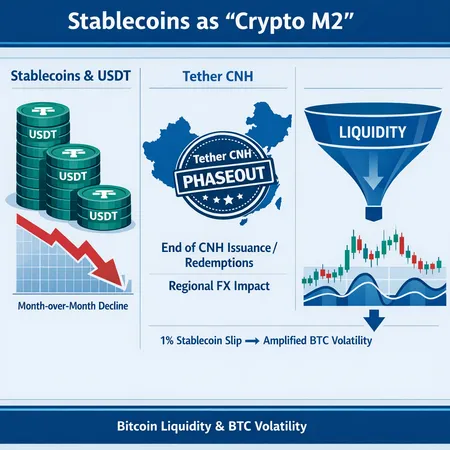
Recently USDT dominance climbed to its highest level since April. That surge is a classic flight‑to‑liquidity: USDT has the largest circulating supply and deepest on‑chain liquidity pools across multiple blockchains, so in chaotic markets it tends to take on outsized volume. For traders, the practical benefits are immediate — tight bids/asks, low slippage in USDT pairs, and widespread acceptance as collateral across CEXs and DEXs.
But liquidity concentration comes with caveats. USDT's market position depends partly on market participants' willingness to accept Tether's operational model and disclosure cadence. For institutional treasuries, the questions are: can you redeem at par reliably? What are settlement timings and counterparty controls? Historically, USDT has traded very close to $1 even during stress, but the underlying reserve composition and legal/regulatory posture differ from alternatives, and that shapes risk appetite for treasury managers.
USDC, Coinbase–Kalshi arrangements, and the regulatory/custody picture
USDC has carved a reputation with many U.S.‑facing institutions by emphasizing reserve backing, monthly attestations, and more explicit regulatory engagement. Recent operational arrangements — for example, Coinbase’s cooperation with platforms such as Kalshi around the custody or management of USDC reserves — underscore how USDC is being treated as an institutional grade on‑ramp/off‑ramp mechanism. Those custody lines and banking integrations can increase confidence for organizations that need a predictable redemption path into fiat.
Regulatory and custody implications matter for treasury desks: USDC issuers and major custodians may have the ability to freeze addresses, comply with law enforcement requests, and coordinate with regulated banks. That provides a level of operational predictability and compliance alignment that some institutions prefer, even if it means slightly narrower on‑chain fungibility in edge cases. By contrast, a purely market‑driven reserve approach prioritizes liquidity and ubiquity over the same sort of institutional guarantees.
The practical upshot: if your mandate prioritizes clear fiat redemption channels, on‑chain custody integrated with regulated custodians like exchanges or qualified custodians is a material factor. See how USDC is increasingly used in institutional workflows for this reason.
RWA stablecoins (example: Polygon R25) — opening institutional yield on‑chain
A new wave of stablecoins is backed not by short‑term cash equivalents but by tokenized real‑world assets (RWA): commercial paper, short‑dated treasuries, municipal debt, or even receivables. The Polygon‑based R25 is an example of a yield‑bearing RWA stablecoin designed to deliver a stable peg plus an embedded yield derived from off‑chain instruments. By issuing on Polygon, R25 leverages low gas fees (MATIC) and fast finality to make institutional on‑chain strategies cost‑effective.
RWA stablecoins change the calculus for institutional treasury in three ways:
- Access to yield: Instead of sitting idle in non‑yielding bank accounts during risk‑off, treasurers can hold RWA stablecoins that generate a spread over fiat equivalents while remaining on‑chain and liquid.
- Composability: Because these tokens live on a blockchain like Polygon (POL), they can be used as collateral in lending markets, staking strategies, or AMM liquidity provision — unlocking yield layering that traditional money market funds don't offer.
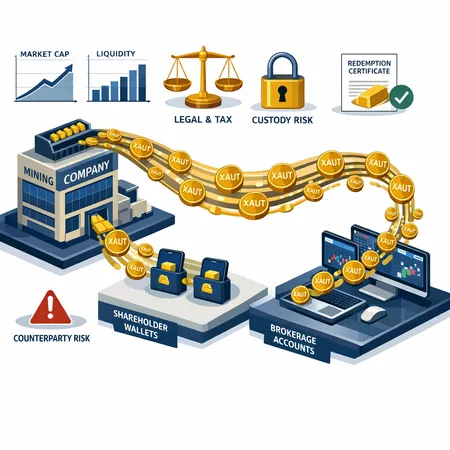
- Counterparty and credit exposure: RWA tokens introduce credit risk tied to the underlying assets and originator. Legal structures (special purpose vehicles, custodial transfers, and trustee frameworks) determine seniority and recovery paths.
Institutional adoption will depend on rigorous legal wrappers, transparent audit and custody practices, clear redemption mechanisms, and regulatory clarity — all areas where RWA projects must match or exceed traditional custody standards to win treasury mandates.
Comparing the instruments: USDT, USDC, and RWA stablecoins
No single stablecoin is the universal right answer. Instead, treasurers should match instrument features to their objective: capital preservation, instant liquidity, regulatory compliance, or yield.
- Liquidity and market access: USDT generally wins for pure on‑chain and cross‑exchange liquidity — lowest slippage and deepest pools. If immediate execution and minimal routing friction are the priority, USDT is often optimal.
- Regulatory alignment and fiat redemption: USDC offers clearer reserve statements and stronger ties to regulated custodians and banking rails. For firms with strict compliance or KYC/AML needs, USDC plus custodial arrangements (e.g., via Coinbase) reduces operational friction when converting back to USD.
- Yield and treasury optimization: RWA stablecoins like R25 aim to provide yield while preserving peg — attractive for treasurers seeking higher short‑duration returns without leaving the chain. But that yield comes with credit, liquidity, and operational complexity that needs active management.
Think of it as a three‑way tradeoff across Liquidity / Compliance / Yield. Your allocation can — and often should — be a mix depending on time horizon and counterparty tolerance.
Practical checklist for treasury desks and institutional traders
When assessing off‑ramp liquidity and on‑chain yield options, use this operational checklist:
- Counterparty & issuer transparency: Are there regular attestations or audits? Who are the custodians and banks? What legal entity issues the token?
- Redemption mechanics: Can you redeem on‑chain for fiat at par? What are settlement times and fees? Are there minimums or KYC constraints?
- Liquidity depth: Measure typical spread and slippage on venues you use. Simulate a stressed withdrawal scenario to estimate impact.
- Regulatory and freezing risk: Does the issuer or custodian have unilateral freeze or clawback powers? How does that align with your compliance policy?
- Credit and asset risk (for RWA): What assets back the stablecoin? What is the credit profile, duration, and concentration risk of the underlying pool?
- On‑chain composability: If you plan to deploy tokens into DeFi, assess smart contract audit history, oracle reliability, and bridge risk between chains.
Operationally, maintain playbooks for three scenarios: immediate liquidation (need maximum liquidity, low slippage), orderly redemption (compliance and bank rails matter), and yield deployment (RWA or short‑duration strategies). Keep liquidity buckets allocated across instruments rather than a single provider.
Execution tips during risk‑off windows
- Pre‑fund corridors: Maintain small, ready balances of both USDT and USDC on the venues where you trade most. That avoids time lag and bridge congestion.
- Use layered exits: Convert a portion to USDT for immediate liquidity and another portion to USDC if you require clean fiat rails or regulatory comfort.
- Vet RWA operational cadence: If using RWA stablecoins for yield, check the periodicity of yield accrual, redemptions (in‑kind vs fiat), and liquidity providers for those tokens.
- Monitor stablecoin dominance and on‑chain flows: A rapid shift toward one stablecoin can tighten liquidity elsewhere — watch order books and DEX pool depths in real time.
Final considerations — aligning policy, risk appetite, and technology
Stablecoin selection is not just a market‑microstructure choice; it is a policy one. Institutional treasury mandates should codify acceptable instruments, set concentration limits, define redemption processes, and require counterparty due diligence. New RWA stablecoins like R25 on Polygon (POL/MATIC) expand the toolkit, offering yield while preserving on‑chain advantages, but they must clear higher legal and operational bars.
For treasury teams and institutional traders assessing these options, prioritize clarity: know the redemption path, the custodian, the legal vehicle, and the fail‑safe playbook. Keep liquidity diversified — a blend of USDT for instant on‑chain depth, USDC for regulated fiat rails, and selective RWA exposure for yield can be an effective, risk‑balanced approach.
Bitlet.app and other treasury tools are increasingly integrating multiple stablecoin rails to make these allocations operationally efficient — but the ultimate decision rests on your compliance, credit tolerance, and execution needs.
Stablecoins and USDC will both remain central to institutional on‑chain liquidity, while RWA offerings will force treasuries to modernize their credit and custody playbooks if they want yield without leaving the blockchain.