The Economics of Decentralized Communication: Lessons from the Dmail Shutdown
Summary
Why Dmail's closure matters for decentralized email
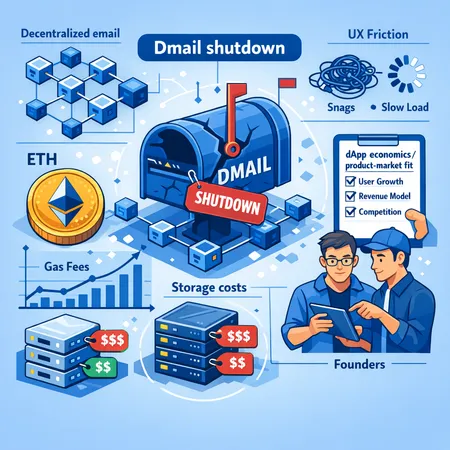
In March 2025 the Dmail Network announced it would cease operations, pointing to rising infrastructure expenses and unsustainable economics as core reasons for winding down. The developer statement cited the gap between the protocol’s ambitions and the reality of long-term storage and bandwidth costs — a familiar refrain in decentralized services that promise permanence and censorship resistance.
This is more than a single-project failure. Dmail's exit shines a light on a core tension in decentralized communication: users expect email-like permanence and near-zero marginal costs, but decentralization externalizes costs (storage, replication, bandwidth) in ways many token economies don't adequately cover. For many builders evaluating decentralized messaging, the DMAIL case is a cautionary example about conflating decentralization ideals with viable product economics.
The main cost drivers for decentralized messaging
Not all costs are created equal. The most important budget line items for a decentralized email or messaging project are:
Storage: Long-term storage of messages, attachments, and indexes is the single largest and most predictable cost. Storing terabytes or petabytes of user data — with multiple replicas for availability — compounds quickly. Even with content-addressed systems, each stored byte has a long tail of retention costs.
Bandwidth: Delivery, replication, and retrieval of message payloads create ongoing egress and networking costs. Messaging systems with high attachment volumes or media-heavy threads are bandwidth-intensive.
Indexing & Search: To provide usable email-like UX, projects must index content for search and thread reconstruction; that requires CPU, I/O and often specialized infrastructure.
Identity & Anti-spam: Sybil resistance, reputation systems, and spam filtering require compute and storage overhead, and sometimes off-chain human moderation costs.
On-chain transaction fees & UX costs: If a protocol uses an L1 for metadata, timestamps, or access control, fluctuating gas fees (e.g., on ETH) and failed transactions introduce variable costs and user friction.
Dmail explicitly pointed to recurring operational costs as unsustainable. When you model messaging usage, storage and bandwidth dominate; everything else stacks on top and erodes margins for token-based incentives or free-tier models.
Why network-level failures and UX friction matter
Decentralized apps don’t operate in a vacuum. Execution problems on major L1s can create cascading UX and cost issues for higher-layer services. A recent analysis shows how spikes in failed transactions and broader execution instability create hidden costs and poor experiences for dApps that rely on the chain for settlement and coordination.
When transactions fail or congestion rises, users face delays, retries, and sometimes lost work. For messaging products this can look like message send failures, delayed delivery confirmations, or higher-than-expected refunds for gas — all of which increase support burden, degrade retention, and create unpredictable costs for the operator.
For projects that stitch on-chain anchors to off-chain content, failed txs add latency and complexity: retries consume gas, off-chain systems must remain consistent after partial operations, and user trust degrades. This phenomenon was well-documented in the broader dApp ecosystem and is a relevant parallel to the pressures Dmail cited.
Where decentralized messaging can survive (and thrive)
Decentralized communication has several niches where it can be sustainable — but only if designs and incentives are tuned to real costs.
Private, high-value communications: Legal, financial, or political communications where users value censorship resistance and privacy enough to pay predictable fees for storage and delivery.
Open communities with shared cost models: Large DAOs and communities can jointly fund storage and bandwidth through subscriptions or treasury allocations — effectively pooling costs across high-engagement groups.
Ephemeral messaging and identity proofs: Use cases that avoid long-term storage (e.g., ephemeral social updates or on-chain attestations) dramatically reduce storage tails.
Hybrid products that degrade gracefully: Systems that can operate in a reduced-capability mode when on-chain throughput is low or expensive will offer better user experiences.
Bitlet.app’s ecosystem work on payments and P2P exchange highlights how hybrid approaches (off-chain efficiency with on-chain settlement) are often the only path to both scalability and composability.
Design patterns that improve sustainability
Below are pragmatic architectural and economic patterns seen in more sustainable decentralized comms projects.
Hybrid on-chain / off-chain architectures
Keep large payloads off-chain and use the chain only for pointers, cryptographic anchors, or access control. This reduces gas exposure while preserving verifiability. For example, store attachments in decentralized storage or content-addressed networks, and write a compact content hash or pointer on-chain.
Trade-offs: reduced availability guarantees compared to full on-chain storage, but far lower costs.
Paid storage and predictable billing
Make storage a line item users or organizations pay for explicitly: subscriptions, prepaid storage buckets, or per-byte micropayments. When customers see the cost directly, expectation management improves and economic alignment is stronger.
Examples: tiered pricing for retention windows (e.g., 30 days free, pay for 1 year archival), or charging projects/DAOs for the data they generate.
Incentive alignment with reputation and spam controls
Charge small fees or staking requirements to deter spam. Use reputation or staking to prioritize storage or delivery. The goal is to move from open but expensive to open with predictable abuse costs.
Selective censorship resistance
Full, unconditional censorship resistance is expensive. Offer configurable guarantees: strong immutability for signed anchors, but optional deletion or pruning for bulky attachments. Let users choose the level of permanence they need.
Layered redundancy (selective replication)
Not every message needs 10 replicas. Define replication classes: critical legal messages get higher redundancy; everyday chats get fewer replicas. This reduces average storage multiplier while preserving guarantees where they matter.
Edge caching and retrieval economics
Use CDN-like caching for frequently accessed content to reduce long-tail retrieval costs. Combine with pay-per-retrieval for cold data.
Revenue and token-model options that can work
- Subscriptions/tenant billing: Predictable for both provider and user; simplest for teams and DAOs.
- Pay-per-storage or retention: Charge based on bytes and retention period; aligns incentives to not hoard data.
- Micropayments for delivery or priority: Users pay tiny fees for immediate delivery or higher QoS.
- Marketplace for storage providers: Let storage providers compete on price/availability; the protocol takes a fee on matching.
- Hybrid token + fiat: Use tokens for governance or discounts, but collect real-world fiat for core infrastructure costs.
Token-only models often fail when token velocity or speculative demand don't match long-term storage tails — a core lesson from DMAIL's economics.
Practical checklist for founders evaluating decentralized comms product-market fit
- Model real storage growth: Simulate user cohorts and retention. Assume heavy-tailed attachment sizes and plan for worst-case growth for at least three years.
- Price retention explicitly: Decide retention tiers and map them to clear unit economics per GB-month.
- Map UX failure modes: Identify how on-chain delays, failed transactions, or network outages will affect core flows and support costs.
- Design hybrid flows: Put large payloads off-chain, anchor crucial metadata on-chain; plan for graceful degradation.
- Define replication policy by class: Not every object needs the same durability. Categorize and cost them differently.
- Plan spam & abuse defenses: Staking/deposit models, rate limits, identity checks — estimate their operating costs.
- Choose a revenue mix: Prefer predictable billing (subscriptions or storage fees) over pure token appreciation assumptions.
- Stress-test in production-like environments: Simulate congestion, failed transactions, and storage explosion scenarios before launch.
- Clarify the censorship-resistance SLA: Be explicit about what immutability means for users and what trade-offs they’re accepting.
- Monitor unit economics continuously: Track cost per active user, per GB stored, per message delivered, and iterate offerings.
A note on UX: friction is a product problem
Many designers treat gas, failed transactions, or sync delays as 'blockchain problems' — but they are product problems too. Users care about consistency, perceived reliability, and clarity around costs. When transactions fail or the UI shows confusing error states, retention drops. The APED analysis of failed transactions highlights how these lower-level execution issues ripple up into poor UX and higher support costs for dApps.
Make UX redundancy a first-class design constraint: optimistic local state, clear retry semantics, and immediate value in the UI before on-chain confirmation are vital.
Final thoughts for founders
Dmail's shutdown is not a verdict on decentralized communication as a category, but a timely reminder: decentralization changes who pays and how costs are perceived. Builders who expect token appreciation alone to underwrite storage and bandwidth are courting failure. Instead, prioritize hybrid architectures, explicit storage billing, and pragmatic trade-offs around censorship resistance.
For founders and product leads, the imperative is simple: model the economics honestly, design for graceful degradation, and make the cost model visible to users. Those are the conditions under which decentralized messaging can move from a niche experiment to a durable product.
For more on infrastructure patterns and trade-offs in web3 products, explore how payments and token economics intersect with messaging use cases inside ecosystems such as Bitlet.app.
Sources
- Dmail Network to cease operations — Bitcoin.com
- Ethereum failed transactions expose deeper issues — Aped.ai
For related reading on market context, many builders still look to Bitcoin as a bellwether and to DeFi projects for lessons on composable infrastructure.