Why Cardano (ADA) Could Outperform in the Next Institutional Rotation
Summary
The high‑level thesis: why institutions might favor ADA in a rotation
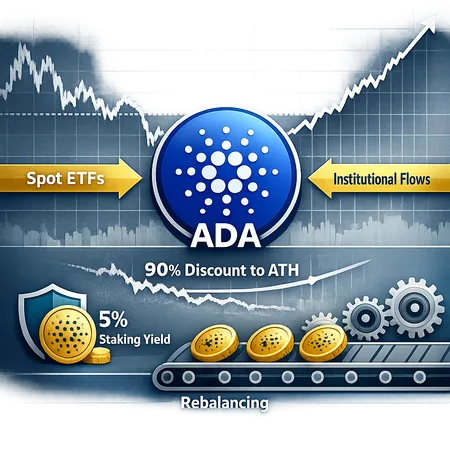
Institutional rotation into altcoins is rarely random. When spot ETFs expand beyond Bitcoin and Ethereum, allocators will prioritize assets that combine liquidity, governance, on‑chain utility and yield. Cardano (ADA) sits at the intersection of those criteria: a deep staking ecosystem, a clear upgrade roadmap, and a market cap that — relative to its all‑time high — implies a large valuation discount that can attract yield‑seeking and allocators searching for mid‑cap upside.
The bullish framing recently advanced by The Motley Fool argues that ADA is trading roughly 90% below its ATH and could re‑rate as product coverage widens and institutional comfort grows around custody and regulated exposure. That piece lays out the case for multiple‑fold upside if rotation follows a paced, ETF‑driven path (see the Fool thesis). Technical commentary from weekly market notes and price analyses also shows ADA sitting near meaningful technical levels that make it a candidate for rotation if macro liquidity and sentiment shift in favor of risk‑on alt allocations (Crypto.News market note, CryptoPotato technicals).
For intermediate investors, the key takeaway: this is not about a single catalyst but about a structural flow — spot ETFs + rebalancing mechanics + staking yield — that can channel steady institutional demand into ADA over months to quarters.
How expanding spot ETFs and rebalancing mechanics could channel institutional flows
Spot ETFs don’t just create initial buy pressure; they create a predictable, programmatic demand curve. Consider two ways ETFs can channel flows into ADA:
- Ongoing inflows into new altcoin ETFs. A new spot ETF that includes or is dedicated to ADA will need to purchase underlying ADA to back product shares. Even modest AUM growth translates to consistent buying pressure.
- Periodic rebalancing and rotation. Multi‑asset products and institutional portfolios rebalance based on mandates, risk budgets and momentum signals. As spot ETFs expand their coverage, wealth managers and allocators may rotate a small percentage of BTC/ETH exposure into altcoins like ADA to capture asymmetric upside and add diversification.
Institutions prefer assets they can custody securely and price and liquidly. ADA’s on‑chain supply distribution, staking model and improving infrastructure make it easier to underwrite from a compliance and custody standpoint than many smaller projects. That reduces friction for ETF issuers and custodians, which lowers the bar for allocation.
That said, rotation into altcoins rarely mirrors a straight line. The earliest ETF flows will likely favor the largest, most liquid names, and rotation into ADA may come as a second wave once issuers and custodians confirm execution and liquidity parameters (the mechanics are more like gears engaging than a single flip).
Staking, liquidity and the institutional calculus
Staking is a practical differentiator. Institutions evaluating ADA will ask: can I earn yield on idle balances without jeopardizing liquidity? Cardano’s nominal staking mechanism lets holders delegate to stake pools with no mandatory lockups — a powerful feature for institutions that want to generate some yield while retaining the option to trade. That contrasts with native locking models on some chains and gives ADA a defensible use case within a treasury allocation.
From an institutional perspective, considerations include:
- Custody and staking integrations: Custodians that offer secure staking services and insurance reduce operational risk. As custodians expand ADA staking support, institutional demand becomes more tenable.
- Liquidity depth: ETFs and large allocators model worst‑case slippage. ADA’s order book depth at major venues and institutional OTC desks will determine how much capital can be efficiently onboarded before prices move materially.
- On‑chain activity and fundamentals: Continued dApp and smart contract adoption on Cardano improves the narrative beyond pure speculation and helps justify medium‑term allocations.
For retail investors, the same staking convenience exists on many exchanges and wallets; platforms like Bitlet.app also make managing recurring purchases and staking straightforward for smaller accounts. But retail should expect that institutional next‑wave flows will require deeper liquidity and may front‑run shorter‑term rallies.
Valuation upside, realistic price targets and timeline
A simple way to frame upside is relative to ADA’s ATH. If ADA is indeed ~90% below its ATH, reaching the ATH implies roughly a 10x return from current depressed levels. That is the clean, headline case often cited by bullish commentators.
A more nuanced, realistic path looks like this:
- Base case (6–12 months): 2–4x from current levels. Initial ETF inflows and rebalancing drive rotation into top altcoins; ADA benefits from momentum and modest re‑rating as staking and custody stories firm up. Technical overshoots are possible, but sustained upside depends on continued inflows.
- Bull case (12–24 months): 5–10x. Broader ETF coverage, improved liquidity, and macro tailwinds send ADA back toward ATH levels. If Cardano’s ecosystem shows measurable growth in dApps, DeFi activity and native network usage, institutions may allocate larger percentages, pushing valuation higher.
- Stretch case (24+ months): >10x. This requires a combination of persistent institutional demand, major product innovation on Cardano, and limited new token supply hitting markets. It’s possible but involves materially higher risk and uncertainty.
These are scenario ranges, not guarantees. Note the asymmetry: because ADA sits materially below its ATH, the reward/risk ratio can look attractive, but time, volatility and execution risk are real. Technical analyses and market notes suggest ADA’s immediate path is sensitive to rotation flows and broader crypto market structure (Crypto.News coverage, CryptoPotato technicals).
A practical checklist: How institutional and retail investors can evaluate conviction
Below is a pragmatic checklist — use it as a decision framework rather than a binary gate.
Institutional checklist
- Custody & Compliance: Are qualified custodians offering insured ADA custody and staking services? Is the asset supported by major custodians used by institutional traders?
- Liquidity & Slippage Modeling: Can the target allocation be executed without unacceptable market impact? Have OTC desks and liquidity providers been vetted?
- Product Availability: Are spot ETF vehicles or liquid derivatives available that fit the mandate? What are fee structures and redemption mechanics?
- Staking Ops & Governance: Is stake delegation operationally seamless? Can treasury or client accounts control staking policies without concentration risk?
- Counterparty / Custodian Risk: Does the institution have counterparty limits and do custodians provide adequate SLA/insurance?
Retail checklist
- Allocation Size & Time Horizon: Am I treating ADA as a multi‑month tactical allocation or a longer‑term position? Size positions to withstand volatility.
- Staking Yield vs. Liquidity Needs: Does the staking yield compensate sufficiently for the reduced immediacy of liquid exit? Understand auto‑compounding and fees.
- Execution Venue: Are you using regulated exchanges or wallets with good custody and low withdrawal friction? Consider OTC or limit orders for larger buys.
- Risk Management: Set stop levels and position size limits. Avoid emotional re‑leveraging on FOMO.
Both cohorts should monitor ETF issuance calendars, custody announcements and on‑chain growth metrics. A disciplined approach to scaling in (dollar‑cost averaging or staged buys tied to liquidity events) helps manage execution risk during rotation.
Risks and what could derail the thesis
No thesis is airtight. Key risks include:
- Liquidity shock or large sell pressure that overwhelms ETF buying, causing overshoot and reducing confidence.
- Regulatory setbacks impacting ETFs, custody providers or staking operations.
- Technical or ecosystem stagnation on Cardano that undermines the narrative of productive yields and developer growth.
- Faster rotation into alternative layer‑1s that siphons attention and capital away from ADA.
Investors should model these outcomes and calibrate position sizes accordingly.
Conclusion: A measured case for ADA in the next rotation
Cardano has structural features that make it a plausible beneficiary of broader institutional rotation into altcoins: a sizeable valuation gap to ATH, staking that offers utility to treasury holdings, and improving custody and liquidity plumbing. The Fool article articulates the headline upside from a 90% discount to ATH, while market notes and technical analysis show ADA sitting at meaningful junctures for rotation (Fool analysis; Crypto.News; CryptoPotato).
Execution matters more than thesis alone: custody, liquidity depth, ETF mechanics and real on‑chain adoption will determine whether ADA captures a calm stream of institutional capital or merely a short, volatile squeeze. For intermediate investors assessing multi‑month allocation shifts, ADA is worth a research allocation and staged exposure if you believe ETF coverage and staking integrations will drive steady flows.
For broader context on market rotations and how major assets often lead the way, remember that allocators still treat Bitcoin as the bellwether, while emerging narratives in DeFi and staking are nudging alt allocations higher. Platforms and tools that simplify recurring purchases and staking can help implement a measured exposure plan—Bitlet.app is one example of these emerging services.
Sources
- The Motley Fool — Prediction: This Cryptocurrency Could Soar X in 2026: https://www.fool.com/investing/2026/02/20/prediction-this-cryptocurrency-could-soar-x-in-202/
- Crypto.News — ETH, XRP, ADA, BNB Hype: Mixed Signals This Week: https://crypto.news/eth-xrp-ada-bnb-hype-flash-mixed-signals-this-week/
- CryptoPotato — Crypto Price Analysis (Feb 20): ETH, XRP, ADA, BNB and Hype: https://cryptopotato.com/crypto-price-analysis-february-20-eth-xrp-ada-bnb-and-hype/