Can Justin Sun’s TRX Treasury Buys Stabilize an Altcoin? A Tactical Guide for Traders
Summary
Executive summary
Justin Sun’s recent push to add TRX to Tron Inc.’s balance sheet is one of the highest‑profile examples of a protocol founder using corporate treasury accumulation to influence market dynamics. Public reporting suggests Tron Inc.’s holdings have been growing toward the neighborhood of $540M in TRX, and Justin Sun’s messaging has explicitly encouraged continued accumulation as a defensive strategy (CoinSpeaker, Bitcoinist).
This article examines whether concentrated treasury buys can meaningfully stabilize an altcoin and seed broader confidence. I cover the scale and timing of Tron Inc.’s additions, the toolkit of liquidity‑defense mechanics (buybacks, market‑making, on‑chain treasury tactics), historical precedents and tradeable signals that allocators can use when considering tactical rotation into Layer‑1 treasuries such as TRX from a BTC‑heavy base — plus practical entry and risk rules for portfolio managers.
What Tron Inc. has done — scale, cadence and signaling
Tron Inc.’s approach, as reported, is a clear example of active treasury accumulation rather than a passive reserve build. Coverage indicates a multi‑month campaign in which on‑chain inflows and disclosed treasury purchases have materially increased the firm’s TRX holdings toward the half‑billion dollar mark. Justin Sun’s public commentary — the “keep going” rhetoric — frames the buys as a steady, confidence‑building program rather than a one‑off intervention (CoinSpeaker; Bitcoinist).
Timing matters: those buys arrived during pockets of wider altcoin weakness and when BTC was consolidating, a setup that makes concentrated buys more visible and potentially more effective as a narrative device. That said, visibility is a double‑edged sword: public accumulation can deter short squeezes, but it also invites scrutiny about centralization, market manipulation and regulatory attention.
How concentrated treasury buys can defend liquidity — mechanics and limitations
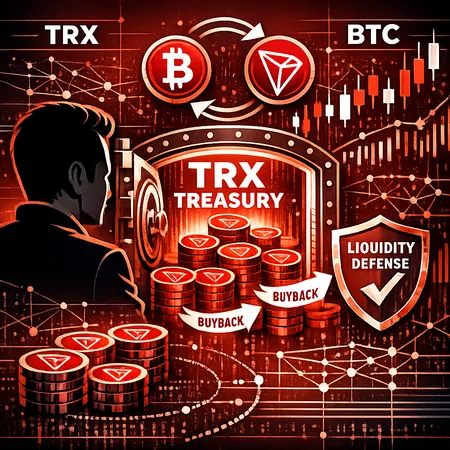
There are three broad mechanisms treasury teams use to influence price and liquidity: direct buybacks, market‑making support and on‑chain treasury strategies.
Direct buybacks
Buybacks are simple: the treasury purchases tokens on market to reduce sell pressure and raise the floor. They provide immediate price support and can change market perception if repeated and sustained. The effectiveness scales with size relative to daily liquidity — a $500M war chest has far more capacity than a $5M one. But buybacks are costly and must be funded responsibly; repeated, predictable buybacks can also encourage “free rider” behavior where short sellers test the program expecting intervention.
Market‑making and liquidity provision
A more nuanced technique is to deploy funds to act as a market‑maker: place layered bids, backstop large sells and provide incentives (e.g., subsidized AMM pools, LP rewards) to deepen liquidity. This creates durable liquidity rather than simply removing supply. Market‑making can be less visible, reducing regulatory optics, but requires ongoing operations and governance clarity to avoid token inflation or budget overruns.
On‑chain treasury strategies
On‑chain strategies include using reserves to seed liquidity on DEXs, providing collateral for lending markets, or deploying token buybacks that are algorithmic (e.g., buys when on‑chain metrics cross thresholds). These can tie the treasury’s actions to objective triggers, improving credibility. Yet algorithmic rules are only as strong as the oracle inputs and governance model; mis‑specification risks systemic failure.
Limitations across all approaches
- Scale dependency: the power to stabilize is proportional to treasury size relative to market depth and float. Small treasuries can’t stop systemic sells.
- Signal vs. substance: messaging can move price short term, but long‑term stability requires adoption, utility and liquidity.
- Centralization and moral hazard: concentrated ownership shifts ecosystem risk to a single actor — if the treasury divests rapidly, confidence can evaporate.
Historical precedents — what works, what fails
Not all treasury or corporate accumulation stories are the same. Useful analogues for traders and allocators:
Corporate BTC treasuries (e.g., MicroStrategy): sustained, disclosed purchases by a corporate treasury can act as a visible backstop and attract long‑duration capital. The MicroStrategy case shows how financial reporting and perceived commitment can create a narrative that changes investor behavior; it also highlights concentration and regulatory reporting obligations. This is not a perfect one‑to‑one for altcoins because BTC has vastly deeper liquidity and institutional demand.
Exchange buybacks & burns (e.g., BNB token economics): centralized exchanges often use fee revenue to burn tokens or buy back supply; this can support price via supply sinks. It’s a different mechanism than direct treasury buys but demonstrates that coordinated supply management can influence markets when paired with real utility and fee generation.
Cautionary tales (e.g., algorithmic/stablecoin collapses): projects with opaque treasuries, complex peg mechanics or poor governance can fail spectacularly despite large reserves. Concentrated holdings don’t immunize an asset against design flaws or extreme withdrawals. History shows that transparency + credible governance are as important as raw balance sheet size.
These examples underscore that scale, market structure, transparency and the asset’s underlying demand curve determine whether treasury accumulation stabilizes price.
Tradeable signals for altcoin allocators
If you’re rotating from BTC-heavy positions into Layer‑1 treasuries like TRX, take a signals‑driven approach. Below are practical, tradeable indicators and how to use them.
On‑chain and treasury signals
- Treasury inflow/outflow spikes: sustained inflows into a known treasury address are bullish; abrupt outflows into exchanges are a red flag. Track public addresses for repeat purchase patterns.
- Treasury cost‑basis clustering: if you can infer an average buy price for the treasury (from disclosed buys or on‑chain tracing), that price band becomes a probable support/resistance level. Buy dips toward that band with caution.
- DEX liquidity depth and AMM TVL: rising TVL and deeper DEX liquidity reduces slippage for large buys and makes treasury defense more effective.
Market microstructure signals
- Exchange reserve decline: falling exchange balances suggest reduced immediate sell pressure and can amplify treasury buys.
- Order‑book skew and bid depth: look for asymmetry where bids accumulate at multiple tiers — this hints at coordinated defense or market‑maker activity.
- Funding rates/open interest: divergent funding (negative funding with rising OI) may indicate short accumulation; a treasury can target funding imbalances with buys or perpetual hedges.
Macro and sentiment signals
- BTC trend and dominance: altcoin rotations tend to accelerate when BTC consolidates and BTC dominance falls. If you’re rotating out of Bitcoin, confirm BTC consolidation or a predictable pullback first.
- Narrative credibility: transparency (regular treasury updates, governance votes) increases the chance solidity is perceived as durable — monitor PR cadence and on‑chain proofs.
How to translate signals into trades (practical rules)
- Scale in, don’t all‑in: use a 3–6 tranche ladder with size tied to proximity to inferred treasury cost basis.
- Pair hedges: consider a BTC/TRX relative trade to isolate altcoin alpha (long TRX vs short BTC or reduced BTC exposure).
- Stop and re‑evaluate: place stops below obvious structural supports (e.g., major DEX pool ranges) and tighten if treasury flow reverses.
- Watch liquidity risk: if the treasury is the dominant buyer, an exit can be costly. Maintain position limits and liquidity buffers in the portfolio.
Governance, centralization and regulatory considerations
Treasury accumulation is not only market mechanics — it’s governance. Concentrated holdings can accelerate development and marketing, but they also centralize risk and attract scrutiny. Regulators increasingly look at activities that resemble market manipulation; transparency and clear, rules‑based buy programs reduce regulatory friction.
Portfolio managers should ask: is the treasury acting with board‑level oversight? Are buys disclosed, algorithmically triggered or ad‑hoc? What legal entity holds reserves and what are the reporting obligations? Answers to these shape both tail‑risk and the efficacy of liquidity defense.
A pragmatic playbook for allocators
- Establish your risk budget for concentrated treasury exposure (e.g., 1–5% of risk portfolio).
- Monitor on‑chain treasury flows and exchange reserves daily.
- Wait for confirmation: treasury accumulation and improving liquidity depth (DEX TVL, order‑book bids) before scaling in.
- Enter in tranches toward the treasury’s inferred cost basis and use pair hedges if rotating from BTC.
- Set explicit stop criteria tied to liquidity deterioration or large treasury outflows.
- Reassess governance signals quarterly — transparency and rule adherence matter for long‑term holdings.
Platforms like Bitlet.app can be useful to execute and manage staggered entries and to track portfolio-level exposure during macro rotations into Layer‑1 treasuries.
Bottom line — can Justin Sun’s TRX buys stabilize the market?
Yes — but only conditionally. Large, persistent and credible treasury buys can underwrite a price floor and reshape market narratives, especially in thinner altcoin markets. The effectiveness depends on (a) relative scale vs. daily liquidity, (b) the sophistication of defense mechanics (market‑making and liquidity incentives are more durable than one‑off buybacks), and (c) governance and transparency that make the defense credible rather than ephemeral.
For traders and allocators, the smart approach is tactical and signal‑driven: treat treasury accumulation as an input — not a guarantee — and use on‑chain flows, order‑book structure, funding/futures data and governance cues to time entries. Maintain disciplined sizing and hedges to manage the tail risks that come with centralized, founder‑led interventions.
Sources
- Report on Tron Inc. adding TRX to its treasury and holdings growing toward ~$540M: Justin Sun pushes TRX accumulation as Tron outperforms Bitcoin — CoinSpeaker
- Coverage of Justin Sun’s ‘keep going’ strategy and how active buying can stabilize TRX: Keep going: Sun drives TRX buy‑up as maxi rallies — Bitcoinist
- Context on capital flows post‑2024/25 cycles and why alternative stabilization plays matter: Where smart money is looking — NewsBTC