Stablecoins, Yields and Geopolitics: RLUSD Minting, A7A5 Flows and the New AML Dilemma
Summary
Executive overview
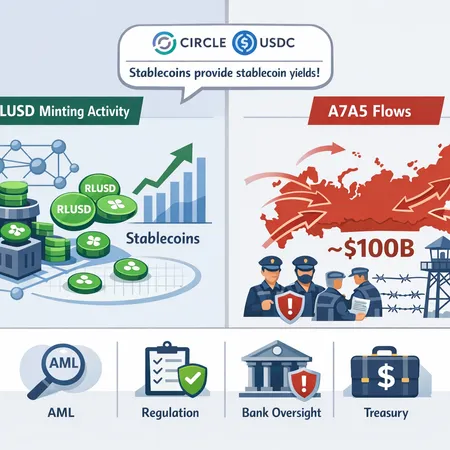
Stablecoins are no longer just a liquidity convenience inside crypto rails — they are now instruments that draw scrutiny from banks, law enforcement and policy makers. Recent minting activity on the XRP Ledger (10 million RLUSD) and investigative reporting that a rouble‑linked token called A7A5 moved ~USD 100 billion before global crackdowns create an urgent need to re‑examine how issuers, custodians and counterparties manage compliance, liquidity and geopolitical risk.
This piece unpacks three linked threads: on‑chain issuance and circulation data, the real‑world use of rouble‑linked stablecoins and AML implications, and the contentious debate over paying interest on stablecoins. It closes with concrete recommendations for compliance officers, stablecoin product teams and regulators who must balance innovation and systemic safety. For background market context, remember that cryptocurrencies like Bitcoin still act as a price bellwether, while many stablecoin flows settle into DeFi rails and off‑chain custodial arrangements. Bitlet.app is one of the platforms watching these dynamics closely.
What happened recently: RLUSD minting and broader issuance trends
On‑chain activity matters because minting events are the clearest signal of issuer intent and sudden liquidity shifts. In late reporting, 10,000,000 RLUSD were minted on the XRP Ledger — an on‑chain action that increases nominal stablecoin supply and can change cross‑platform liquidity dynamics in short order. The event, visible and auditable on the ledger, signals issuer activity and potential distribution plans: whether to support liquidity pools, underlying treasury operations, customer balances or market making.
Minting alone doesn't prove nefarious intent; it is the pattern that matters. A controlled, transparent mint coupled with reserve attestations or audited collateral lowers risk. Contrastingly, opaque minting followed by large outbound flows into custodial or off‑ramp destinations raises red flags for AML teams and counterparties. In mature markets, USDC or other regulated stablecoins usually accompany attestations and clear issuer governance — but the rise of many new, niche or jurisdictionally ambiguous tokens has increased the signal‑to‑noise problem for compliance teams.
Geopolitical uses of rouble‑linked stablecoins: the A7A5 case study
Investigations suggest a rouble‑linked token dubbed A7A5 moved nearly USD 100 billion prior to global crackdowns. Whether all those transfers constitute illicit behavior is a matter for law enforcement and forensic tracing, but the magnitude and speed of those flows highlight two crystal clear points:
- Stablecoins pegged to politically sensitive fiat (or exploiting weak controls) can be used to circumvent sanctions and capital controls, intentionally or via negligence.
- Large, opaque on‑chain flows complicate AML screening when issuer identity, reserve proof and KYC/AML policies are unclear.
The A7A5 reporting demonstrates how geographic ties and political incentives can convert a technical token into a strategic instrument. That can force traditional banks and correspondent networks to treat any relationship with related counterparties as high risk, magnifying de‑banking and liquidity fragmentation.
From a compliance standpoint, the solution is not simply blocking tokens by geography; it is building richer intelligence around issuer governance, transaction counterparty chains, and reserve assurances. Tools that combine chain analysis with off‑chain identity and sanctions screening are now a baseline requirement for any treasury considering stablecoin use.
(See the investigative reporting here for details: Russia’s A7A5 stablecoin moved $100B before global crackdown).
The debate over paying interest on stablecoins: Circle, banks and the economics of yields
A central flashpoint in recent months has been the practice of offering yields on stablecoins — often via lending to institutions, DeFi protocols, or centralized market makers. Circle’s CEO publicly defended stablecoin rewards and yield products against bank criticism, arguing that reasonable returns help market participants manage working capital and that issuer policies can be safe when transparently managed and collateralized.
Banks counter that attractive stablecoin yields can look like deposit substitutes, drawing funding away from deposit‑taking institutions and pressuring their balance sheets. Regulators worry about maturity transformation: if stablecoin issuers or their treasury counterparties take short notice deposits and invest in longer‑dated or risky instruments, systemic fragility could emerge quickly during stress.
There is nuance here. Not all yields are created equal:
- Yields sourced from transparent repo markets and short‑term Treasuries carry very different risk than yields from high‑leverage lending into exotic DeFi credit pools.
- Centralized yield passthroughs without proper reserve segregation, attestation and third‑party custody increase counterparty concentration risk.
Circle’s public defense (outlined in recent coverage) frames the business case from a market‑utility perspective, but compliance officers must translate that into operational constraints: limited tenor mismatch, clear segmentation of reserve assets, and robust attestation regimes that external auditors can verify. See Circle’s engagement with the debate here: Circle CEO defends stablecoin rewards.
AML, regulatory and systemic risks introduced by yield‑bearing stablecoins
Yield changes the risk calculus. When a stablecoin holder is earning interest, the probability of larger aggregate balances and longer retention increases. That raises several risks:
- Concentration risk: Institutional treasuries or market makers can accumulate outsized holdings of a yield‑bearing token, making single‑issuer or custodial failures systemically meaningful.
- Liquidity mismatch: If an issuer invests reserves into illiquid instruments to deliver yield, a run on redemptions can produce forced asset sales and contagion.
- AML/FT exposure: Yield mechanisms that route funds through opaque counterparties, cross‑chain bridges, or non‑custodial pools complicate KYC trails, enabling layering and obfuscation.
Compliance teams should treat yield as a variable that increases monitoring intensity. Automated transaction monitoring must include heuristics for large balance accretion, chain‑based clustering for related wallets, bridge usage patterns, and counterparty risk scoring. The RLUSD minting event is a reminder that new supply can be deployed quickly; the A7A5 case shows how flows can be politically sensitive.
For on‑chain transparency, issuers should publish real‑time reserve proofs (proofs of solvency and attestation for assets backing yields) and provide auditors with full access to custody and investment records. When reserves include illiquid or off‑balance instruments, issuers need conservative haircuts and public documentation of investment policies.
Practical policy recommendations and risk mitigation for treasuries and compliance officers
- Due diligence framework for stablecoin selection
- Require issuer attestations and independent audits as a minimum. Prefer issuers with transparent governance, public reserve reports and regulated custody.
- Assess where reserves are invested. Favor coins whose backing is predominantly high‑quality liquid assets.
- Limits and concentration controls
- Set exposure limits per issuer (e.g., a treasury should limit holdings of any single stablecoin to X% of liquid reserves).
- Monitor counterparty correlations: holdings of RLUSD and other niche tokens may correlate with common market makers or custodians.
- Enhanced transaction monitoring
- Integrate blockchain analytics with sanctions lists. Specifically flag interactions with wallets/entities that route through high‑risk jurisdictions or known bridge contracts.
- Build heuristics for abnormal mint/redemption patterns; large mint events should trigger a compliance review.
- Operational guards around yield products
- Only accept yield products with fully documented counterparty credit practices, daily liquidity provisions and no hidden leverage.
- Require live reserve attestations that clearly segregate yield‑generating investments from redemption liquidity pools.
- Legal and contract protections
- Require contractual representations on KYC/AML practices from issuers and any outsourced liquidity managers.
- Specify resolution and redemption waterfall clauses in the event of issuer distress.
- Regulator engagement and reporting
- Maintain open channels with prudential and AML authorities; share suspicious activity patterns that could signal state‑level evasion attempts.
- Advocate for clearer rules around off‑ledger reserve investments and yield generation to harmonize expectations across jurisdictions.
Implementing the above: a short checklist for treasury teams
- Verify issuer audit/attestation and custody arrangements before initial on‑ramp.
- Cap single‑issuer exposure and regularly stress‑test liquidity under severe redemptions.
- Use chain analytics and third‑party screening tools to monitor inbound and outbound flows, especially after large mint events such as the RLUSD issuance.
- Require full transparency before participating in any yield product; prefer yield derived from repo and government securities.
Conclusion: balancing innovation with prudence
Stablecoins remain powerful plumbing for today’s crypto economy, but recent events expose how quickly they can become vectors for geopolitical risk and systemic fragility if left unmanaged. The RLUSD minting shows how supply can expand visibly on‑chain; the A7A5 investigation shows how politically sensitive tokens can be used at scale. The debate over stablecoin yields, where Circle and others have publicly defended rewards, underscores the need for clearer operational standards and stronger AML integration.
For compliance officers and regulators, the path forward is practical: insist on transparency, limit concentration, require realistic liquidity management, and bake AML plus sanctions screening into every stage of the stablecoin lifecycle. These steps will allow treasuries and product teams to leverage the efficiency of stablecoins while constraining the very real geopolitical and systemic risks described above.
Sources
- Fresh on‑chain activity: 10M RLUSD minted on the XRP Ledger — details: https://u.today/10000000-rlusd-minted-on-xrp-ledger-details?utm_source=snapi
- Investigation into Russia‑linked stablecoin flows: https://bitcoinist.com/russias-a7a5-stablecoin-moved-100-billion-before-global-crackdown-elliptic/
- Circle CEO defends stablecoin rewards amid bank concern: https://bitcoinist.com/banks-concern-stablecoin-interest-absurd-circle-ceo/