XRP After the Lawsuit: Escrow Unlocks, Whale Accumulation, and Near‑Term Price Scenarios
Summary
Why the SEC vs Ripple closure matters for markets
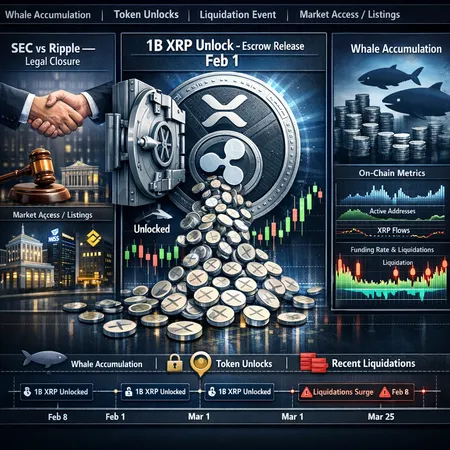
The legal cloud that hung over XRP for years finally lifted with the official closure of the SEC vs Ripple litigation in August 2025. That matter is more than headline noise: regulatory clarity shifts the behaviour of custodians, exchanges and institutional allocators. Listings that had been suspended or restricted are easier to justify for custody providers and white‑label exchange services; institutional desks that avoided XRP because of compliance risk can now write policies to handle it explicitly.
Practically, this increases potential on‑ramp liquidity and reduces the chance that a future corporate compliance review forces a delisting. For many traders, correlation to broader crypto market moves still matters—Bitcoin remains the bellwether for risk appetite—but delisting risk being materially lower changes mid‑ and long‑term liquidity assumptions.
The Feb 1, 2026 1B XRP escrow unlock — mechanics and market implications
Ripple’s escrow mechanism releases XRP monthly, but the outstanding event in market calendars is the scheduled February 1, 2026 unlock of 1 billion XRP. Finbold reported this specific unlock and its timing, which matters because the market treats a known, concentrated supply release differently from an unknown mint or miner sell pressure. Historically, Ripple has sometimes sold from escrow for operational needs and sometimes returned unused amounts to escrow; the market watches what portion becomes available liquidity versus what is re‑escrowed.
A 1B XRP unlock represents a sizable notional supply addition on the day of release, but the immediate price impact depends on three variables: how much enters exchange order books, how much is distributed OTC to custodians/liquidity partners, and whether larger holders absorb the release. If a large share lands on exchanges, expect short‑term downward pressure; if Ripple and counterparties route sales through OTC desks and programmatic liquidity providers, the hit can be muted.
Whale accumulation vs funding pressure: what on‑chain data says
On‑chain monitoring shows notable whale positioning ahead of the unlock. Reports highlighting large transfers and accumulation suggest smart money is increasing exposure (see analysis in CoinPaper). Large wallet accumulation can dampen the sell pressure from token unlocks when those wallets act as buyers rather than sellers. However, accumulation concentrated among a handful of addresses raises distribution risk: one or two large sellers can still overwhelm thin order books.
At the same time, derivatives markets create another axis of vulnerability. Funding rates, open interest and long/short imbalances mean that even a modest spot move can cascade into liquidations, amplifying volatility. Recent reporting of a significant XRP liquidation event underscores this dynamic—leveraged positions were wiped out when price moved sharply, creating a feedback loop of selling and further prices declines (see CurrencyAnalytics). Traders need to watch exchange inflows, whale transfers to exchanges, and funding rates in real time to judge whether accumulation is truly absorbing supply or simply creating a crowded trade.
Recent liquidation event — a reminder of short‑term fragility
The liquidation event covered by CurrencyAnalytics shows how concentrated leverage in XRP can produce outsized intraday moves. When leverage is high, margin calls force automatic selling that lands back on order books, widening spreads and producing flash crashes that are often independent of fundamental news. That pattern is typical across high‑beta altcoins: a supply shock (e.g., exchange sell orders after an unlock) or a headline can trigger liquidations, which then deepen the move.
The practical implication: even with favorable long‑term fundamentals post‑lawsuit, short‑term price paths are governed by market microstructure. Watch exchange balances (are wallets sending large batches to exchanges?), the state of order book depth, and derivatives metrics. Platforms and liquidity providers — and traders using services like Bitlet.app — will find these signals essential for deciding entry and exit timing.
Integrated short‑term scenarios and probability‑weighted paths
Below are three pragmatic near‑term scenarios. Assign your own probabilities based on risk tolerance, but this framework helps translate on‑chain and legal signals into tradeable views.
Bullish (20–35% probability): Ripple routes the unlock primarily through OTC channels and returns a portion to escrow; whales continue to accumulate and exchange inflows remain muted. Institutional interest post‑legal clarity supports tighter spreads and renewed listing momentum. Price rebounds on lower realized sell pressure and hedged desks buy dips.
Neutral (35–50% probability): A balanced outcome where some unlocked XRP reaches exchanges and some is absorbed OTC. Whales hold or incrementally buy, but derivatives funding and retail selling keep volatility elevated. Price grinds with wide intraday ranges—opportunity for range traders but risky for large directional bets.
Bearish (15–35% probability): Significant unlocked supply hits exchanges, coinciding with high leverage in the derivatives market. A liquidation cascade (similar to the recent event) amplifies selling, leading to a sharp drawdown. Even with legal clarity, short‑term liquidity mismatch and profit‑taking by large holders create extended correction.
These scenarios are not mutually exclusive across different time slices: an initial bearish shock on Feb 1 could give way to a bullish recovery over weeks if buyers step in and on‑chain accumulation resumes.
Practical trading and risk management checklist
- Position sizing: Limit exposure relative to portfolio volatility; consider smaller initial entries with staggered buys.
- Use on‑chain alerts: Monitor large transfers to exchange addresses and notable whale wallet moves (CoinPaper coverage can help identify patterns). A sudden spike in exchange inflows should raise caution.
- Hedge where appropriate: Use options or inverse products to protect spot exposure ahead of the unlock if you’re short‑term oriented.
- Watch derivatives metrics: High open interest and skewed funding rates increase liquidation risk. Pull back if funding rates are extreme and open interest spikes suddenly.
- Avoid chasing short‑term squeezes: Liquidation cascades create fast moves with low liquidity; plan exits in advance and consider limit orders for better execution.
For long‑term holders: the legal closure strengthens the case for retaining XRP exposure if you believe in network utility and adoption. But dollar‑cost averaging and staged accumulation reduce the risk of buying at a local peak during unlock volatility.
Where to watch live: metrics that matter
- Exchange balances and inflows/outflows for major custodial platforms.
- Whale transfers and concentration of supply (are the same addresses accumulating?).
- Open interest and funding rates on perpetual markets.
- Spot order book depth around key support/resistance levels.
Also watch broader market sentiment—altcoins often move in sympathy with macro risk appetite and DeFi flow dynamics. Institutional announcements (custody integrations, new listing approvals) can change the calculus quickly now that the SEC matter is closed.
Conclusion — balance legal clarity with microstructure caution
The closing of the SEC vs Ripple case removed a major structural overhang and meaningfully improved the narrative around custody and listings. That matters for medium‑term liquidity and institutional participation. Yet the Feb 1, 2026 1B XRP escrow unlock is a predictable, mechanical supply event that will test market depth. On‑chain whale accumulation offers a counterweight, but recent liquidation episodes demonstrate that leverage and order‑book fragility can dominate short‑term outcomes.
For active traders: treat the unlock as a high‑info event—use on‑chain and derivatives signals to time entries and protect positions. For long‑term holders: focus on disciplined accumulation and ignore intraday noise unless it creates a tactical buying window.
Sources
- Factcheck: Is the SEC vs Ripple case officially closed? (CoinPedia)
- Ripple set for second 1 billion XRP unlock in 2026 (Finbold)
- XRP on a knife’s edge as whales pile in (CoinPaper)
- Ripple’s XRP experiences significant liquidation (CurrencyAnalytics)
(Analysis synthesized for active traders and investors; monitor live on‑chain data and centralized exchange metrics. Bitlet.app users may find integrated order tools and alerts helpful when parsing this event.)