Wallet-Native Perpetuals: Binance Wallet + Aster and the Rise of On-Chain Leveraged Trading
Summary
Why wallet-native perpetuals matter now
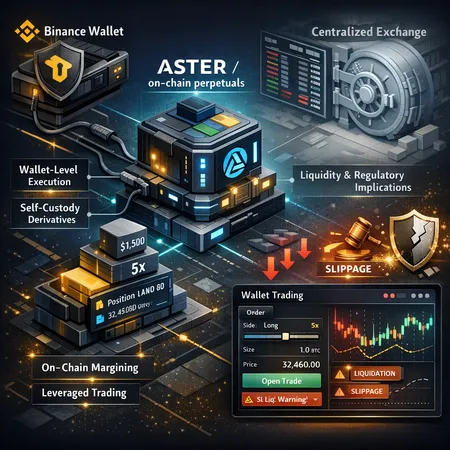
Wallet-native perpetuals change one simple but profound factor in derivatives: custody of collateral and execution context. Instead of routing margin and orders through a centralized matching engine, the integration between Binance Wallet and Aster lets users keep keys in their wallets while interacting with a protocol that runs margining and perpetual logic on-chain. That means visibility, auditability and a straightforward custody model — but it also brings on-chain constraints: gas, latency, front-running risk and new settlement mechanics.
For many traders, Bitcoin remains the primary market bellwether, but the execution environment is evolving: product managers and derivatives desks can no longer assume that all leveraged flows must pass through centralized exchanges. Wallet trading with on-chain perpetuals is a middle ground: custodial freedom plus derivatives primitives.
How the Binance Wallet + Aster integration works, technically
At a high level the integration combines a self-custodial wallet UI (Binance Wallet) with Aster’s on-chain perpetual contracts. Coverage of the rollout explains that this enables leveraged futures trading directly from a user’s wallet while the perpetuals are settled and margin-managed via smart contracts Coindesk report.
Technically you can think of the stack in three layers:
Wallet layer: Private keys remain with the user; trades are signed locally and transactions are submitted directly to the blockchain or via the wallet’s RPC routing. This is the essence of self-custody derivatives — collateral is held by smart contracts the user controls, not by an exchange custody pool.
Protocol layer (Aster): Perpetual contracts live as smart contracts on-chain. They manage margin accounting, funding rate calculations, position state, and liquidation triggers. Because these computations are on-chain, state changes are transparent and verifiable.
Liquidity & execution layer: Orders can be filled against on-chain liquidity (AMMs, orderbooks implemented via smart contracts, or liquidity orchestration services). The wallet signs intent; Aster’s contracts or on-chain market makers execute trades and update position state.
Finbold’s coverage describes the user experience as enabling on-chain perpetuals and self-custody trading by integrating Aster into Binance Wallet, positioning the flow as wallet-level execution rather than routing through a centralized derivatives backend Finbold coverage.
On-chain margining and settlement
On-chain margining means collateral is deposited or allocated in smart contracts that track a trader’s position exposure continuously. Liquidation checks are executed either via scheduled transactions or reactive transactions triggered by price oracles and keeper bots. Funding payments, unrealized P&L bookkeeping and margin ratios are computed on-chain so everything is auditable.
This differs from centralized derivatives where margin calls, P&L and account state are managed off-chain by the exchange and only final settlements (or withdraws) hit the blockchain.
UX and custody trade-offs vs centralized derivatives platforms
The UX promise: retain custody, trade leveraged products without depositing funds to a custodian, and see transparent settlement logic. But the trade-offs are material:
Friction & latency: On-chain transactions require gas and block confirmation. Traders used to instant fills on centralized orderbooks will notice longer round-trips and occasional price movement between signing and execution.
Fee model: Whereas centralized venues subsidize fills with orderbook depth and low taker fees, on-chain fills will incur gas and potentially larger slippage. However, innovative routing and gas-optimized contract design can reduce costs over time.
Custody control: Self-custody means no counterparty custodial risk but a direct increase in user responsibility — private key safety, wallet recovery, and the inability to rely on exchange insurance or internal risk teams.
UX features: Margin UI, partial fills, and complex order types (iceberg, TWAP) will take longer to match the polished features of centralized derivatives. That said, wallet-integrated experiences like Binance Wallet can abstract signing and present near-native UX for simpler perp flows.
For teams building products, the choice becomes a design trade: prioritize transparency and custody (on-chain) or prioritize execution speed, deep liquidity and sophisticated UX (centralized). Bitlet.app product teams considering hybrid flows might route smaller-risk strategies on-chain while keeping larger blocks and hedging with centralized venues.
How Aster’s on-chain perpetuals differ from centralized perpetuals
Aster’s core distinction is execution and state locality: perpetual logic running on-chain means position bookkeeping, funding, and liquidation are deterministic and public. Centralized perpetuals typically rely on an internal ledger, off-chain matching engines and centralized insurance funds to smooth volatility and socialized losses.
Implications of Aster’s model:
Transparency: Funding rates and margin calculations can be validated on-chain. That reduces information asymmetry and makes pricing behaviour auditable.
Settlement finality: State transitions are enforced by smart contracts; there’s less scope for discretionary freezes or delayed withdrawals by a central operator.
Liquidity sourcing: On-chain perpetuals must either attract native on-chain LPs or rely on integrated AMMs and cross-protocol liquidity routing. Centralized exchanges aggregate deep liquidity because they pool global order flow and internalize matching.
Socialized risk handling: Central exchanges often use insurance funds, clawbacks, or AMM layers to handle cascading liquidations. On-chain models must encode liquidation mechanics (keepers, liquidator incentives) which can behave very differently during stress.
In short, Aster converts exchange-style derivatives into protocol-native primitives where trust is placed in smart contracts and market mechanics rather than in central operators.
Regulatory and liquidity implications for retail and institutional users
Regulation: Self-custody perpetuals sit in a gray area. On one hand, decentralized contract execution may reduce direct regulatory oversight over the protocol itself; on the other hand, wallet providers and integrators (like Binance Wallet) may be subject to jurisdictional requirements such as KYC, sanctions screening, and reporting depending on how they surface the product.
Institutions will weigh legal, compliance and custody controls carefully. Some will accept on-chain exposure for hedging or research, while larger institutions may demand custody integration with trusted key management solutions, multi-sig, or qualified custodians that can speak to compliance policies.
Liquidity: For retail, on-chain perpetuals can mean wider access to derivatives without account creation. But liquidity depth is evolving: initially fills may be thinner and slippage higher. Institutions care about fill size and market impact; they will test whether aggregated on-chain liquidity and cross-protocol routing can match central exchanges’ depth.
A practical middle path is liquidity composability: using on-chain liquidity for smaller allocations while maintaining credit lines or prime relationships with centralized venues for large-ticket transactions.
Risk assessment: what changes and what stays the same
Key risks deserve explicit attention for active derivatives traders and product teams.
Liquidation mechanics: On-chain liquidations are rule-based and executed by third-party liquidators or keepers. During sharp moves, gas spikes or oracle lag, liquidations can cascade, leaving traders exposed to slippage and partial fills. Understand whether Aster uses single-sided liquidations, partial fills, or auction mechanisms.
Slippage & price impact: On-chain fills against AMMs or on-chain orderbooks can suffer larger price impact for size. Traders should model expected slippage versus centralized markets and optionally use limit orders or reduce leverage for large blocks.
Oracle and price manipulation: On-chain perpetuals rely on oracle feeds. Feed latency, manipulation or fragmentation can cause incorrect margin calls. Robust oracles, time-weighted prices, and multiple feed aggregation mitigate but do not eliminate this risk.
Smart-contract risk: A protocol bug or exploited contract can lead to loss of funds. Audits, bug-bounty histories, and upgrade governance models should form part of the risk assessment.
MEV & front-running: Since transactions are public before inclusion, sandwiching or priority manipulation can affect execution cost. Flashbots-style private submission and gas-optimization tactics can reduce exposure.
Operational risk: For institutional actors, integrating on-chain modules into treasury systems introduces new operational overheads (key management, reconciliation, reporting).
Practical steps for traders and product teams to manage risk
Start small and simulate: Run small trades or paper-trade on testnets where available. Monitor realized slippage and liquidation behavior in live conditions.
Use conservative leverage: Lower initial leverage until you’ve measured the protocol’s liquidation responsiveness and oracle reliability.
Maintain margin buffers: Keep excess collateral to avoid being auto-liquidated during short-lived volatility or oracle lag.
Prefer limit orders or staged execution for large size: Avoid market-sweeping fills that amplify price impact on on-chain liquidity.
Monitor funding rates and liquidity depth: On-chain funding dynamics can differ from centralized markets; track on-chain metrics and funding rate volatility.
Check oracle provenance and lag: Prefer protocols that publish oracle sources, aggregation windows and slippage tolerances.
Evaluate smart-contract risk: Review audits, upgradeability patterns and whether the protocol maintains an insurance or backstop fund. Diversify counterparty/protocol exposure.
For institutions: consider custody wrappers (multi-sig, MPC), integration with compliance tooling, and hybrid routing strategies that split execution across on-chain and centralized venues.
What this means for product strategy and the market
For DeFi product managers, wallet-native perpetuals are both an opportunity and an engineering challenge. They open up new flows: permissionless derivatives access, composable hedges with DeFi lending and automated strategies, and on-chain audit trails that can make risk management more transparent. They also force teams to address UX constraints (gas, order types), liquidity aggregation and governance of upgradeable protocols.
Active traders need to accept different tradeoffs: self-custody grants control but also responsibility. For some strategies — smaller size, algorithmic hedges, or fully on-chain market-making — the transparency and composability of on-chain perpetuals can be materially beneficial. For heavy block trading or latency-sensitive arbitrage, centralized venues still hold advantages.
Final assessment
The Binance Wallet and Aster integration is an important step toward mainstreaming wallet-level leveraged trading. It makes self-custody derivatives practical and exposes a wider audience to the dynamics of on-chain perpetuals. That progress does not eliminate trade-offs: liquidity depth, execution latency, oracle security and smart-contract risk must all be managed.
For traders and product teams evaluating a move on-chain: treat this as a phased transition. Run tests, adapt risk frameworks, and build hybrid execution strategies that exploit the strengths of both worlds. As the on-chain liquidity ecosystem matures, wallet-native perpetuals will become a standard lever in derivatives toolkits — but only after careful design and risk adaptation.
Bitlet.app product and risk teams, for example, will want to monitor early liquidity behavior and user recovery flows as these integrations scale.
Sources
- Coindesk: Binance Wallet unlocks in-app leveraged crypto futures trading with Aster team-up — https://www.coindesk.com/business/2026/01/14/binance-wallet-unlocks-in-app-leveraged-crypto-futures-trading-with-aster-team-up
- Finbold: Binance Wallet integrates Aster for on-chain perpetuals trading — https://finbold.com/binance-wallet-integrates-aster-for-on-chain-perpetuals-trading/?utm_source=snapi