How Bitcoin Miners Are Diversifying: AI Infrastructure and Waste‑Heat Reuse
Summary
Executive overview
The economics of BTC mining have become more complex: hashprice volatility, halving events, and rising energy scrutiny force operators to look beyond purely block rewards. Miner diversification is moving from a buzzword to a capital strategy. Two trends are converging: miners renting rack space and power for AI workloads as AI infrastructure demand explodes, and creative reuse of excess heat to lower operating costs and generate local revenue. Both strategies change CAPEX/OPEX mixes, affect miner revenue composition, and—importantly—can reduce the need to sell mined BTC immediately to cover costs.
NVIDIA Rubin and the AI pivot: why now matters
NVIDIA’s Rubin platform hitting production-grade status is a watershed for operators who already own power, cooling, and real estate. Rubin standardizes and simplifies deployment of large AI clusters, and that lowers integration risk for non‑traditional data center tenants in mining facilities. As reported recently, miners are pivoting toward AI infrastructure because Rubin transitions GPU stack complexity into an operationally predictable service layer (see the production announcement).
For miners this matters because the asset base—power agreements, grid interconnects, and large halls—maps well to AI workloads. Facilities idle during low‑hashprice periods can host training or inference jobs. The incremental revenue is not pegged to BTC price: it depends on utilization, contract type (spot vs. reserved), and service margins. The result is a complementary income stream that smooths cash flow swings and leverages existing CAPEX.
Business case and CAPEX/OPEX implications of AI services
Deploying AI infrastructure in mining sites can take several shapes: 1) direct conversion of halls to GPU pods, 2) hybrid floors with ASICs and GPU racks, or 3) colocation leasing to hyperscalers. Each path has different capital profiles. Converting to GPU compute often requires investment in power distribution upgrades, cooling system changes (higher rack densities), and possibly substations—CAPEX that may be sizable but is often shorter payback than new greenfield builds.
On OPEX, AI workloads typically pay higher margins per kW than BTC mining when purchased under multi‑year contracts. However, GPUs and associated management demand higher skilled ops teams and different failure replacement rhythms. From a financial perspective, miners trade some commodity exposure (BTC price) for contractual revenue—reducing revenue variance but introducing technology refresh cycles. Leading miners are modeling blended utilization and scenario analyses to compare IRR and payback between re‑racking ASICs versus hybrid deployments. As Rubin lowers orchestration friction, the threshold to enter the market falls for mid‑sized operators.
Waste‑heat reuse in practice: the Canaan greenhouse pilot
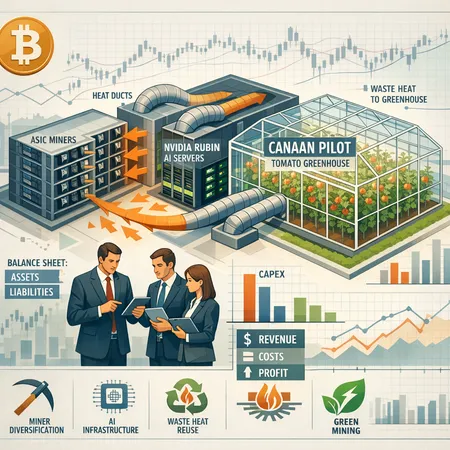
A practical example of miner diversification is using ASIC waste heat for industrial or agricultural processes. Canaan’s Manitoba pilot warmed tomato greenhouses using Avalon rig waste heat, turning an externality into a cost center that produces local value (detailed in the case study). That approach is attractive where heating demand is seasonal or continuous and where power prices make harvesting heat economically sensible.
Waste‑heat projects are operationally straightforward: ducting warm air to adjacent structures, installing heat exchangers, and controlling humidity/temperature. They add modest incremental CAPEX and engineering, but they also unlock OPEX savings for the partner (e.g., farmers) or new revenue streams for the miner through service contracts or revenue sharing from crop sales.
Economics of waste‑heat reuse: payback and scale
Compared with AI pivots, waste‑heat reuse often has lower technical complexity and faster payback, particularly in cold climates or where local industries demand heat. Capital outlays typically include ducting, pumps, controls, and civil work. Ongoing OPEX is minimal relative to mining itself and can even be net‑positive when the miner shares in the downstream economic activity.
From an accounting standpoint, miners can recognize these projects as ancillary businesses: revenue from heat services shifts some operating cost basis off pure mining margins. Importantly, by reducing facility cooling costs or monetizing heat, miners lower net energy costs per BTC mined and decrease the frequency with which they must liquidate BTC to cover operating expenses.
Balance‑sheet and BTC sell pressure implications
Diversified revenue streams change the shape of miner balance sheets in two clear ways. First, recurring contractual revenue (from AI colocation or heat‑service agreements) improves cashflow predictability, which supports higher debt capacity or lowers the need for equity raises. Second, economically hedged income reduces reliance on BTC‑for‑dollar conversion to meet payroll, interest, or capital expenditures—muting immediate sell pressure on BTC inventory.
However, the degree to which these activities reduce long‑term BTC supply pressure depends on scale. Small pilots and localized heat deals merely shave marginal sell needs. Large‑scale AI deployments that deliver multi‑million dollar annual contracts can materially offset operating burn and change a miner’s treasury policy. Executives should run scenario analyses: model how different utilization rates and contract tenors affect monthly USD revenue and the implied reduction in BTC sales required to stay cash‑neutral.
For analysts, this is important because it means miner revenue is becoming more correlated with broader data center markets in addition to crypto markets. Creditworthiness and valuation metrics will increasingly emphasize contracted revenue and asset flexibility alongside hashrate and energy cost.
ESG, regulatory and market perception benefits
Both AI integration and waste‑heat reuse improve ESG profiles in tangible ways. Waste‑heat projects are straightforward wins: they reduce waste, support local economies, and are easy to communicate to stakeholders. AI services, while more energy intense per compute, can be positioned as maximizing utilization of existing physical infrastructure rather than building new centers—an argument many sustainability teams find persuasive.
Regulators and corporate buyers increasingly evaluate miners on environmental impact. Demonstrable green mining initiatives—heat reuse or shared infrastructure—reduce reputational risk and can unlock preferential rates or tax credits in some jurisdictions. Mentioning these programs in investor decks and sustainability reports can also attract ESG‑focused capital. Bitlet.app and other industry platforms are tracking these shifts as miners reframe their business models.
Implementation considerations and risks
Successful diversification requires a realistic appraisal of operational capabilities and market demand. Key risks include: technology mismatch (ASIC vs GPU power delivery), stranded asset risk from specialized retrofits, market concentration risk if AI demand softens, and counterparty risk in long‑term heat or compute contracts. Miners should pilot, measure, and scale—the Canaan greenhouse and early Rubin integrations provide useful templates but are not plug‑and‑play everywhere.
Contract design matters: miners should prefer mixed tenure contracts (some spot, some reserved) for AI services, and performance‑linked arrangements for heat reuse partners. Financial controls must ensure BTC treasury policies account for new revenue diversification and the different volatility profiles of service vs. mined income.
Conclusion: strategic diversification is becoming table stakes
Miner diversification into AI infrastructure enabled by Rubin and pragmatic projects like waste‑heat reuse are not fads; they reflect rational responses to market cyclicality, ESG pressure, and the economics of large, power‑dense facilities. For miner executives and industry analysts, the takeaway is clear: evaluate diversification not as a distraction but as a balance‑sheet tool. Done well, these strategies reduce short‑term BTC sell pressure, improve cash‑flow predictability, and make mining companies more resilient—and more investable—into the next cycle.
Sources
- NVIDIA’s Rubin production and miners pivoting to AI
- Canaan’s Manitoba waste‑heat tomato greenhouse pilot
For readers wanting to explore related developments, note that broader macro narratives—such as how Bitcoin treasury strategies evolve—will interact with these operational shifts over time.