XRP Spot ETFs and Ripple Unlocks: How 2026 Reshapes XRP’s Market Structure
Summary
Executive snapshot
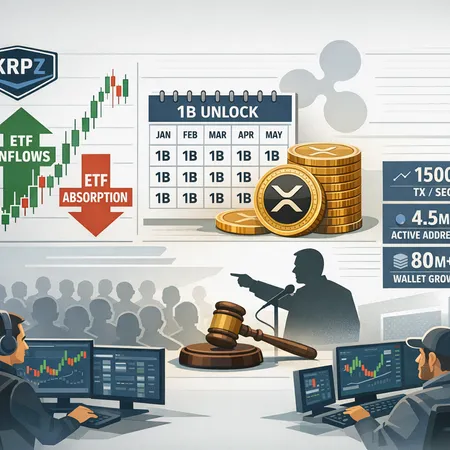
By the start of 2026 the market is watching two simultaneous forces: spot XRP ETFs accumulating supply on one side, and Ripple’s scheduled monthly supply unlock of 1 billion XRP on the other. ETF products such as XRPZ have led net inflows recently, and market structure now reflects a tug-of-war between institutional demand and token releases. This piece unpacks ETF flows, the mechanics of Ripple’s unlocks, the legal and public narrative around XRP (including John Deaton’s recent comments), on-chain adoption signals, and concrete trade scenarios for Q1 2026. It’s written for traders and crypto-legal observers who need a practical, evidence-led guide rather than high-level conjecture.
ETF inflows and product leadership: why XRPZ matters
Since spot ETF listings, product-level flows have been the clearest short-term driver of price and liquidity. Recent reporting shows net ETF inflows of roughly $5.58 million in wrap-ups that highlighted XRPZ and other funds taking the lead; that’s small relative to macro markets but material for XRP’s order books and market-making behavior (Blockonomi ETF wrap-up).
A few structural points to keep in mind:
- ETFs create a predictable institutional demand channel — managers buy spot XRP to match inflows and may use authorized participants to source supply.
- Product leadership matters: an ETF with high marketing and AP relationships (like XRPZ) can concentrate flows and tighten spreads.
- Net inflow figures are snapshots; the conversion of ETF custody positions into exchange-lifted liquidity depends on custodial behavior and arbitrage activity.
For many traders, cues from broader markets (for example, Bitcoin) still set risk appetite, but XRP ETFs are increasingly the marginal buyer in XRP-specific moves.
Ripple’s monthly 1B unlock: mechanics and real-world impact
Ripple’s scheduled monthly unlock of 1 billion XRP — reported to have restarted at the start of 2026 — is a headline number that needs context (U.Today on unlocks). Two clarifications:
- Unlock ≠ Immediate Sell: Tokens moving out of escrow increase the available supply but don’t automatically hit order books. Ripple typically releases to on-ledger wallets and makes operational decisions about distribution.
- Absorption Channels: Newly unlocked XRP can flow to corporate partners, OTC desks, exchanges, or custodians for ETFs. The net market impact depends on how much is absorbed by demand channels — especially ETFs — versus how much enters liquid exchange inventories.
Recent analysis ties ETF inflows to a rising ability to absorb unlocked supply, arguing that well-capitalized ETF channels can blunt dump risk and actually support tighter on-chain liquidity conditions (AmbCrypto analysis). In short: monitor custody transfers and AP buy-side behavior, not just the raw 1B figure.
ETF absorption vs. circulating supply: watching the net flows
The phrase ETF absorption captures how much of unlocked supply is soaked up by institutional demand. Track these variables in realtime:
- Custodial inflows to known ETF wallets (publicly visible on-chain) and deposit tickets reported by custodians.
- Exchange reserve changes — is exchange-listed liquidity growing after unlock windows?
- Authorized participant behavior and creation/redemption rates for ETF shares.
When ETF absorption outpaces exchange listings, market structure tightens: less XRP is available for spot sellers, which can reduce volatility and create a premium for immediate delivery. Conversely, if custodial flows stagnate, unlocked XRP that finds its way to exchanges will increase selling pressure.
A practical tip for traders: overlay ETF flow reports with exchange reserve charts and stablecoin gateway volumes to estimate true liquidity change rather than relying on headline unlock numbers.
Legal and PR narratives: John Deaton and the civic framing
The XRP legal saga has always been part regulatory precedent and part public narrative. Recently, lawyer and advocate John Deaton framed XRP holders’ role as civic — positing that public holding and market participation push back against government overreach (U.Today on Deaton). That framing matters in two ways:
- Sentiment effect: A strong, rights-based narrative can mobilize retail and institutional supporters, leading to accumulation during volatility.
- Regulatory optics: If the discourse shifts from an enforcement-risk story to one about investor rights and market fairness, regulators may face political pressure that reduces perceived tail risk.
But caution: legal narratives often have asymmetric timing and impact. Positive PR can support price, but binding legal outcomes (court rulings, regulatory guidance) change long-term institutional appetite more decisively than tweets or op-eds. Traders should therefore weigh narrative-driven flows against measurable on-chain and custodial data.
On-chain adoption signals to monitor
Beyond custody and ETF flows, genuine XRP adoption shows up in utility metrics. Key measurable signals:
- Active addresses and unique daily senders — sustained growth suggests real demand beyond ETF accumulation.
- DeFi and gateway activity — while XRP’s DeFi footprint is smaller than some chains, on-ramping through stablecoin rails and liquidity provision events matter.
- Large wallet concentration and movement patterns — large transfers from escrow to exchanges vs. to custodians tell different stories.
Analysts argue that ETFs can catalyze infrastructure (custody, market-making, OTC desks), which in turn lowers friction for broader adoption — a virtuous circle if ETF absorption scales faster than unlocked supply (U.Today expert take). Use on-chain dashboards and exchange custody trackers to separate headline inflows from durable adoption.
Tradeable scenarios going into Q1 2026
Below are practical, scenario-based plays for traders and legal observers. Each scenario pairs a likely supply-demand dynamic with tactical approaches and risk controls.
- ETF-Absorption Bull Case
- Thesis: ETF inflows (XRPZ-led) consistently soak up unlocked supply, exchange reserves fall.
- Trade approach: Tactical long on dips; prefer liquid derivatives for leverage with tight stop-losses. Consider accumulation on reduced exchange reserves and confirmation of ETF AP creation rates.
- Risk control: Watch for sudden custodial outflows or large escrow transfers to exchanges.
- Unlock-Dump Bear Case
- Thesis: A sizeable portion of the monthly unlock lands on exchanges and selling pressure overwhelms buy-side demand.
- Trade approach: Short-biased or hedge positions on spot and perp basis; use option structures if available to define downside risk.
- Risk control: Be ready to cover if ETF inflows spike unexpectedly (contrarian squeezes can be sharp).
- Narrative-Driven Volatility
- Thesis: Legal/PR wins (or losses) shift sentiment rapidly; John Deaton’s civic framing could catalyze retail accumulation or political support.
- Trade approach: Event-driven trades around court dates, major PR, or ETF filings. Size positions modestly and prefer instruments with favorable margin rules.
- Risk control: News can quickly decouple from on-chain demand — use liquidity thresholds to avoid slippage.
- Adoption Acceleration
- Thesis: Infrastructure improvements and rising on-chain metrics indicate durable adoption; ETFs act as the bridge to institutional demand.
- Trade approach: Medium-term accumulation, pair trades (long XRP vs short correlated alt where adoption lags). Monitor active addresses and stablecoin gateway volumes.
- Risk control: Validate adoption with multiple independent signals; don’t rely solely on ETF flow data.
Practical watchlist: metrics and dashboards
For immediate monitoring, track these items daily/weekly:
- ETF creation/redemption tallies and XRPZ-specific flow updates (watch Blockonomi-style wrap-ups).
- Escrow transfer watchers (large, tagged transfers out of Ripple escrow wallets).
- Exchange reserves and stablecoin onramps.
- Active addresses, unique senders, and DEX gateway volumes.
- Legal calendar items and high-profile advocacy statements (e.g., John Deaton).
Bitlet.app users and other traders should combine on-chain dashboards with ETF reporting to get a clearer picture of real liquidity versus headline supply changes.
Conclusion: a new market structure in formation
Entering 2026, XRP’s market structure is being actively remade by two interacting forces: institutional ETF demand (with XRPZ taking an early lead) and predictable, monthly token unlocks from Ripple. The net effect is not predetermined — it hinges on how efficiently ETF channels absorb supply and whether adoption metrics reflect real utility beyond passive accumulation.
For traders and legal observers the rule is simple: watch the flows that actually hit order books (custodial transfers, exchange reserves, AP creations) and layer that with sentiment indicators from legal narratives. That combination — measurable flows plus narrative context — will define the tightness, volatility, and tradeable setups in Q1 2026.
Sources
- https://blockonomi.com/xrp-spot-etfs-wrap-up-2025-with-5-58m-inflow-as-xrpz-takes-the-lead/
- https://u.today/ripple-kicks-off-2026-with-1-billion-xrp-unlock?utm_source=snapi
- https://u.today/john-deaton-names-xrp-holders-role-in-stopping-us-government-overreach?utm_source=snapi
- https://ambcrypto.com/xrp-adoption-rises-as-etf-inflows-absorb-supply-signals-to-watch-into-2026/
- https://u.today/expert-breaks-down-how-xrp-etfs-open-the-door-to-cryptos-big-2026?utm_source=snapi