Why Bitwise’s ‘Grind Up’ Thesis Matters: Positioning for a Decade of Steady Bitcoin Returns
Summary
Introduction
Matt Hougan, CIO of Bitwise, recently articulated a thesis that should reframe how wealth managers think about Bitcoin: rather than a series of dramatic blow-off tops and parabolic rallies, BTC may deliver a decade of steady, lower-volatility returns — a “grind up” rather than a roller coaster. His view leans on institutional allocation, persistent ETF flows, and maturing market structure to compress volatility and smooth returns. This article does a close reading of that argument, contrasts it with super-cycle proponents, and gives practical guidance for positioning portfolios if BTC becomes a steady-return asset.
Reading Hougan’s thesis: core claims and assumptions
Hougan’s argument, summarized in interviews and coverage, hinges on a few interconnected claims: first, large institutions will continue to allocate gradually to BTC as part of diversified portfolios; second, regulated ETF vehicles channel predictable, steady demand that reduces the amplitude of price spikes; third, as spot and futures markets deepen, liquidity improves and volatile one-way squeezes become less frequent. See his comments in context in the original coverage of the Bitwise thesis here, and in shorter form via Cointelegraph’s summary of the argument here.
Those claims rest on several assumptions worth unpacking: that regulators will not abruptly curtail ETF mechanics, that an expanding institutional investor base continues to deploy capital at multi-year horizons, and that retail-driven episodic leverage events become a smaller share of total market activity. Each assumption is plausible but not guaranteed.
What Hougan’s thesis implies about returns and volatility
If Bitcoin becomes a steady-return asset, the statistical profile of BTC returns would shift: lower realized volatility, smaller kurtosis (fewer extreme tails), and a higher correlation with traditional risk assets only in transitional phases. Practically, that means annualized returns might be less explosive than past cycles but also less destructive on drawdowns — a smoother equity-like or commodity-like return stream that appeals to allocators seeking diversification and return enhancement.
How this compares with the ‘super-cycle’ narrative
Not everyone agrees. Contrasting views — typified by analysts who predict a coming Bitcoin super-cycle — argue we’re at the dawn of a condensed era of outsized gains driven by network effects, retail FOMO, and macro flows concentrated in a short window. An example of that counter perspective is discussed in NewsBTC’s piece on when a super-cycle might kick in here.
Key differences between the narratives:
- Time profile: Grind up = slow, steady accumulation over years; Super-cycle = rapid, front-loaded appreciation within months to a couple of years.
- Driver mix: Grind up depends on institutional allocation and ETFs; Super-cycle depends on retail leverage, derivatives squeezes, and narrative-driven FOMO.
- Risk profile: Grind up implies smaller drawdowns and lower tail risk; Super-cycle implies higher upside but also the possibility of violent busts.
Both views are not mutually exclusive over the very long run — a market can grind higher for years and still experience episodic super-cycles — but they imply very different positioning and risk management for investors.
Market mechanisms that validate a ‘grind up’ scenario
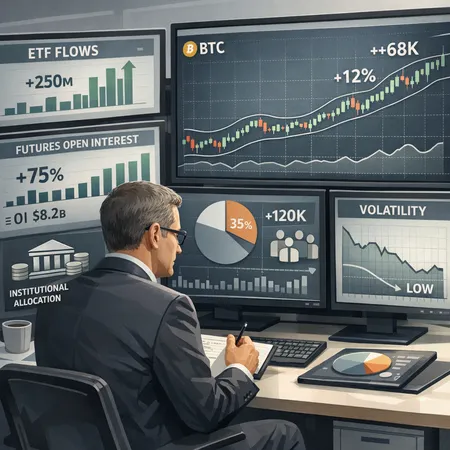
Three market plumbing elements matter most: ETF flows, futures open interest and structure, and retail engagement. Each can materially affect realized volatility and the predictability of BTC returns.
ETF flows and institutional allocation
Regulated ETFs aggregate and smooth demand. Blockonomi’s analysis lays out how steady institutional ETF flows can provide a base of continuous buying that props up price without causing extreme spikes: these are predictable, portfolio-driven purchases rather than frantic retail bids Blockonomi link. However, inflows can reverse; remember that ETFs also permit redemptions and can experience drawdowns — U.Today recently highlighted that Bitcoin ETFs have seen meaningful drawdowns since launch, reminding us that ETF inflows are not a one-way valve U.Today link.
For Hougan’s thesis to hold, institutional allocation must be persistent: think steady rebalances, long-term plan contributions, and portfolio-level adoption rather than speculative ramping. Watch metrics like custody inflows to major custodians, institutional issuance, and the ratio of passive ETF holdings to spot market float.
Futures open interest, leverage, and volatility
The structure of derivatives determines how much leverage can amplify price moves. Lower relative open interest and more balanced long/short positions reduce the probability of cascading liquidations that whip out prices. If open interest grows slowly alongside spot liquidity and if professional market-makers and custodians tighten funding spreads, then systemic liquidations become less frequent and volatility declines.
Practically, a grind-up world features rising notional futures markets that are better collateralized, more hedged by institutions, and connected to spot through efficient arbitrage — again, the kind of maturation Matt Hougan highlights.
Retail engagement: the wild card
Retail remains the most variable component. If retail becomes a minority of active spot and futures volume, episodic leverage squeezes are less likely. But if retail re-enters in force (pay attention to on-chain metrics, DEX volumes, and margin platform activity), the super-cycle route remains on the table. In short: steady institutional demand can temper volatility, but retail surges can overturn the moderation story quickly.
Implications for investors: allocators vs traders
How you position should follow your time horizon, risk budget, and belief in which narrative will dominate.
For long-term allocators and wealth managers
If you accept the grind-up scenario, treat BTC as a strategic allocation that behaves more like a long-duration alternative: a set-and-forget slice that contributes to return and diversification. Recommended practical moves:
- Position sizing: consider 1–5% of portfolio in core exposure for conservative allocators, 5–10% for return-seeking endowments or family offices. Those ranges are illustrative — calibrate to client risk profiles.
- Rebalancing cadence: shift from ad-hoc trading to disciplined rebalancing quarterly or semi-annually to capture dollar-cost averaging benefits and keep exposures aligned to policy limits.
- Vehicle choice: for wealth managers constrained by custody or regulatory rules, spot ETFs or regulated trusts may be preferable; institutional-grade custody and multi-signature setups remain essential for direct holdings.
- Tax planning: longer holding periods improve tax efficiency in many jurisdictions. Consider tax-loss harvesting windows and consult with tax counsel for treatment of crypto assets.
For short-term traders and allocators seeking alpha
Traders relying on episodic volatility must remain nimble. If the market indeed grinds up with dampened volatility, returns from pure directional speculation or leverage shrink; alpha will come from relative value, basis (spot vs futures), options volatility-selling strategies, or cross-asset tactical trades.
Tactically, traders should:
- Monitor futures open interest and funding rates for transient opportunities.
- Use smaller, event-driven positions and avoid one-way leveraged bets that depend on retail-driven squeezes.
- Expect lower realized volatility; adjust risk limits and Sharpe-based performance expectations accordingly.
Portfolio construction guidance if Bitcoin is a steady-return asset
Below are practical, actionable rules to implement the grind-up view in client portfolios.
Position sizing and allocation frameworks
- Core-satellite approach: allocate a core exposure in low-cost, spot-like vehicles (ETFs or custody-backed trusts) that represent a strategic bet, and use a small satellite sleeve for tactical or active exposures (options, futures hedges).
- Risk parity and volatility targeting: if BTC volatility compresses, consider volatility-targeted tilts to maintain consistent risk contribution within a multi-asset portfolio.
- Scenario buckets: maintain a small ‘‘event risk’’ bucket (1–2%) for opportunistic plays should a super-cycle narrative materialize.
Rebalancing and risk controls
- Fixed rebalancing (quarterly) aligns well with a grind-up path and avoids selling into short-term noise.
- Use cash buffers to meet rebalancing needs rather than forced liquidations of crypto during drawdowns.
- Consider dynamic rebalancing when macro signals or derivatives stress indicate regime shifts.
Tax and custody considerations
- Custody: employ institutional custody with clear segregation, insurance, and cold-storage practices. For clients who prefer turnkey solutions, regulated spot ETFs provide an operationally simple route.
- Tax: longer holding periods often reduce tax friction; for institutions, consider in-kind transfers and tax-efficient vehicles when available.
- Documentation: for model portfolios, explicitly document how crypto exposures are treated in policy statements and client mandates.
A practical note: platforms such as Bitlet.app now offer services across custody and installment allocations for retail and wealth segments, which can simplify recurring purchases and operational flows for long-term positions.
Practical playbook and risk checklist
If you’re leaning into a decade-long grind-up thesis, monitor these indicators to validate or invalidate that view:
- ETF flows: steady, directional inflows that persist across quarters support the thesis; abrupt reversals or concentrated one-time inflows weaken it. (See Blockonomi and U.Today coverage for recent ETF dynamics.)
- Futures open interest and funding: a well-hedged futures market with manageable funding rates suggests lower liquidation risk.
- On-chain retail metrics: rising retail activity on exchanges and margin platforms is an early warning of renewed super-cycle risk.
- Liquidity depth: tighter bid-ask spreads and larger resting order sizes at top exchanges indicate a deeper market less prone to flash crashes.
Signals that would falsify the grind-up view include rapid, sustained retail mania accompanied by explosive futures leverage, or a structural shock that forces institutional sellers (e.g., severe regulatory clampdowns or major custody failures).
Conclusion
Matt Hougan’s grind-up thesis is a deliberate re-framing: think steady institutional accumulation and ETF-driven smoothing rather than repeated parabolic moves. For wealth managers and intermediate-to-advanced investors, that means adjusting expectations, refining position-sizing frameworks, and operationalizing custody and tax efficiency. It doesn’t eliminate the possibility of episodic super-cycles — those can still happen — but it asks fiduciaries to plan for a future where BTC delivers patient, portfolio-friendly returns.
Sources
- Bitwise comments and interview coverage: https://cryptonews.com/news/bitwise-cio-sees-bitcoin-on-a-10-year-grind-up-with-steady-returns/
- Cointelegraph summary of Bitwise thesis: https://cointelegraph.com/news/bitcoin-returns-strong-decade-analysts-2026-bitwise-matt-hougan?utm_source=rss_feed&utm_medium=rss&utm_campaign=rss_partner_inbound
- Super-cycle analyst perspective: https://www.newsbtc.com/news/bitcoin/heres-when-bitcoin-super-cycle-will-kick-in-analyst/
- ETF drawdown data and flows analysis: https://u.today/bitcoin-etfs-see-largest-drawdown-since-launch?utm_source=snapi
- Institutional ETF flow context: https://blockonomi.com/bitcoin-price-consolidates-near-fair-value-amid-steady-institutional-bitcoin-etf-flows/
For focused reading on market mechanics, institution-level custody, and implementation options, see the linked sources above. Also consider exploring historical futures open interest and on-chain retail metrics to track which narrative — grind up or super-cycle — is gaining momentum.
For many allocators, a pragmatic approach is to set policy, automate steady contributions, and review signals quarterly, rather than chase each short-term story. As always, balance conviction with risk management and clear operational plans.