Ethereum Under Stress: ETF Outflows, Whale Accumulation, and Near-Term Scenarios
Summary
Executive snapshot
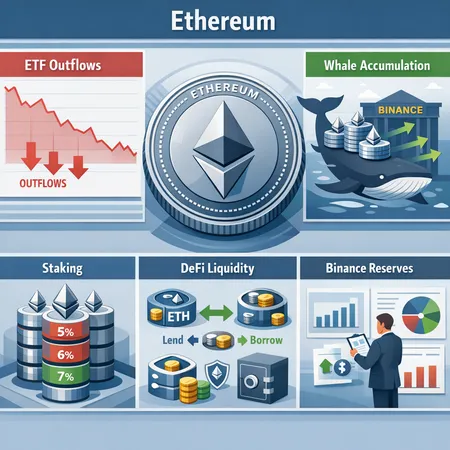
U.S. Ether ETFs posted a six-day consecutive outflow streak, a fresh technical headwind that showed up quickly in ETH price action. At the same time, on-chain scanners flagged sizable withdrawals of ETH from Binance and clustering of large balances into whale-controlled wallets — a pattern consistent with accumulation. Those two forces are not mutually exclusive: ETFs work through institutional rails and product flows, while whales can hoard or redistribute tokens on-chain, influencing liquidity but not ETF NAV directly.
For readers who track cross-asset capital flows, note that the same period saw persistent ETF outflows for ETH while Bitcoin ETFs attracted inflows, a divergence that matters for short-term rotation and risk premia. For many traders, Bitcoin ETF behavior is still a useful macro signal for rotational money between the two largest crypto assets.
Why the six-day outflow matters for price
A sustained streak of ETF outflows is more than a headline — it represents net selling pressure from wholesale buyers who use ETFs to gain or shed exposure. The crypto.news piece documenting the six-day ETF outflow streak shows that U.S. Ether ETFs consistently recorded net redemptions, which translates into lower demand for underlying ETH at market hours and higher selling into liquidity pools. That withdrawal pattern exacerbates short-term technical weakness because it removes a steady buyer layer that had supported prices over prior months.
From a price-action perspective, ETF outflows often steepen selling ladders: market participants anticipating lower institutional demand will mark bids lower, algorithmic liquidity providers widen spreads, and derivatives desks adjust funding rates. The news.bitcoin.com summary comparing Bitcoin and Ether ETF flows highlights how capital can rotate between products — meaning ETH may feel additional pressure if allocators favor BTC during risk-on windows.
Whale accumulation and Binance reserve drains: the counterpoint
On-chain analytics reveal a different story at the exchange and wallet layer. Reports show significant withdrawals of ETH from Binance reserves and subsequent accumulation into large addresses. The Cryptopolitan analysis details these on-chain flows and interprets them as whales accumulating ETH from exchange balances rather than retail-driven buying. This behavior matters for three reasons:
- Withdrawals from exchange reserves reduce immediate sell-side liquidity, raising the price impact of large market orders.
- Concentration of ETH in whale wallets can indicate intent to hold, stake, or move into OTC/over-the-counter custody rather than sell into spot orderbooks.
- However, whale accumulation does not directly offset ETF redemptions because ETFs and custody flows operate on different timelines and counterparties.
In short: ETF outflows remove a predictable institutional bid; whale accumulation tightens exchange liquidity and could amplify volatility if whales decide to rebalance.
Reconciling the two signals: how they interact
These forces should be read as complementary layers, not contradictions. ETF outflows are an institutional demand shock that can lower market-making incentives and widen spreads. Simultaneously, exchange reserve declines mean there is less depth to absorb that same selling pressure, which can produce outsized moves on smaller volumes.
A useful analogy: ETFs are like a steady river; whale withdrawals shrink the riverbed. If the river slows (ETF outflows) while the bed narrows (lower exchange liquidity), the flow becomes more turbulent. Practically, that turbulence shows up as chop around key supports, sharper intraday swings, and an increased probability of short-lived breakdowns to new lows.
Near-term scenarios: recovery, consolidation, or further weakness
Below are concise, plausible scenarios based on the interaction between ETF flows and on-chain accumulation. Time horizon: days to 6–8 weeks.
Scenario A — Recovery (high-probability if ETF flows reverse):
- Trigger: U.S. Ether ETF inflows resume or Bitcoin ETF inflows slow, leading managers to rebalance toward ETH.
- On-chain confirmation: sustained decline in exchange balances accompanied by stable or rising whale wallet dormancy.
- Price behavior: quick mean-reversion bounce into prior support turned resistance; volatility falls.
- Implication: staking yields compress slightly as more ETH is staked and liquid staking derivatives (LSDs) are used to re-enter DeFi exposure.
Scenario B — Grindy consolidation (base case):
- Trigger: ETF outflows slow but do not flip; whales continue to accumulate slowly.
- On-chain confirmation: Binance reserves remain subdued but large wallets show mixed activity (some staking, some movement).
- Price behavior: prolonged sideways action with periodic tests of support levels; DeFi liquidity tightens during testing.
- Implication: borrowing costs in DeFi tick upward; liquid staking issuance rises modestly as yield-seeking flows allocate between staking and lending.
Scenario C — Further weakness (tail risk if outflows persist):
- Trigger: ETF outflows persist for multiple additional weeks and macro risk pushes allocators to reduce crypto exposure.
- On-chain confirmation: exchange reserve declines accelerate but whales begin to move or realize profits, increasing sell-side pressure in OTC or derivatives markets.
- Price behavior: sharper drawdown, higher realized volatility, forced deleveraging in margin-heavy sectors of DeFi.
- Implication: staking yields may spike as validators compete for fewer staking deposits; DeFi collateral availability contracts, increasing liquidation risk for leveraged positions.
Key on-chain and off-chain metrics to watch
Monitor these indicators together — no single metric tells the whole story.
- ETF flows: daily inflow/outflow tallies from filings and ETF reporting. The crypto.news and bitcoin.com pieces are useful near-real-time summaries during intense weeks. Link ETF flow changes to price moves rather than assuming causation.
- Exchange reserves: net changes on Binance reserves are particularly informative because Binance remains a primary liquidity pipeline. Sudden drops can signal accumulation or transfer to cold storage.
- Large withdrawals and dormancy: upticks in large transfers followed by long inactivity suggest hodling or staking intent.
- DeFi liquidity metrics: TVL, borrow rates, and usable collateral — compressed liquidity increases slippage and raises liquidation risk.
- Staking inflows and LSD supply: rising liquid-staking issuance can indicate institutional desire for staking yield while keeping DeFi composability.
Implications for staking yields, DeFi collateral, and institutional demand
Staking: If accumulation continues, a larger share of ETH may be locked into staking contracts or long-term cold wallets, tightening circulating supply and supporting staking yields. Conversely, if ETF outflows force reallocations into USD or BTC, validators may see a surge of withdrawals in liquid staking products as allocators prefer LSDs for flexibility.
DeFi collateral: Sharper moves in ETH can stress borrowing markets. Tightening DeFi liquidity will raise borrow rates and lower collateral depth, increasing liquidation cascades for leveraged positions. For risk managers, that means watching stablecoin liquidity alongside ETH denominated collateral.
Institutional demand: ETF flows are the clearest institutional signal. Persistent outflows reduce the marginal willingness of allocators to add ETH, while a reversal would validate the thesis of renewed institutional appetite. On-chain whale accumulation is supportive — but only insofar as those wallets remain inactive or locked.
Positioning guidance for intermediate DeFi investors and allocators
- Size exposure relative to scenario probability: avoid levering long while ETF outflows persist unless you have a clear short-term hedge. Consider derivative hedges or reducing position size.
- Use liquid staking derivatives judiciously: LSDs provide yield plus DeFi exposure, but watch counterparty and smart contract risk. If staking yields spike, that may present a relative value play versus lending protocols.
- Monitor exchange reserves and large withdrawals daily: a persistent decline in Binance reserves with ETF inflows reversing is a strong bullish confluence. If reserves fall while ETF outflows continue, liquidity-driven volatility is likelier.
- Keep capital for tactical re-entry: volatility events caused by low depth create opportunities to add on weakness. Set limit orders and have pre-defined entry bands rather than reacting to headlines.
Bitlet.app users and allocators should fold ETF flow and on-chain reserve checks into their regular rebalancing cadence rather than treating them as one-off events.
Final take
The six-day ETF outflow streak is a clear near-term headwind for ETH price action, but whale accumulation via Binance outflows is an important counterweight that tightens supply and changes how price could behave on either side of the trade. For allocators and DeFi investors, the interplay between ETF-driven demand and on-chain liquidity will dictate short-term risk: watch flows, reserves, and on-chain dormancy closely, size positions conservatively, and use liquid staking or derivatives only with clear risk parameters.