Solana After Firedancer: Jupiter's JUPUSD, NFT Collapse, Is Adoption Stalling?
Summary
Executive snapshot
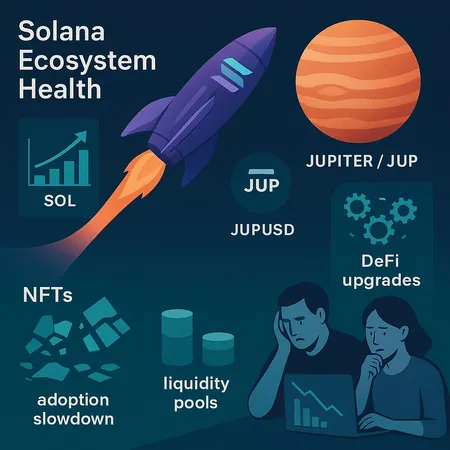
Solana has just experienced a string of narratives: Firedancer started running on mainnet and caused a visible market bump, while Jupiter used Breakpoint 2025 to unveil JUPUSD and eight protocol-level DeFi upgrades. At the same time, on-chain activity tells a less sunny story — NFT sales broadly plunged even as some Solana-specific NFT metrics spiked, and critics point to weakening liquidity and developer engagement. This piece walks through what changed technically, what it might mean economically, where the risks still sit, and how investors or builders can assess whether the ecosystem is genuinely recovering or merely repricing on hype.
Firedancer: what it actually moved (and why it matters)
Firedancer is designed to be a performance-optimized validator client intended to improve throughput and reliability for Solana validators. Early mainnet runs have shown better resource efficiency and smoother validation in controlled conditions; traders and node operators care because validator performance translates into lower latencies, fewer missed slots, and a healthier ecosystem for high-frequency DeFi and NFT activity. News outlets captured the immediate market reaction: reports tied Firedancer going live to a short-term SOL price rally of roughly 5% as sentiment improved (NewsBTC).
But the technical win needs to translate to sustained operational metrics. Meaningful improvements will show up as sustained increases in validator uptime, decreases in rollback incidents, lower average confirmation times during peak load, and more even stake distribution. For validators this can lower operating costs and reduce out-of-slot errors; for users it reduces failed transactions and front-running noise. Those are real usability improvements, but they don’t automatically fix demand-side problems like shallow liquidity pools or dwindling active wallets.
Market reaction vs fundamentals
Short-lived price moves after tech announcements are common in crypto — expect volatility. The NewsBTC piece captures a sentiment-driven price move, not a permanent shift. Investors should separate the immediate reflexive rally in SOL from the deeper question: will Firedancer materially increase the number of transactions, active addresses, and protocol-level revenue on Solana? That separation matters for anyone deciding to increase exposure to SOL or to allocate risk to Solana-native tokens like JUP.
Jupiter at Breakpoint: JUPUSD and eight DeFi upgrades — practical implications
At Solana Breakpoint 2025, Jupiter announced JUPUSD, a Jupiter-native stablecoin, along with eight major DeFi upgrades intended to improve routing, liquidity efficiency, and cross-protocol composability. Coinpedia’s coverage outlines the product slate and suggests the aim is to reduce slippage, speed up multi-hop swaps, and bootstrap new lending and margin flows via a native stablecoin (Coinpedia).
JUPUSD could be meaningful in three ways: first, as an on-chain settlement primitive that reduces reliance on external stablecoins and cross-chain bridges; second, by creating new yield-bearing primitives and lending markets pegged to JUPUSD; third, by changing Jupiter’s token dynamics — JUP might see new utility if it’s used to collateralize pools or to bootstrap peg support. For the broader DeFi stack, smoother routing and improved capital efficiency lower execution costs for traders and could raise TVL if liquidity providers get better returns and lower impermanent loss.
That said, the launch of a new stablecoin carries non-trivial risks: peg stability under stress, initial liquidity provisioning, regulatory scrutiny, and integration lags with major DEXs and lending platforms. JUPUSD’s success depends on liquidity — both in terms of market depth and integrations across wallets and protocols. Watch the JUPUSD market cap, on-chain peg health (deviation from $1), and volume routed through Jupiter as early adoption signals.
NFTs — a nuanced collapse and a Solana outlier
Macro NFT volumes recently fell; global NFT sales dropped about 15% to $64.9M in the period reported, but Solana sales simultaneously jumped ~44%, according to market data aggregators (crypto.news). That contrast is important: Solana is not immune from the broader market slowdown, but there can be concentrated bursts of activity driven by single collections, wash trading, or marketplace promotions.
A jump in Solana NFT dollar volume does not necessarily indicate durable demand. Buyer counts, unique wallets transacting, and secondary market turnover rates are better indicators of genuine collector or speculator interest. The broader plunge suggests buyer activity is declining across markets; when combined with the Solana-specific spike, it often signals concentration — a few projects or events temporarily inflate metrics. Investors and builders should prefer metrics like unique buyers/month, time-weighted floor-price stability, and cross-collection penetration to headline volume numbers when assessing NFT health.
Critiques: liquidity, engagement, and the adoption slowdown narrative
Skeptics argue that despite technical upgrades, Solana faces deeper adoption hurdles: falling liquidity in DEX pools, waning developer engagement, and fewer active wallets. A recent critical analysis highlights slowing adoption with measurable drops in liquidity and user engagement as reasons for concern (CoinTribune). Those are not trivial: DeFi primitives need on-chain liquidity to function, while developers need incentives and clear product-market fit to keep building.
Empirical checks: look at TVL across Solana protocols, DEX volumes vs. AMM liquidity depths, GitHub commits and contributor counts for flagship projects, and month-over-month active wallet counts. If TVL and active addresses decline for multiple quarters even while network latency improves, the ecosystem risks becoming technically capable but economically hollow. Conversely, if technical improvements reduce friction and a large enough UX cohort returns (wallets, marketplaces, aggregators), you can see a virtuous cycle of liquidity returning.
A practical framework for investors and builders
The following framework helps cut through the noise and decide whether Solana’s narrative is recovering or stalling. Treat it as a checklist and pulse monitor rather than an immutable rubric.
Technical health (short term): validator uptime, average block confirmation times, rollback frequency, and post-Firedancer latency metrics. Positive trend = technical tailwind. Negative trend = operational risk.
Liquidity & market depth: DEX liquidity (depth at 1% / 5% slippage), TVL across lending/AMM protocols, and stablecoin on-chain supply. Watch JUPUSD’s market cap and peg metrics as a lead indicator.
User activity: daily/weekly active wallets, unique NFT buyers, and median transactions per wallet. Growth in unique users matters more than raw volume spikes.
Developer momentum: new protocol launches, GitHub activity, grant programs, and hackathon outcomes. Developer churn or slowed commit rates is an early warning.
Token economics & integrations: adoption of JUPUSD in lending protocols, usage of JUP in governance or liquidity mining, and cross-protocol routing volume. If JUP begins to circulate as settlement currency, that’s a strong adoption signal.
External risks: regulatory developments for stablecoins, cross-chain bridge incidents, or macro liquidity shocks that can hit DeFi and NFT markets simultaneously.
Decision heuristics:
- Bullish signal set: sustained validator performance gains, rising TVL and DEX depth, JUPUSD peg stability and growing supply, increasing unique active wallets, and steady developer activity. These suggest a durable narrative recovery.
- Bearish signal set: persistent declines in active wallets, contracting TVL despite technical upgrades, JUPUSD failing to find peg/volume, and developer exodus. This combination implies structural adoption issues.
Example investor playbook
Short-term trader: capitalize on volatility around tech announcements, but use tight risk controls. Medium-term investor (6–18 months): monitor the checklist quarterly—add exposure if at least four of six categories trend positively. Ecosystem builder: prioritize integrations with Jupiter for routing and JUPUSD support, and focus on user onboarding to convert volume into unique users.
If you use platforms to monitor liquidity and trade tokens, Bitlet.app can be part of an overall kit for tracking positions and token flows across Solana — but don’t rely on any single data point.
Bottom line: incremental wins, not a guaranteed rebound
Firedancer’s mainnet run and Jupiter’s Breakpoint announcements are meaningful — they tackle core bottlenecks in performance and settlement. Short-term market reactions (a bump in SOL, attention for JUP and JUPUSD) are expected. However, systemic adoption depends on the demand side: sustained user growth, deeper liquidity, and developer momentum. The recent NFT sales plunge and adoption critiques show that supply-side fixes alone won’t guarantee recovery.
For investors and builders, the right posture is empirical and patient: validate technical improvements on-chain, watch JUPUSD for early peg and liquidity signs, measure unique user growth rather than headline volumes, and use the checklist above to update conviction objectively. If Firedancer and Jupiter catalyze a multi-quarter uptick in TVL, active wallets, and stablecoin usage, the narrative is recovering. If those on-chain indicators remain muted, the story is stalling — and price action will likely follow fundamentals rather than announcements.
Sources
- NewsBTC — Solana’s Firedancer mainnet and market reaction: https://www.newsbtc.com/altcoin/solanas-long-awaited-firedancer-launch-sparks-5-rally/
- Coinpedia — Jupiter unveils JUPUSD and Breakpoint 2025 upgrades: https://coinpedia.org/news/jupiter-unveils-jupusd-stablecoin-and-major-defi-upgrades-at-solana-breakpoint-2025/
- Crypto.News — NFT sales plunge while Solana sales jumped: https://crypto.news/nft-sales-plunge-15-to-64-9m-solana-sales-jump-44/
- CoinTribune — critical analysis of Solana’s adoption slowdown: https://www.cointribune.com/en/solana-struggles-with-adoption-slowdown/?utm_source=snapi