Institutionalizing XRP: TOXR ETFs, CFTC Shifts, and RLUSD’s Settlement Play
Summary
Why institutionalization matters now
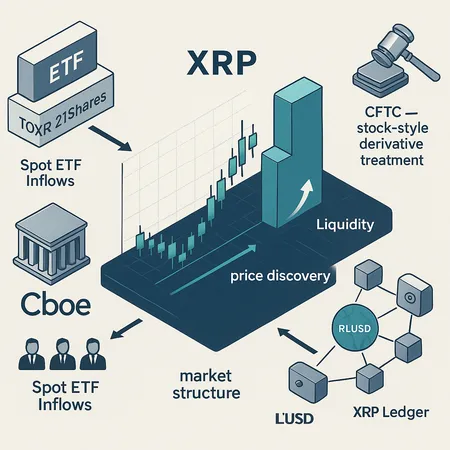
The last year has a familiar theme: crypto instruments that once lived at the fringe are being folded into mainstream capital-market plumbing. For XRP that means three converging forces — spot ETFs such as 21Shares’ TOXR cleared by Cboe, evolving regulatory signals from U.S. authorities that make Ripple‑linked products look more like stock‑style instruments, and native stablecoin rails on the XRP Ledger (notably RLUSD) for near-instant settlement. Each by itself is market-moving; together they change where liquidity lives, how price discovery works, and what custody looks like for institutional desks and compliance teams.
For many macro desks, Bitcoin remains the primary bellwether, but XRP is becoming a different animal: shorter settlement cycles, tighter spreads when liquidity is present, and granular custody requirements for assets flowing into ETFs and on‑ledger stablecoins. Bitlet.app clients and institutional users should watch how these mechanics interplay with execution and regulatory reporting.
How spot ETFs (TOXR) actually create market impact
Spot XRP ETFs operate like other physically backed ETFs: authorized participants (APs) create shares by delivering basketed XRP into an ETF custodian, and redeem by returning shares and receiving XRP. That creation/redemption mechanism is the primary arbitrage engine that keeps ETF prices tethered to NAV, but it also sources demand from the institutional buyer base behind ETF flows.
21Shares’ TOXR — cleared by Cboe — has seen rapid inflows that are already material to available XRP liquidity, approaching roughly the billion‑dollar mark in total flows according to recent reporting. The practical effect is straightforward: every meaningful creation requires APs to acquire XRP on the spot market or from OTC counterparties, which reduces the exchange‑available float and raises market impact for large spot fills. When inflows are sustained, the ETF becomes a consistent liquidity sink.
See the reporting on TOXR and Cboe clearance for inflow context here: 21Shares' TOXR XRP ETF cleared by Cboe as inflows near $1 billion.
Liquidity walls, upside triggers, and delta between ETF and spot
Institutional traders need to model two related but distinct risks: liquidity walls and upside triggers. A liquidity wall appears when on‑exchange orderbooks thin as APs and custodians hoard inventory for ETF creation; large institutional sell orders then move price more than historical depth would suggest. Upside triggers occur when ETF flows are large enough to push price through stop clusters or algorithmic liquidity bands, prompting short covering and momentum buying.
Key practical points for execution desks:
- Monitor ETF inflow cadence and AP activity: sustained net creation days imply an on‑going bid beneath the spot market.
- Watch exchange vs OTC inventory: ETF demand often pulls from OTC liquidity pools, which may transmit less immediately into displayed orderbooks.
- Stress test slippage by simulating fills against the post‑creation available float rather than historical depth.
APs and market‑makers can dampen volatility by providing inventory, but that inventory comes at a cost — wider quoted spreads and increased margin usage — which gets passed into execution costs and can accentuate short-term moves.
Regulatory tilt: CFTC moves and stock‑style trading implications
A notable regulatory development is a CFTC posture that could let Ripple‑linked instruments trade more like stock‑market derivatives, with implications for margining, clearing, and venue choice. If Ripple products move into frameworks that emphasize standardized clearing and stock‑style trading mechanics, institutional desks gain access to more predictable counterparty risk models, centralized clearing, and possibly deeper synthetic liquidity.
This shift has several cascading effects:
- Derivatives desks can use listed, cleared products to hedge ETF exposure, compressing basis risk.
- Margin models change: cleared instruments typically carry different initial and variation margin profiles than bespoke swaps, which affects capital allocation.
- Trading venues may bifurcate: some order flow shifts to regulated venues with standardized contracts while spot liquidity remains on crypto venues and OTC desks.
For analysis and framing of this transition, see the coverage on the CFTC’s potential impact here: CFTC move sparks Ripple’s leap toward stock‑style trading.
RLUSD on the XRP Ledger: settlement rails that matter
Gemini’s integration of RLUSD on the XRP Ledger is a practical game changer for settlement. On‑ledger stablecoins like RLUSD allow exchanges and institutions to settle XRP trades — and move custody — with lower latency and lower counterparty settlement risk than traditional fiat wires. That means faster arbitrage, tighter intraday funding windows, and more robust cross‑venue settlement strategies.
The integration is more than a convenience: it converts settlement timing from T+1 or longer fiat rails down to sub‑second ledger movements (subject to exchange rails for on/off ramps). For institutional desks this reduces failed settlement risk, reduces capital tied up in NCC (net capital charges) and shortens the time to re‑use collateral. Gemini’s announcement summarizing RLUSD rails and faster settlement is discussed here: Gemini integrates billion-dollar RLUSD into XRP Ledger.
Practical implications:
- Exchanges can net positions faster and offer tighter cross‑exchange execution.
- Custodians can move assets between cold‑storage, vaults, and active trading accounts with lower settlement leg risk.
- Compliance teams must map on‑ledger stablecoin flows to fiat reporting requirements and KYC/AML controls.
Combined market‑structure effects and what traders/compliance officers should watch
Layer these changes and you get a market that behaves differently:
- Concentrated custody: ETF holdings move free float into institutional vaults, reducing displayed depth and increasing dependency on APs and market‑makers.
- Faster settlement loops: RLUSD and XRPL rails reduce time between trade and finality, enabling tighter hedging but also increasing the velocity of position updates and AML monitoring needs.
- Cross‑market arbitrage: If Ripple‑linked derivatives migrate toward stock‑style clearing, arbitrage between ETFs, spot, and cleared derivatives will compress spreads but amplify sudden flows when arbitrage disequilibrium appears.
For compliance officers this means updating surveillance to link ETF flows, on‑ledger transfers, and exchange orderbook signals. For traders it means recalibrating execution algos to account for a thinner display but deeper OTC and custodial liquidity ecosystem.
Custody, settlement choices, and counterparty considerations
Institutional custody decisions now sit at the intersection of two tradeoffs: minimizing operational/counterparty risk versus preserving execution optionality. Custodial vaults serving ETFs reduce custody complexity for issuers and APs, but they also centralize a large percentage of supply. On‑ledger settlement using RLUSD offers a decentralised alternative for instant settlement, but it requires integrations with exchanges, treasury systems, and compliance middleware.
Checklist for custody and compliance teams:
- Ensure custodians support rapid proof of reserves and segregation reporting for ETF flows.
- Validate on‑ledger transaction monitoring for RLUSD and reconciliation procedures to fiat rails.
- Recalibrate KYC/AML rules to reflect higher‑velocity transfers enabled by RLUSD and XRPL.
- Confirm legal opinions and custodian agreements address recovery scenarios in markets with high ETF concentration.
Scenario planning: upside, drawdown, and regulatory shocks
A few plausible scenarios to stress-test:
- Continued ETF inflows: persistent buying tightens float, raising price and increasing slippage for sellers. Hedging via cleared derivatives reduces VAR but could increase basis events.
- Rapid outflows/redemption wave: APs redeem and the ETF returns XRP into the spot market, creating sudden sell pressure; exchanges without deep liquidity can see cascades.
- Regulatory clarification in favor of broader trading: more venues list cleared Ripple derivatives, improving hedging but shifting volatility timing to the overlap of spot and derivatives settlement windows.
Each scenario changes capital and compliance needs. Simulate both liquidity and operational stress simultaneously — a classic market‑plus‑settlement event is the most damaging.
Conclusion: operationalize the new market reality
XRP’s institutionalization is not a single event but a compound process: ETFs like TOXR create persistent bid pressure and concentrate custody, CFTC posture changes can open new hedging and listing venues, and RLUSD on XRPL materially shortens settlement cycles. For institutional traders, that means new alpha and new execution risks. For compliance officers, it means reworking surveillance, custody, and settlement controls to reflect faster, more concentrated flows.
This is a market‑structure shift that rewards desks and operations teams that build integrated trade, custody, and compliance workflows — and those that stress‑test against both liquidity and settlement shocks. Keep watching ETF flows, AP behavior, on‑ledger stablecoin movement, and regulatory signals; together they will determine where liquidity sits and how price discovery evolves.
Sources
- https://coinpedia.org/news/21shares-toxr-xrp-etf-cleared-by-cboe-as-inflows-near-1-billion/
- https://coinpaper.com/13034/cftc-move-sparks-ripple-s-leap-toward-stock-style-trading?utm_source=snapi
- https://coinpaper.com/13033/gemini-integrates-billion-dollar-rlusd-into-xrp-ledger-faster-cheaper-settlements-ahead?utm_source=snapi