XRP's Institutionalization: ETFs, Bitwise 10 Inclusion, and the Paradox of Shrinking Exchange Reserves
Summary
Executive snapshot
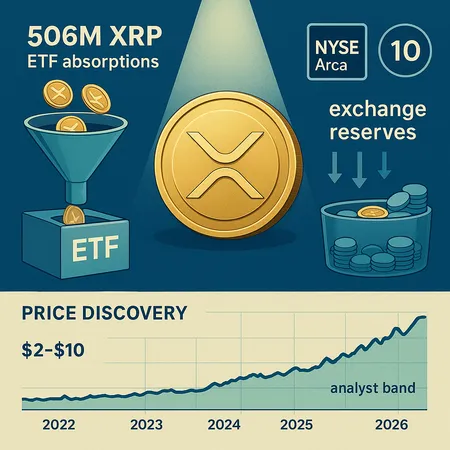
Institutional infrastructure is converging on XRP: physical ETPs and ETFs absorbing supply, Bitwise adding XRP to a regulated NYSE Arca product, and large outflows from exchange custody. Those three signals together compress the tradable float even if total supply remains unchanged, and that compression is central to any credible thesis for multi-dollar price discovery in 2025–2026. This report parses the mechanics behind 506 million XRP absorbed by ETFs, what Bitwise’s inclusion means for mainstream access, why exchange reserves collapsed by more than $1 billion, and lays out realistic price scenarios and risk controls for asset managers and retail investors.
How 506M XRP absorbed by ETFs changes float and market mechanics
What "absorption" actually means
When analysts report that ETFs or ETPs have absorbed 506 million XRP, they’re referring to product managers acquiring that balance and placing it under custodial control for fund shareholders. This is not a burn or destruction of supply — it’s a reclassification of where XRP sits: from exchange or retail wallets into institutional custody. Cointelegraph documented the 506M figure and framed it as supporting price-discovery prospects; the practical effect is fewer tokens immediately available for spot-selling on exchanges. See the original report here: Cointelegraph article on ETF absorption.
Order book impact and liquidity nuance
Reducing the on-exchange float tightens order book depth. For identical bids, the price impact of a sell order grows as visible liquidity shrinks. That’s the heart of ETF-driven scarcity: the same pool of buy-side demand meets a smaller immediate supply, so small inflows of capital can move price disproportionately. But nuance matters. Many institutional custodians and authorized participants (APs) manage creation/redemption windows and can supply liquidity via OTC desks, so price sensitivity depends on how quickly custodians allow tokens to re-enter tradable markets.
Market mechanics differ from a token burn
Contrast this with on-chain token burns: burns permanently lower total supply and often materially shift tokenomics. ETF absorption is reversible via redemptions, secondary markets, or AP arbitrage. The key driver of short-to-medium term price behavior is not permanence but friction: time-to-liquidity, custodial transfer constraints, and the concentration of sell pressure into fewer venues.
Bitwise 10 inclusion: regulated access and index-driven demand
Bitwise’s move to add XRP to its Bitwise 10 Crypto Index Fund (BITW) on NYSE Arca is more than symbolic. Coinpedia’s coverage of the inclusion highlights two practical effects: (1) index-driven allocations from multi-asset managers and pension-friendly funds that track or benchmark to BITW may now hold XRP by default; (2) regulated wrappers on an exchange-listed product reduce allocation friction for institutions that avoid direct custody of native tokens. Read the announcement here: Bitwise adds XRP to BITW.
Inclusion also increases the likelihood of steady, predictable inflows that are less correlated to day-to-day crypto headlines — think rebalances and quarter-end flows driven by index weightings. That steady demand complements episodic ETF flows and can anchor expectations for longer-term scarcity.
The sharp fall in exchange reserves: off-exchange demand or custodial reshuffling?
The raw data and immediate interpretations
Over the past month exchange reserves for XRP reportedly crashed by over $1 billion according to reporting in Finbold. At first glance, that looks like investors are withdrawing XRP for long-term custody — a bullish sign for those focused on circulating tradable supply. Source: Finbold on XRP exchange reserves decline.
However, exchange reserve metrics are messy. They capture balances held on exchange hot wallets, but do not distinguish between:
- Transfers to regulated custodians tied to ETPs (tokens now counted as off-exchange but still professionally liquid)
- Movement into cold custody for long-term holding
- Internal transfers between exchange wallets or to OTC counterparties
- Accounting adjustments as custodians reconcile holdings during ETF creations
Evidence for real demand vs. bookkeeping effects
Two pieces of evidence tilt the needle but do not close the case. First, ETP inflows data show XRP outpacing major protocols in weekly flows, with XRP inflows nearly six times higher than Ethereum and Solana in a period reported by Coinpaper — that suggests genuine demand into products that hold XRP: Coinpaper on ETP inflows. Second, the 506M absorption number corroborates that product managers are acquiring inventory.
But the alternative explanation — custodial shifts from exchange hot wallets to regulated custodians for ETPs — would also reduce publicly visible exchange reserves while not meaningfully changing the ease with which large sellers could liquidate via APs or OTC desks. In short: the reserve collapse is necessary but not sufficient evidence of permanent market scarcity.
Scenario planning: paths to price discovery ($2–$10 thesis) into 2026
Analysts quoted by Cointelegraph posit a $2–$10 range under different flow assumptions. That range is wide because the supply-demand balance depends heavily on how persistent ETF and index inflows are, and how quickly custodians monetize holdings when redemptions occur. See their analysis here: Cointelegraph price-discovery piece.
Below are concise scenario frameworks investors can use when sizing exposure.
Base case (most probable under neutral macro): $2–$4
- Assumptions: Continued, steady ETF and BITW-driven inflows but balanced by AP-driven liquidity provisioning and occasional profit-taking. Exchange reserves remain lower but custodians allow predictable redemptions.
- Mechanism: Scarcity raises realized volatility and mean price level, but arbitrage and OTC liquidity prevent extreme spikes.
- Timeframe: 12–18 months if inflows continue at current rates.
Bull case (conditional on persistent flows + market breadth): $6–$10
- Assumptions: ETF and Bitwise inflows accelerate, new institutional entrants follow, and there’s limited sell-side available on exchange order books. Simultaneous macro tailwinds (risk-on, broad crypto adoption) amplify demand.
- Mechanism: A compressed tradable float, combined with episodes of concentrated buy pressure, generates outsized price discovery. Index-driven demand acts as a sticky bid.
- Triggers: Large corporate treasury allocations, additional ETP listings, or scarcity-driven narrative momentum.
Bear / Liquidity-risk case: sub-$1.5 or unchanged
- Assumptions: Macro tightening, regulatory setbacks, or custodians increasing liquidity through redemptions and OTC sales. Exchange reserves may reconstitute if custodians dump into spot markets.
- Mechanism: With sell pressure coordinated or triggered by outside shocks, reduced visible reserves prove ephemeral and price reverses.
Probabilities and risk management
A pragmatic allocation framework: limit any single position to a fraction of liquid net worth (e.g., 1–5% for retail depending on risk tolerance; larger but disciplined exposures for asset managers with mandated risk budgets), use layered entries, and size exits to liquidity conditions. For institutions, model redemption lag, AP behavior, and OTC desk capacity into scenarios rather than assuming instant liquidity.
Practical guidance for asset managers and retail investors
- For asset managers: consider liquidity-adjusted allocations. If portfolio rules allow, tilt size gradually as on-chain and custody metrics confirm sustained outflows to ETPs and Bitwise rebalances. Build margin buffers; model ARP/AP redemption timelines.
- For retail investors: dollar-cost-averaging reduces the risk of mistiming fast ETF-driven rallies. Be explicit about time-horizon: ETF-driven scarcity can create short, sharp rallies that are challenging to navigate with concentrated, full-sized entries.
- Custody and platform choice matter. If you’re allocating materially, custody with regulated providers reduces counterparty risk. Note: platforms like Bitlet.app operate in the same ecosystem that supports custody and retail access, but this is not investment advice — it’s a contextual reference to infrastructure evolution.
Final assessment: structural change, not a magic bullet
The convergence of ETF absorption (506M XRP), Bitwise 10 inclusion, and a >$1B drop in exchange reserves represents a structural shift in where XRP is held and how newcomers can access it. That shift increases the plausibility of a multi-dollar price discovery scenario, especially in a risk-on macro environment and continued institutional demand. But the story is not simply scarcity = permanent higher prices. Custodial mechanics, AP and OTC liquidity, regulatory developments, and macro forces will determine whether reduced exchange reserves translate into persistent scarcity or a transitory liquidity illusion.
Smart sizing, contingency planning for liquidity events, and ongoing monitoring of ETP flows and exchange reserve data are essential for anyone allocating to XRP or tracking index-driven demand like Bitwise.
Sources
- Cointelegraph — XRP ETF absorption and $2–$10 analyst thesis: https://cointelegraph.com/news/xrp-price-may-grow-from-2-to-10-in-less-than-a-year-analyst?utm_source=rss_feed&utm_medium=rss&utm_campaign=rss_partner_inbound
- Coinpedia — Bitwise adds XRP to Bitwise 10 Index on NYSE Arca: https://coinpedia.org/news/ripple-news-xrp-joins-bitwise-10-index-signaling-mainstream-adoption/
- Coinpaper — Weekly digital ETP inflows: XRP outpaces ETH and SOL: https://coinpaper.com/13003/xrp-outshines-ethereum-and-solana-weekly-digital-etp-inflows-nearly-6x-higher?utm_source=snapi
- Finbold — Exchange reserves for XRP fall by over $1 billion: https://finbold.com/value-of-xrp-reserves-on-exchanges-crashes-over-1-billion/?utm_source=snapi