Legal Risk and Market Impact: Do Kwon, UK BTC Seizures and an Institutional Playbook
Summary
Executive overview
The crypto industry is experiencing a period of intensified enforcement. Two recent, high-profile examples — the sentencing developments around Terra founder Do Kwon and a UK Bitcoin seizure linked to a large money‑laundering case — crystallize risks that compliance officers, institutional allocators and legal counsel must treat as persistent rather than episodic. This piece unpacks what happened, why now, and what institutions should do to reduce legal exposure while maintaining market access.
Why now: enforcement momentum and signaling
Regulators and prosecutors across jurisdictions are increasingly willing to pursue cross-border cases, extraditions and asset seizures. That shift is driven by several factors: a backlog of major failures that harmed retail and institutional investors, improved blockchain tracing tools, and political pressure to show tangible results. Two recent public developments illustrate the trend and its mechanics.
First, the legal aftermath of Terra — once a $60+ billion ecosystem — continues to wind through courts. Coverage of Do Kwon’s sentencing developments, including a reported five‑year prison term, shows that accountability narratives for failed crypto projects have real, long-term consequences for founders and backers (Do Kwon's sentencing).
Second, law enforcement’s use of asset seizure as a tool has escalated. A publicized UK seizure of Bitcoin connected to a large money‑laundering investigation tied to Zhimin Qian demonstrates how prosecutors are converting on‑chain evidence into tangible forfeiture actions and using cross-border cooperation to freeze assets (UK Bitcoin seizure report). When authorities can trace BTC flows with increasing confidence, custodians and counterparties become vectors for enforcement.
These developments are not isolated: they form two threads of the same tapestry — founder liability and AML enforcement — that together raise the baseline of legal risk in crypto markets.
Case study: Terra, Do Kwon and the legal trajectory for failed projects
Terra's collapse produced a cascade of civil suits, criminal investigations and token delistings. For compliance teams, the Terra episode highlighted several durable legal themes:
- Founder and operator liability: Allegations against project founders can result in criminal charges, extradition efforts and prison sentences, as seen in ongoing coverage of Do Kwon’s case. That creates legal tail risk for anyone materially associated with the protocol.
- Token classification and restitution: Courts and regulators may treat native tokens differently depending on how they were marketed and used. Secondary tokens (example tickers: LUNA, LUNC) can become instruments in restitution or recovery proceedings, complicating custody and trading.
- Counterparty contagion: Funds, market makers and centralized exchanges that provided leverage, custody or secondary markets for collapsed tokens can be named in suits or subject to investigations.
Operationally, the Terra saga produced immediate market effects—liquidity evaporated for implicated tokens, counterparties pulled lines of credit, and exchanges tightened listing standards. For institutions, the lesson is clear: failed projects can create multi-year legal and market fallout, not just a one-time price shock.
Case study: UK BTC seizure and the Zhimin Qian money‑laundering case
The UK seizure demonstrates how law enforcement turns on‑chain tracing into asset recovery. According to reporting, authorities seized a significant amount of BTC connected to a money‑laundering network. The mechanics of such actions typically involve:
- Chain analysis to link deposits and withdrawals to known illicit flows;
- Mutual legal assistance and cross-border cooperation to freeze wallets or compel custodians to lock accounts;
- Administrative forfeiture or criminal asset recovery once links are established.
This is not only a law‑and‑order story. For custodians and exchanges handling BTC, it means an elevated operational risk: accounts can be frozen by court order, and assets may be subject to forfeiture even if the platform was unaware of illicit use. For market participants, it raises practical questions: how soon must platforms act on subpoenas, what records will satisfy prosecutors, and which jurisdictions will demand custody cooperation? Coverage of the UK seizure highlights these cross‑border dynamics (UK Bitcoin seizure report).
For many traders, Bitcoin remains the primary market bellwether; when BTC is seized or litigated over, the signal ripples through derivatives, lending markets and risk models.
How prosecutions and seizures affect market sentiment, custody and compliance costs
These enforcement events alter both perception and plumbing in crypto markets.
Market sentiment and price mechanics
High‑profile prosecutions tend to produce immediate negative sentiment: sell‑offs, widened spreads and flight to liquid, regulated assets. Tokens directly associated with litigation (e.g., legacy LUNA/LUNC positions) suffer the most, but contagion can spread to correlated risk assets. Institutional allocators must assume that legal shocks compress liquidity and can cause forced deleveraging across portfolios.
Custody practices and counterparty selection
Custodians now face both reputational risk and legal exposure. Practical responses include:
- Narrowing the list of assets accepted for custody;
- Requiring enhanced provenance and source‑of‑fund attestations for large deposits;
- Implementing transaction monitoring tuned to seizure‑style indicators.
These changes increase the operational friction for on‑chain strategies and make regulated custodians more selective — which can create a two‑tier market where uninsured or offshore custody attracts higher risk but lower compliance barriers.
Compliance costs and legal overhead
Expect higher ongoing costs: more KYC/AML staff, more forensic‑grade chain analysis subscriptions, broader legal retainer arrangements and higher insurance premiums for custodial and exchange operations. For funds, compliance teams must budget for deeper counterparty due diligence and potential litigation reserves.
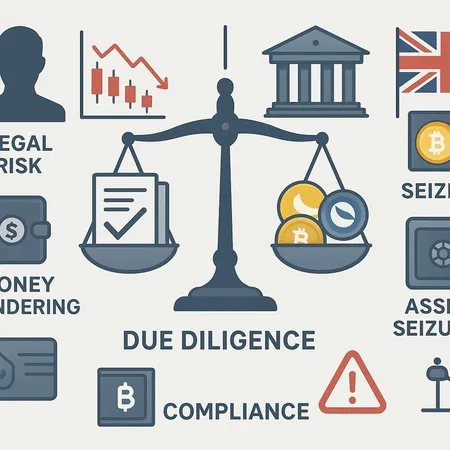
Practical due‑diligence checklist for institutional allocators
Below is a tactical checklist designed for compliance officers, allocators and legal counsel to reduce legal exposure and limit contagion risk.
Legal & governance
- Obtain legal opinions on token classification in primary jurisdictions.
- Review incorporation, governance and terms of service for counterparties.
- Confirm jurisdictional risk (where is the custodian/exchange chartered and regulated?).
Founder and counterparty background
- Conduct enhanced due diligence on founders, major contributors and early backers (litigation history, sanctions lists, criminal records).
- Review token sale mechanics and any promises that could be construed as securities‑like.
Token provenance and on‑chain analytics
- Use chain analysis to identify sanctioned addresses, mixer exposure or connections to known illicit flows.
- Require provenance attestations for large token inflows and establish blocking thresholds.
Custody & operational controls
- Prefer regulated, insured custodians with transparent policies on legal holds and cooperation with law enforcement.
- Contractually define response times and legal procedures for subpoenas, freezes and seizure events.
- Ensure multi-signature and key‑management practices include clear signatory governance and emergency procedures.
AML/KYC and transaction monitoring
- Integrate real‑time transaction monitoring tuned for seizure indicators and layering patterns.
- Maintain robust KYC for institutional counterparties, not just retail customers.
Financial and liquidity stress testing
- Model scenarios where assets are frozen or delisted; size potential redemption/gating needs and margin calls.
- Maintain contingency liquidity (cash or highly liquid BTC) to meet shortfalls without forced selling of illiquid tokens.
Insurance and contractual protections
- Seek insurance that covers legal freeze and third‑party liability where available.
- Add contractual indemnities and representations around AML compliance from counterparties.
Reporting and escalation
- Create an incident response playbook that includes legal, compliance, trading and PR roles.
- Establish pre‑approved messaging templates for regulators and counterparties.
This checklist should be operationalized into on‑boarding checklists, monthly monitoring reports and pre‑trade approvals for new allocations.
Likely near‑term market signaling from further prosecutions and asset seizures
Expect the following signals over the next 6–18 months as enforcement activity continues:
- Episodic volatility spikes when notable seizures or sentences are announced, with outsized effects on thinly traded tokens.
- A premium on regulated custody and lower spreads for assets held with transparent, cooperative providers.
- Faster delisting or restriction cycles for tokens under legal cloud, increasing rebalancing costs for funds.
- Consolidation of compliance standards as exchanges and custodians adopt similar AML controls to avoid second‑order liability.
- Jurisdictional arbitrage: activity may migrate to less‑cooperative or emerging markets until enforcement catches up.
For allocators, each signal is a trigger: tighten counterparty exposure limits on negative news, review custody arrangements, and rerun scenario analyses immediately after major enforcement actions.
Practical first steps for compliance teams and allocators
- Run an immediate portfolio review for legal exposure: identify all holdings in tokens associated with ongoing litigation or seizure reporting (e.g., LUNA/LUNC legacy exposures).
- Confirm custodial agreements: get written commitments on how custodians will respond to court orders and legal holds.
- Upgrade monitoring: add targeted chain‑analysis alerts for counterparties and counterpart addresses tied to investigations.
- Update playbooks: ensure legal and trading desks have a rehearsed action plan for freezes, withdrawals and client communications.
Platforms and service providers — including custody providers and P2P exchanges — are adapting. Even marketplaces such as Bitlet.app are seeing demand for clearer custody assurances and stronger provenance checks as clients prioritize compliance over frictionless access.
Final thoughts
The Terra and UK BTC cases mark a maturation in crypto enforcement: prosecutors are combining traditional investigative tools with on‑chain visibility to pursue both individuals and assets. That creates a higher baseline of legal risk for anyone offering custody, lending or market‑making in crypto markets. For institutional allocators, the right response is neither withdrawal nor paralysis. It is disciplined, legal‑first due diligence; robust custody; active monitoring; and scenario planning to withstand episodic seizures and prosecutions without catastrophic forced liquidations.