XRP's Next Phase: 21Shares Spot ETF Live, Binance Supply Shock, and What Comes Next
Summary
Why the 21Shares Spot ETF Matters now
The approval and launch of a spot ETF tied to XRP — most notably 21Shares — changes the distribution and demand equation for the token. ETFs create a predictable, time-stamped demand pathway: authorized participants (APs) and institutions can buy ETF shares rather than on-memory on-ramps to native markets, and authorized creation/redemption mechanics link the ETF to spot markets. That matters because many allocators treat spot ETFs as the easiest institutional wrapper for exposure, and those flows can be large and persistent.
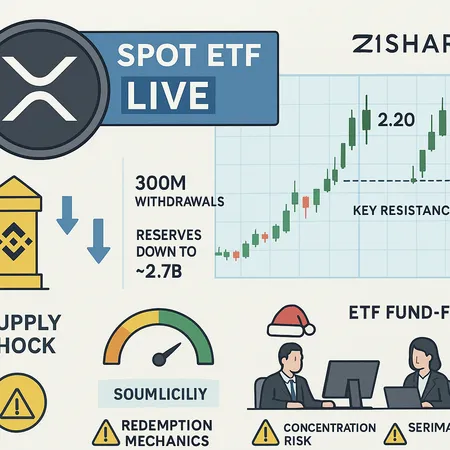
In practical terms, the market reacted quickly. XRP traded around $2.20 in the immediate aftermath of the approval, a price point picked up by reporting at the time, as traders priced in creation flows and adjusted risk premia from potential reduced selling pressure on the open market (Blockonomi reported the $2.20 figure). For allocators who track ETF-led altcoin rotations, that price action confirmed one thing: ETF availability shortcuts capital allocation decisions and can compress the time between narrative and allocation.
For context within crypto markets, remember how Bitcoin ETFs altered BTC's liquidity profile and institutional access in prior cycles — XRP's ETF is not identical but it borrows much of the same structural playbook.
Structural supply changes — the Binance reserves story
A crucial follow-up to the ETF narrative is the supply picture on centralized exchanges. Exchange reserves often act as a short-term liquidity buffer: when reserves fall, there is less immediate on-exchange inventory to satisfy market orders, widening the price impact of flows.
CryptoQuant and reporting picked up a material drop in Binance's XRP holdings, falling to approximately 2.7 billion XRP after a series of withdrawals totaling roughly 300 million tokens (as chronicled in reporting summarized by Coinpedia) (Coinpedia report). That’s a multi-year low for one of the largest on-ramps and cross-market liquidity hubs.
Why this matters: a lower exchange reserve does not automatically mean circulating supply shrinks — tokens still exist — but it does mean immediate execution liquidity on Binance is reduced. For an ETF ecosystem where APs may need to source and deliver XRP for ETF creations or redemptions, thinner exchange books increase the chance that APs will buy in OTC markets or tap other sources, potentially pushing spot prices higher, at least transiently.
In short: the supply shock framing is real in liquidity terms. When a large, liquid venue like Binance sheds inventory, markets feel it.
Short- and medium-term technical scenarios
Technical traders are actively debating two primary narratives: a momentum-driven continuation (the so-called Santa rally breakout) and a more conservative consolidation into higher time-frame structure.
Bullish scenario (momentum + ETF flows): If creation flows materialize and liquidity remains scarce on-exchange, XRP can track higher quickly. Analysts have flagged Bollinger band expansion and momentum signals consistent with a breakout into the year-end rally window — sometimes called a Santa rally — where seasonally higher flows and lower market-making appetite amplify moves (U.Today examined these breakout probabilities). Key resistances to watch on higher-time frames will be prior swing highs and psychological handles; traders should map the $2.50–$3.00 zone as the next meaningful barrier before testing multi-year highs.
Neutral/consolidation scenario (flow mismatch): If ETF demand is smaller or APs mainly source inventory off-exchange without impacting public order books, price may consolidate in a range as markets digest the new structure. In this view, the $1.50–$2.20 band could become a coil before the next leg.
Bearish scenario (profit-taking + redemptions): If there are redemption waves into the ETF structure, or if concentrated holders rotate out, accelerated selling could re-test support levels and widen spreads on illiquid order books.
A useful rule for sizing positions: treat the ETF launch as a regime change but not a guarantee of uninterrupted upside. Volatility will likely increase, presenting both shorter-term swing opportunities and higher tail risk.
What institutions and market makers are recalibrating
Market makers and institutional desks face a more complex inventory management problem when a spot ETF enters the ecosystem.
On-exchange inventory vs OTC sourcing: With Binance reserves lower, APs and market makers will decide whether to maintain larger on-exchange books (costly) or rely on OTC/prime brokers. Larger on-exchange books reduce basis risk for rapid creations/redemptions but increase counterparty and custody costs.
Hedging and basis mechanics: ETF creation/redemption windows and the basis (ETF price vs spot price) will be actively arbitraged. If the ETF trades at a premium, APs will deliver XRP to the ETF issuer, draining spot liquidity further. Conversely, persistent discounts could push APs to short the ETF and buy spot.
Concentration risk: Fewer tokens on major exchanges can amplify the influence of large sellers. Institutions monitoring counterparty exposures will watch where withdrawals land — custodial wallets, staking contracts, or OTC counterparties — since clustering can affect how redemptions are satisfied.
Market makers will likely widen spreads initially, especially on large aggressive orders, and conditionally provide deeper liquidity only as they rebuild hedges across venues. That adjustment period is the core operational window during which ETF-led flows can have outsized price impact.
Practical sizing framework for allocators
For retail and institutional allocators tracking ETF-led altcoin rotations, a simple, scenario-based sizing framework helps:
Base Case (small allocation): 1–3% of crypto allocation. Applicable if you view ETFs as a long-term infrastructure improvement but want to limit short-term volatility exposure.
Active Volatility Play (trading bucket): 2–5% of crypto capital earmarked for tactical trades. Use tight risk limits and be ready for higher bid-ask spreads and slippage due to lower exchange reserves.
Conviction Position (multi-month): 5%+ for investors who believe in structural adoption and can tolerate drawdowns. These allocators should use layered buys, set clear stop-loss or rebalancing rules, and consider custody options like those used by institutions.
Bitlet.app can be a resource for retail allocators building installment or earning strategies, but whatever vehicle you choose, define your time horizon and maximum drawdown.
Risks — why caution still matters
Even with bullish flows, multiple risks argue for prudence:
Redemption mechanics and basis risk: ETF redemptions can require the delivery of large spot quantities. If redemptions spike and APs must source XRP in a thin order book, the result can be sharp price moves.
Concentration and single-point failures: If a handful of wallets or exchanges hold a large fraction of exchange-accessible XRP, their behavior matters more than ever. Low exchange reserves increase that concentration risk.
Regulatory and operational frictions: ETF rules, custody constraints, and settlement frictions can create temporary mismatches between ETF demand and spot liquidity.
Overheated narratives: Santa rally talk and headlines citing year-over-year outperformance (see reporting that frames XRP as a top performer since the U.S. elections) can pull in momentum players who reverse quickly on lower-than-expected inflows (Coinpaper coverage). Short-term FOMO can exacerbate drawdowns when flows fade.
Bottom line and tactical checklist
XRP’s ETF era begins with both opportunity and new operational complexity. The market’s immediate reaction — trading around $2.20 — signaled that ETFs matter. The simultaneous drop in Binance reserves to roughly 2.7B XRP amplifies the potential for large ETF-driven moves by tightening on-exchange liquidity.
Tactical checklist for allocators:
- Define horizon: Is this a trading play or strategic allocation? Size accordingly.
- Monitor ETF flows vs spot liquidity weekly: watch exchange reserves and known AP behavior.
- Use layered entry and explicit stop levels to manage tail risk from redemptions or inventory squeezes.
- Watch basis and spreads: persistent premiums or discounts reveal where pressure lies.
Remember: narratives change fast in crypto. Historical analogs from DeFi and prior ETF launches are helpful guides, but they do not guarantee outcomes. Build a plan, test it with small exposures, and scale only after you’ve observed how real flows interact with the thinner exchange books.
Sources
- https://blockonomi.com/xrp-xrp-price-trading-at-2-20-as-toxr-etf-receives-approval/
- https://coinpedia.org/news/xrp-reserves-on-binance-drop-to-2-7-billion-tokens-marking-multi-year-lows/
- https://u.today/xrp-on-the-verge-of-13-santa-rally-breakout-but-do-not-get-too-comfortable-bollinger-bands?utm_source=snapi
- https://coinpaper.com/12724/xrp-reigns-supreme-best-performing-crypto-since-last-year-s-u-s-elections?utm_source=snapi