How Bitcoin Miners and Corporates Are Reinventing Treasury Strategy: Heat Recovery, Institutional Bets, and the Case for Litecoin
Summary
Executive summary: why CFOs and sustainability officers should care
Bitcoin mining is no longer just a bet on BTC price and has evolved into a suite of industrial and commercial activities. Beyond block rewards and transaction fees, miners are monetizing waste heat, offering hosting and co-location services, and partnering with corporates that want crypto exposure. These shifts matter for treasurers and sustainability leads because they change risk, cash-flow profiles, and ESG footprints associated with miner partnerships.
For many corporate decision-makers, two facts jump out: miners can now sell heat as a product, and institutional capital is pouring into U.S. miners. The former rewrites operating margins; the latter reshapes counterparty risk and regulatory exposure. For context on the heat-reuse trend, see detailed reporting on miners repurposing waste heat for home heating and commercial applications in the U.S. CNBC coverage.
The new revenue stack for Bitcoin miners
Traditionally, a miner’s revenue came from BTC block rewards and fees. Today, savvy operators layer additional income streams:
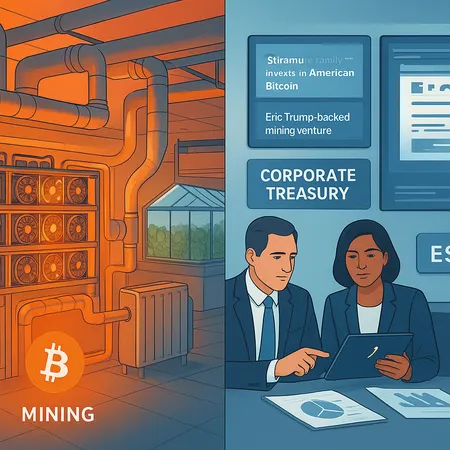
- Heat recovery sales: capturing ASIC waste heat and directing it to district heating, greenhouses, or even residential systems. This creates a recurring cash flow that is partially decoupled from BTC’s spot price.
- Hosting and colocation: third parties pay miners to host hardware — stable, contractual income versus volatile self-mining returns.
- Hashrate leasing or yield products: miners package hashpower access for investors or platforms, sometimes structured as revenue-sharing agreements.
- Energy arbitrage and demand response: leveraging variable power pricing, renewables curtailment credits, and grid services to sell flexibility.
Each of these reduces reliance on BTC price appreciation and makes miner cash flows more predictable — a material consideration for treasury allocation and corporate risk models.
Heat recovery: business models and practical examples
Heat recovery ranges from low-friction local solutions (e.g., sending warm air to adjacent buildings) to complex commercial projects (piping hot water to district systems). There are three pragmatic models companies should evaluate:
- Direct offtake: the miner sells heat or hot water to a single counterparty under a long-term contract (analogous to an energy purchase agreement). This is attractive for corporates that need baseload thermal supply.
- Distributed residential solutions: miners place modular rigs inside or near housing units, using waste heat for space heating — a model recently documented in U.S. pilot projects and journalistic coverage of entrepreneurs heating homes with mining rigs (see the CNBC report).
- Value-added services: combined offerings such as greenhouse heating + CO2 capture, where miners lease heat to agritech firms and share revenues.
Economically, heat contracts can stabilize miner EBITDA and shorten payback on capital-intensive ASIC deployments. For sustainability teams, heat reuse also presents a credible emissions-offset narrative — but it requires rigorous measurement and verification.
Institutional capital: the U.S. miner renaissance
The U.S. market has seen a wave of institutional and politically connected capital entering mining. A high-profile example: the Scaramucci family’s $100 million investment into Eric Trump’s American Bitcoin miner/treasury company, which underscores how investor networks and political linkages are reshaping boardrooms and capital flows in the sector (CryptoNews coverage).
What that means for corporate counterparties:
- Counterparty transparency: institutional backers often demand stronger governance, audited financials, and tighter compliance — which can be beneficial for a corporate choosing a partner. But political ties can also introduce reputational and concentration risk.
- Capital access and scale: institutional funding enables miners to pursue larger heat-reuse projects and long-term power contracts, improving the chances of reliable service-level agreements (SLAs) for heat customers.
- Regulatory spotlight: as high-profile investors enter the sector, expect greater attention from regulators, auditors, and sustainability auditors.
Why some treasuries are looking beyond BTC: the case for Litecoin and diversification
Most corporate digital-treasury programs start with BTC because of liquidity, market depth, and institutional-grade infrastructure. But a growing number of treasury teams are asking whether alternative on-chain assets can add operational value.
Litecoin (LTC) is surfacing in these conversations for several reasons:
- Transaction speed and fees: LTC typically offers faster confirmations and lower fees than BTC, which can be relevant for operational payments and micropayments.
- Correlated but distinct risk profile: LTC historically tracks BTC but with its own liquidity and market dynamics; some treasurers view it as diversification rather than a hedge.
- Treasury use-cases beyond price appreciation: certain corporate pilots target LTC for programmable payouts, employee remittances, or low-fee settlement rails.
Platforms and thought-leaders are already discussing the next wave of corporate digital-asset treasuries that include LTC alongside BTC — see commentary on how treasuries might build multi-asset strategies in the next phase of corporate adoption (DailyCoin analysis).
That said, LTC brings its own trade-offs: slightly lower market depth than BTC, different custody requirements, and less institutional support from exchanges and custodians. Any treasury allocation should be framed by liquidity stress tests and clear policy limits.
Real-world corporate adoption: from proof-of-concept to commercial rollout
Corporate pilots are increasingly moving into commerce and payments. Retail-level examples of Bitcoin adoption — and how miners and exchanges plug into that ecosystem — illuminate possible paths for other firms. For instance, expansion moves like Steak ‘n Shake’s Bitcoin acceptance pilot in El Salvador show how retail rollouts can follow a cross-section of miners, payment processors and exchanges (Coingape report).
For treasuries, these pilots demonstrate two things: one, digital assets can be operationalized for customer payments and B2B settlements; and two, miner partnerships that provide heat and hosting can be commercialized alongside payments solutions — creating bundled service opportunities.
Risk profile: what changes when miners become commercial heat providers or institutional targets
A miner that sells heat or takes institutional investment is no longer a pure commodity exposure. Key risk considerations include:
- Operational risk: equipment failures, thermal losses, and site permitting issues can interrupt heat off-take and therefore revenue.
- Regulatory risk: environmental permitting, energy market rules, and local zoning may affect project viability.
- Market and liquidity risk: treasuries holding BTC or LTC face price volatility; miner-backed yields can also be subject to asymmetric counterparty credit risk.
- Reputational and political risk: high-profile investors can amplify scrutiny, which is material for publicly listed corporates.
Practical framework: a regulatory and ESG checklist for evaluating miner-backed offerings
Below is a concise, action-oriented checklist CFOs and sustainability officers can use before committing capital or entering service agreements with miners.
Governance & counterparty due diligence
- Confirm ownership, investor composition, and board structure. Identify politically exposed persons (PEPs) and disclose reputational ties.
- Require audited financials and verified capital commitments.
- Check for ongoing litigation, sanctions, or enforcement actions.
Legal, regulatory & tax
- Verify permits for heat reuse, emissions, and energy infrastructure at the site level.
- Map applicable federal, state, and municipal regulations (including utility interconnection and waste-heat rules).
- Assess tax treatment for heat-offtake contracts, miner-hosting revenue, and on-balance-sheet crypto holdings.
ESG & carbon accounting
- Require carbon accounting: specify scope 1, scope 2 and, where relevant, scope 3 emissions baselines and methodologies.
- Confirm energy sourcing: what share of electricity is from renewables, and are RECs or PPAs used? Determine additionality and double-counting risks.
- Validate heat reuse claims with third-party metering, continuous monitoring, and independent verification to support emissions benefits.
Financial & treasury considerations
- Stress-test treasury allocations (BTC, LTC) under extreme liquidity scenarios and adverse price moves; define stop-loss and rebalancing rules.
- Model downside scenarios for miner-delivered revenue (e.g., heat sales cut by 25–50%).
- Ensure custody and settlement procedures meet corporate governance — segregated custody, insurance, and multi-signature controls.
Contractual & operational protections
- Include SLAs for heat delivery: temperature, uptime, response time for equipment failures, and penalties for non-performance.
- Negotiate clear termination and transition terms, including hardware removal, data retention, and site remediation responsibilities.
- Define O&M standards, spare parts inventory, and preventive-maintenance schedules.
Reporting, transparency & auditability
- Require monthly reporting: energy consumption, heat output, uptime, emissions, and P&L reconciliations.
- Insist on annual independent audits of environmental claims and financial reconciliations.
- Specify public disclosure requirements and incident notification protocols for regulators and stakeholders.
A pragmatic path for pilot programs
Start with a small, time-bound pilot that aligns with both treasury objectives and sustainability goals. Recommended pilot design:
- Limit duration (3–12 months) and exposure (pilot cap on BTC/LTC holdings or guaranteed heat volumes).
- Use escrowed contracts or staged payments tied to verifiable meters and SLA milestones.
- Incorporate an independent third-party auditor to verify thermal output and emissions benefits.
- Run parallel liquidity and stress tests on any proposed LTC allocation; ensure custodial arrangements are institutional-grade.
Platforms across the ecosystem — from exchanges to service providers like Bitlet.app — are building tooling to make some of these operational tasks easier, but institutional due diligence remains essential.
Bottom line: opportunities, caveats, and next steps
Miners monetizing heat and institutional investors entering U.S. mining change the calculus for corporate treasuries. These developments can deliver predictable revenue streams, lower net emissions via useful heat reuse, and new commercial offerings. However, they also introduce operational complexity, regulatory scrutiny, and novel counterparty risks.
For CFOs and sustainability officers considering miner partnerships or adding BTC/LTC to treasuries: prioritize verifiable metrics, insist on strong governance, and pilot deliberately. The combination of heat recovery economics and diversified digital treasuries can be powerful — but only if paired with rigorous controls, transparent reporting, and scenario-based risk management.
For more background on corporate treasury use-cases and how multi-asset strategies are being discussed in the market, see sector commentary on the next wave of corporate digital-asset treasuries (DailyCoin). And for a recent U.S. angle on institutional bets into mining, read coverage of the Scaramucci family’s investment in the American Bitcoin venture (CryptoNews).
For practitioners: map your pilot to specific balance-sheet tolerances, demand independent verification of environmental claims, and build playbooks for both BTC (BTC) and LTC (LTC) liquidity events.