Avalanche (AVAX) Short-Term Upside: MACD Triggers, $20–$25 Targets, and Risk Controls
Published at 2025-11-15 21:31:05
Avalanche (AVAX) Short-Term Upside: MACD Triggers, $20–$25 Targets, and Risk Controls – cover image

Summary

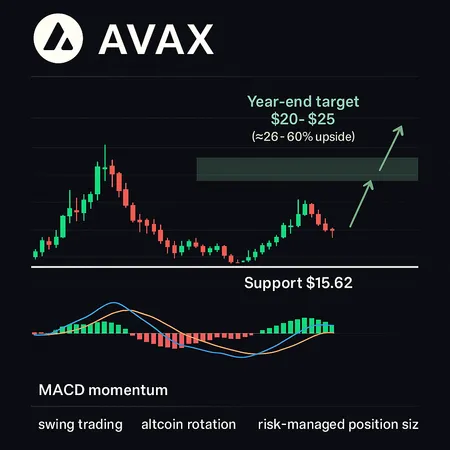
This article unpacks the short-term bullish case for Avalanche (AVAX), focusing on MACD momentum signals and the key support at ~$15.62 that underpins a $20–$25 year-end target. It quantifies upside scenarios (roughly 28–60% from support) and explains the technical triggers traders should watch, including MACD crossover and histogram expansion. The piece compares AVAX’s relative strength versus other Layer-1s amid an ongoing altcoin rotation and references market commentary projecting a bullish AVAX range. Practical position-sizing formulas, stop placement guidelines, and trade-exit alternatives are provided for swing traders and altcoin investors seeking clear risk controls.
content
content":"## Why AVAX is on traders’ radars now\n\nShort version: *momentum is building*, and the technical picture has a clean reference level. Blockchain.News recently flagged bullish MACD momentum and laid out a $20–$25 year-end scenario, a thesis that rests on a sequence of MACD triggers and a key support band near **$15.62** (see the report [here](https://blockchain.news/news/20251115-price-prediction-target-avax-20-25-by-december-2025-as)). For swing traders hunting high-conviction altcoin setups, AVAX combines an identifiable risk point with a favorable reward range — exactly the sort of asymmetric trade you want in a portfolio-sized allocation.\n\nThis article breaks the trade into: the technical triggers (MACD and structure), scenario math for 28–60% upside, relative strength versus other L1s during altcoin rotation, and concrete size/stop rules for disciplined swing entries.\n\n## Technical triggers: MACD momentum and structure to watch\n\nThe headline trigger traders cite is a **bullish MACD** — a crossover of the MACD line above the signal line with expanding histogram bars. This classic momentum shift suggests buyers are stepping in and that shorter-term momentum is aligning with longer-term trend attempts. Use the standard MACD parameters (12, 26, 9) as your baseline and watch for: a) crossover, b) rising histogram, and c) MACD above zero for confirmation of trend support.\n\nA confirmed MACD crossover is not an automatic buy; pairing it with price structure — higher lows, reclaim of a near-term resistance level, or a break above a short-term moving average — gives the signal weight. If MACD rolls over quickly without price following through, the trade loses conviction.\n\n### Why the $15.62 support matters\n\nSupport around **$15.62** functions as the logical invalidation line for the bullish scenario. It’s a clear level for placing hard stops (more on sizing below). As long as price respects that band and MACD is trending positive, the path to higher targets remains plausible. A clean retest-and-hold at this support with MACD stabilizing is the kind of setup swing traders like: defined risk, visible momentum, and measurable targets.\n\n## Scenario analysis: $20–$25 targets and upside math\n\nStarting from the support reference of **$15.62**, here are two simple, illustrative scenarios:\n\n- Target A: $20 — this is ~**28%** upside from $15.62.\n- Target B: $25 — this is ~**60%** upside from $15.62.\n\nThese figures match the rough ranges discussed by bullish analysts and reflect a typical swing-trade time horizon into year-end. The $20–$25 band assumes a sustained momentum run (MACD remaining constructive) and growing participation from rotation flows into infrastructure altcoins. Note that Blockchain.News frames a similar $20–$25 year-end outcome tied directly to bullish MACD behavior and momentum continuation.\n\nScenario probabilities are not certainties. Treat them as roadmap points: a MACD crossover and follow-through puts Target A within reach; a sustained rotation and broadening market participation are more likely to reach Target B. If momentum stalls near intermediate resistance, scale out rather than hold full size to the upper target.\n\n## Relative strength and altcoin rotation: why AVAX could outperform\n\nNot all Layer-1s move the same during rotations. AVAX’s narrative — high throughput, subnet architecture, and developer activity — places it among the infrastructure tokens that benefit when capital rotates out of speculative memecoins and into ecosystems with clear utility. CoinPedia’s roundup on undervalued altcoins shows how capital has been scanning for infrastructure names with upside potential, and AVAX is frequently cited in that context (see their analysis [here](https://coinpedia.org/price-analysis/undervalued-altcoins-to-watch-in-2025-fil-ton-and-hbar-show-strong-upside-potential/)).\n\nRelative strength matters: when the altcoin market pivots toward L1s, AVAX can outperform if its on-chain metrics (active addresses, DEX volume, or subnet adoption) move ahead of peers. For many traders, [Avalanche](/en/tags/Avalanche/news) is being watched as a rotational candidate rather than a purely speculative play, which improves the trade’s risk-reward profile.\n\n## Position sizing and stop rules for swing traders\n\nThis section gives concrete, repeatable rules — no guesswork.\n\n1) Define your risk per trade\n\n- Conservative: risk **0.5%** of account equity.\n- Standard: risk **1%**.\n- Aggressive: risk **2%** (only for experienced allocators).\n\n2) Use the support band as your stop reference\n\n- Hard stop: place a stop just below **$15.62**. Add a buffer to account for noise (e.g., 3–7% below support depending on volatility).\n\n- Volatility stop alternative: use ATR (14) × 1.5–2.0 below the entry or below support. ATR adapts to current price action and prevents being stopped by normal intraday swings.\n\n3) Position size formula (token units)\n\nUnits = (Account Equity × Risk %) / (Entry Price − Stop Price)\n\nExample: account = $50,000, risk = 1% ($500), entry = $16, stop = $14. Units = 500 / (16 − 14) = 250 AVAX. If the entry is closer to support (say $15.8) and stop at $15.0, the per-unit risk shrinks and you can buy more units for the same dollar risk.\n\n4) Reward-to-risk and scale management\n\n- Aim for minimum 2:1 R:R on any swing. With an entry near $16 and stop at $14, a $20 target yields (~(20−16)/(16−14)) = 2:1 R:R. For the $25 target the R:R is 4.5:1, which justifies partial scaling in and out.\n\n- Scale-out plan: take ~30–50% off the table at intermediate resistance (e.g., $20), move stop to breakeven, and let the remainder run to the higher target. This preserves gains while keeping upside exposure.\n\n5) Portfolio allocation guidance\n\n- For most swing portfolios, limit any single altcoin to **2–5%** of liquid equity. This keeps idiosyncratic risk manageable.\n\n- If AVAX is part of a thematic bet (infrastructure rotation), tilt allocation to the higher end of that band but rebalance regularly. Traders on platforms like Bitlet.app commonly couple position sizing with clear stop discipline to avoid outsized drawdowns.\n\n## Execution checklist for a disciplined AVAX swing\n\n- Confirm MACD crossover with expanding histogram.\n- Verify price respects ~$15.62 support on intraday and daily timeframes.\n\n- Set initial stop below support (or use ATR rule).\n\n- Size position using the formula above, capping single-coin exposure at 2–5% of portfolio.\n\n- Define targets and scaling points: partial take at $20, remainder to $25 (adjust to price action).\n\n- If MACD fails to confirm or price decisively breaks below $15.62, exit according to stop rules — no debate.\n\n## Risks and alternative invalidation paths\n\nA few risks to keep top of mind: macro-led crypto selloffs, negative on-chain metrics, or a shift in liquidity flows away from L1 infrastructure. A decisive daily close below $15.62 — especially on volume — invalidates the bullish scenario and should prompt re-evaluation. Smaller intraday breaks below support with quick reclaims are less meaningful, hence the value of ATR or percentage buffers on stops.\n\n## Final thoughts\n\nThe AVAX short-term upside thesis is tidy: a defined support at **$15.62**, bullish **MACD momentum** as the trigger, and a measurable reward band to **$20–$25** that translates into roughly **28–60%** upside. That range is already being discussed in market write-ups, and capital rotation into infrastructure names could provide the fuel. Still, success comes down to discipline: confirmed technical triggers, conservative risk per trade, and scaling rules that lock in gains while preserving optionality.\n\nFor swing traders focused on altcoin rotation, AVAX is a setup worth watching — just keep stops honest, position sizes small relative to the portfolio, and trade the plan."}

Why AVAX is on traders’ radars now

Short version: momentum is building, and the technical picture has a clean reference level. Blockchain.News recently flagged bullish MACD momentum and laid out a $20–$25 year-end scenario, a thesis that rests on a sequence of MACD triggers and a key support band near $15.62 (see the report here). For swing traders hunting high-conviction altcoin setups, AVAX combines an identifiable risk point with a favorable reward range — exactly the sort of asymmetric trade you want in a portfolio-sized allocation.

This article breaks the trade into: the technical triggers (MACD and structure), scenario math for 28–60% upside, relative strength versus other L1s during altcoin rotation, and concrete size/stop rules for disciplined swing entries.

Technical triggers: MACD momentum and structure to watch

The headline trigger traders cite is a bullish MACD — a crossover of the MACD line above the signal line with expanding histogram bars. This classic momentum shift suggests buyers are stepping in and that shorter-term momentum is aligning with longer-term trend attempts. Use the standard MACD parameters (12, 26, 9) as your baseline and watch for: a) crossover, b) rising histogram, and c) MACD above zero for confirmation of trend support.

A confirmed MACD crossover is not an automatic buy; pairing it with price structure — higher lows, reclaim of a near-term resistance level, or a break above a short-term moving average — gives the signal weight. If MACD rolls over quickly without price following through, the trade loses conviction.

Why the $15.62 support matters

Support around $15.62 functions as the logical invalidation line for the bullish scenario. It’s a clear level for placing hard stops (more on sizing below). As long as price respects that band and MACD is trending positive, the path to higher targets remains plausible. A clean retest-and-hold at this support with MACD stabilizing is the kind of setup swing traders like: defined risk, visible momentum, and measurable targets.

Scenario analysis: $20–$25 targets and upside math

Starting from the support reference of $15.62, here are two simple, illustrative scenarios:

  • Target A: $20 — this is ~28% upside from $15.62.
  • Target B: $25 — this is ~60% upside from $15.62.

These figures match the rough ranges discussed by bullish analysts and reflect a typical swing-trade time horizon into year-end. The $20–$25 band assumes a sustained momentum run (MACD remaining constructive) and growing participation from rotation flows into infrastructure altcoins. Note that Blockchain.News frames a similar $20–$25 year-end outcome tied directly to bullish MACD behavior and momentum continuation.

Scenario probabilities are not certainties. Treat them as roadmap points: a MACD crossover and follow-through puts Target A within reach; a sustained rotation and broadening market participation are more likely to reach Target B. If momentum stalls near intermediate resistance, scale out rather than hold full size to the upper target.

Relative strength and altcoin rotation: why AVAX could outperform

Not all Layer-1s move the same during rotations. AVAX’s narrative — high throughput, subnet architecture, and developer activity — places it among the infrastructure tokens that benefit when capital rotates out of speculative memecoins and into ecosystems with clear utility. CoinPedia’s roundup on undervalued altcoins shows how capital has been scanning for infrastructure names with upside potential, and AVAX is frequently cited in that context (see their analysis here).

Relative strength matters: when the altcoin market pivots toward L1s, AVAX can outperform if its on-chain metrics (active addresses, DEX volume, or subnet adoption) move ahead of peers. For many traders, Avalanche is being watched as a rotational candidate rather than a purely speculative play, which improves the trade’s risk-reward profile.

Position sizing and stop rules for swing traders

This section gives concrete, repeatable rules — no guesswork.

  1. Define your risk per trade
  • Conservative: risk 0.5% of account equity.
  • Standard: risk 1%.
  • Aggressive: risk 2% (only for experienced allocators).
  1. Use the support band as your stop reference
  • Hard stop: place a stop just below $15.62. Add a buffer to account for noise (e.g., 3–7% below support depending on volatility).

  • Volatility stop alternative: use ATR (14) × 1.5–2.0 below the entry or below support. ATR adapts to current price action and prevents being stopped by normal intraday swings.

  1. Position size formula (token units)

Units = (Account Equity × Risk %) / (Entry Price − Stop Price)

Example: account = $50,000, risk = 1% ($500), entry = $16, stop = $14. Units = 500 / (16 − 14) = 250 AVAX. If the entry is closer to support (say $15.8) and stop at $15.0, the per-unit risk shrinks and you can buy more units for the same dollar risk.

  1. Reward-to-risk and scale management
  • Aim for minimum 2:1 R:R on any swing. With an entry near $16 and stop at $14, a $20 target yields (~(20−16)/(16−14)) = 2:1 R:R. For the $25 target the R:R is 4.5:1, which justifies partial scaling in and out.

  • Scale-out plan: take ~30–50% off the table at intermediate resistance (e.g., $20), move stop to breakeven, and let the remainder run to the higher target. This preserves gains while keeping upside exposure.

  1. Portfolio allocation guidance
  • For most swing portfolios, limit any single altcoin to 2–5% of liquid equity. This keeps idiosyncratic risk manageable.

  • If AVAX is part of a thematic bet (infrastructure rotation), tilt allocation to the higher end of that band but rebalance regularly. Traders on platforms like Bitlet.app commonly couple position sizing with clear stop discipline to avoid outsized drawdowns.

Execution checklist for a disciplined AVAX swing

  • Confirm MACD crossover with expanding histogram.

  • Verify price respects ~$15.62 support on intraday and daily timeframes.

  • Set initial stop below support (or use ATR rule).

  • Size position using the formula above, capping single-coin exposure at 2–5% of portfolio.

  • Define targets and scaling points: partial take at $20, remainder to $25 (adjust to price action).

  • If MACD fails to confirm or price decisively breaks below $15.62, exit according to stop rules — no debate.

Risks and alternative invalidation paths

A few risks to keep top of mind: macro-led crypto selloffs, negative on-chain metrics, or a shift in liquidity flows away from L1 infrastructure. A decisive daily close below $15.62 — especially on volume — invalidates the bullish scenario and should prompt re-evaluation. Smaller intraday breaks below support with quick reclaims are less meaningful, hence the value of ATR or percentage buffers on stops.

Final thoughts

The AVAX short-term upside thesis is tidy: a defined support at $15.62, bullish MACD momentum as the trigger, and a measurable reward band to $20–$25 that translates into roughly 28–60% upside. That range is already being discussed in market write-ups, and capital rotation into infrastructure names could provide the fuel. Still, success comes down to discipline: confirmed technical triggers, conservative risk per trade, and scaling rules that lock in gains while preserving optionality.

For swing traders focused on altcoin rotation, AVAX is a setup worth watching — just keep stops honest, position sizes small relative to the portfolio, and trade the plan."}
Share on:

Related posts

Can the Fusaka Hard Fork Reverse ETH Selling Pressure? Throughput, L2 Fees and Real Demand – cover image
Can the Fusaka Hard Fork Reverse ETH Selling Pressure? Throughput, L2 Fees and Real Demand

Fusaka delivers material data availability and throughput gains for Ethereum, but protocol upgrades alone rarely stop short‑term selling. Traders and protocol analysts need to separate technical improvements from real token demand.

Published at 2025-12-03 14:34:41
Dissecting 21Shares’ Renewed Dogecoin ETF Push: Amendments, Market Reaction, and Institutional Prospects – cover image
Dissecting 21Shares’ Renewed Dogecoin ETF Push: Amendments, Market Reaction, and Institutional Prospects

21Shares’ updated Dogecoin ETF filing — with fee disclosures and custodian details — reignited DOGE price action and debate over whether spot Dogecoin products can attract sustainable institutional capital.

Published at 2025-12-03 14:21:45
Shibarium’s Zama Privacy Upgrade: What Fully Homomorphic Encryption Means for Memecoin Security – cover image
Shibarium’s Zama Privacy Upgrade: What Fully Homomorphic Encryption Means for Memecoin Security

Shibarium plans a 2026 privacy upgrade with Zama promising fully homomorphic encryption (FHE) for private transactions and confidential smart contracts. This article examines the technical promise, deployment tradeoffs after the 2025 exploit, developer hurdles, AML tensions, and how this compares to DA-focused upgrades like Fusaka.

Published at 2025-12-03 13:46:15